How to Monitor Online Visibility for Multiple Healthcare Clients From One Dashboard
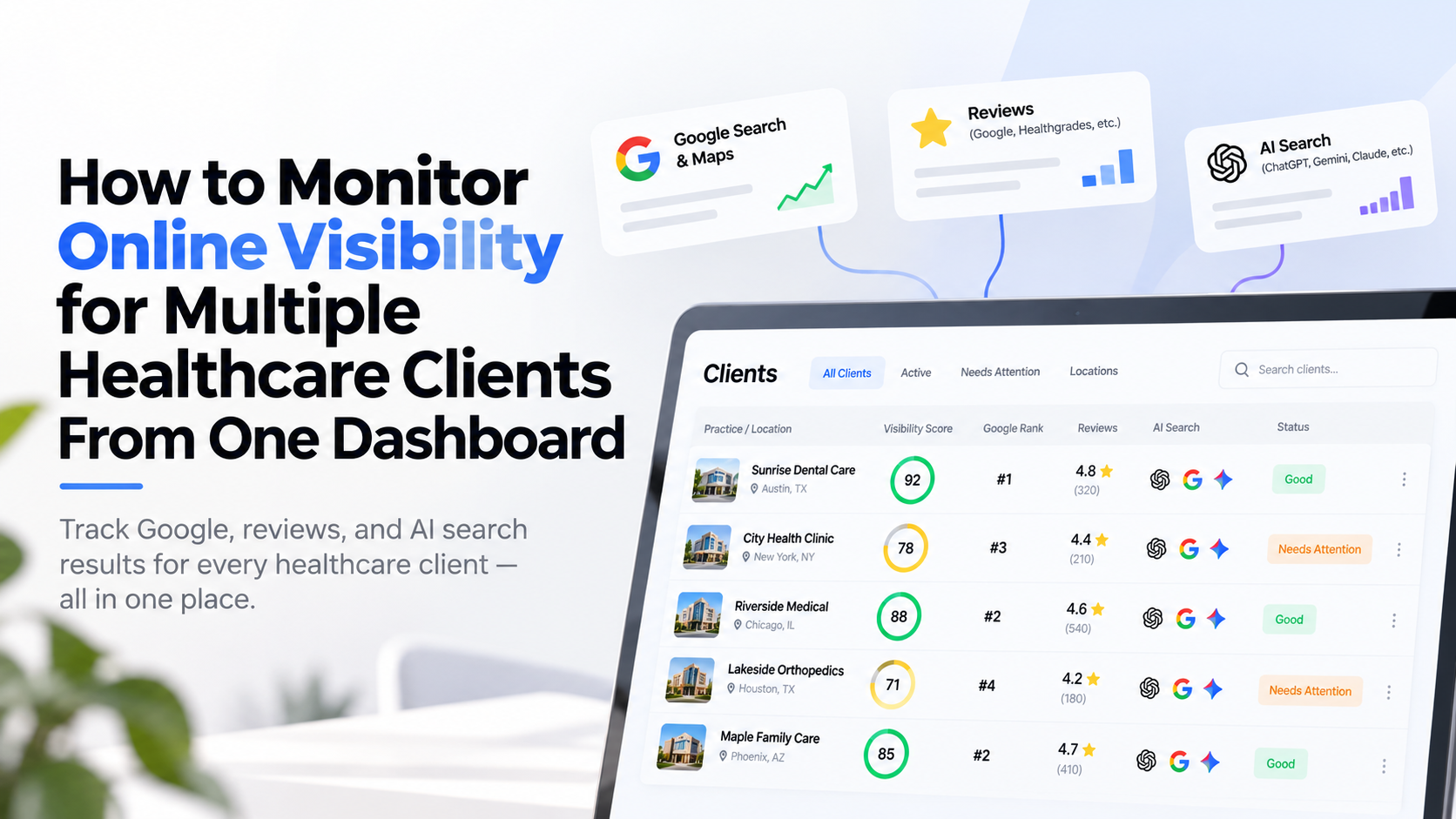
If you manage digital marketing for more than two or three healthcare clients, you already know the real workload isn't strategy, it's logins. One client's Google Business Profile here, another's review inbox there, a spreadsheet of ranking screenshots nobody updates on time, and a client call every month where you're reconstructing "what happened" from memory instead of data. This is the exact gap that healthcare client visibility monitoring software is built to close: a single place to see how every client shows up across Google, review sites, and increasingly, AI assistants like ChatGPT or Google's AI Overviews, without logging into ten different tools.
This matters more in healthcare than in most verticals. Patients don't pick a provider the way they pick a restaurant. According to rater8's 2026 Patient Choice Report, the large majority of patients research a provider online and read reviews before ever booking an appointment, and trade coverage in Medical Economics puts the share of patients who call online reviews "extremely" or "very" important at roughly 70%. Visibility isn't a vanity metric for a medical practice; it's the layer that determines whether a patient even considers calling.
For an agency or in-house marketing team juggling multiple healthcare accounts, that means visibility monitoring isn't optional reporting hygiene, it's a client-retention function. Below is a practical framework for building that monitoring workflow properly: what the software needs to do, how to structure the agency process around it, and where visibility metrics stop and patient outcomes begin.
What "Visibility" Actually Means for a Healthcare Client
Before evaluating any tool, it helps to define what you're actually monitoring. For a medical practice, visibility typically spans:
- Google Business Profile health — accuracy, completeness, Q&A activity, and photo freshness across every location
- Local and organic rankings — where the practice and its providers appear for service and condition searches, plus "near me" queries
- Review volume, velocity, and sentiment — across Google, Healthgrades, Vitals, and other healthcare-specific directories
- Website and on-page health — page speed, schema markup, NAP (name, address, phone) consistency
- AI assistant visibility — whether and how a practice is being surfaced or described when patients ask conversational tools for a provider recommendation
That last category is new enough that a lot of legacy "local SEO" dashboards don't track it well yet, so it's worth asking any vendor directly how they handle it, rather than assuming it's included.
Why Agencies Need a Single Dashboard, Not Spreadsheets
Once you're past two or three clients, manual tracking breaks down predictably. Someone forgets to check a client's GBP for three weeks. A negative review sits unanswered because nobody saw it in time. A client calls asking why their report is late, and the honest answer is that compiling it by hand took longer than expected.
A proper multi-client healthcare dashboard solves three things at once: it centralizes data collection so nobody is manually checking ten tabs, it standardizes what "visibility" means across every client so comparisons are fair, and it creates a cadence (weekly or monthly) that doesn't depend on someone remembering to run a report. This is really what agency visibility monitoring comes down to operationally: less time gathering data, more time acting on it.
If you're managing clients who themselves operate multiple locations, the layer of complexity doubles, since you're not just comparing clients to each other but locations within a single client. That's a distinct enough problem that it's worth reading separately: see this breakdown of comparing digital performance across a multi-location medical practice dashboard for how to structure that view specifically.
Core Criteria for Healthcare Client Visibility Monitoring Software
Not every piece of medical practice software that claims to "do SEO reporting" is built for an agency managing many healthcare accounts. When evaluating healthcare agency software to monitor client visibility, look for:
- True multi-client architecture. You should be able to add, group, and switch between client accounts without re-authenticating or paying per seemingly unrelated add-on. This is different from medical marketing software for multi-location practices built for a single brand with many clinics; an agency tool needs to handle unrelated clients under one login.
- A focused, consistent metric set. Most practitioners in this space recommend standardizing on four to six core metrics per client rather than overwhelming dashboards with everything a tool can measure, according to guidance from Cloud Campaign on choosing a white-label client dashboard. For healthcare, that typically means GBP health, review rating and volume, local ranking position, and review response time.
- White-label and client-facing reporting. A healthcare client reporting dashboard with white label reports lets you present data under your agency's brand instead of the vendor's, which matters for client trust and renewal conversations.
- Review monitoring and alerting, not just rating snapshots. You want to know within hours, not weeks, when a client gets a one-star review.
- Healthcare-specific directory coverage (Healthgrades, Vitals, WebMD Provider Directory, etc.), not just general business listings.
- Reasonable data refresh cadence and transparency about how current the numbers actually are. Nobody wants to present a "weekly" report built on stale data.
- Export and integration options so visibility data can sit alongside your other reporting, rather than living in an isolated silo.
If you're building a broader buying checklist beyond just the monitoring layer, this guide on choosing medical practice marketing software covers the wider evaluation process, including budget tiers and contract terms, in more depth.
Building the Agency Workflow Around the Dashboard
The software is only half the solution. The other half is the process you run on top of it.
Onboarding a new client
Before a client ever sees a report, baseline their current visibility: GBP completeness, current rating and review count, starting rankings for 5 to 10 priority terms, and any glaring NAP inconsistencies. This baseline is what every future report gets measured against, and it's what justifies the account at renewal time.
A regular review cadence
Weekly is reasonable for review monitoring and alerts; monthly is standard for ranking and traffic trend reporting. Trying to do everything weekly burns time without adding insight, since rankings and GBP health don't typically shift meaningfully week to week for most practices.
Escalation rules
Decide in advance what triggers an immediate flag versus what waits for the monthly report. A one-star review, a GBP suspension, or a sudden ranking drop for a money-keyword should trigger same-day attention. A one-point rating dip or a minor metadata gap can wait.
Visibility Monitoring vs. Patient Outcomes: Why the Distinction Matters
This is the part agencies most often get wrong when presenting results to healthcare clients, and it's worth being precise about.
Visibility metrics, rankings, GBP views, review counts, tell you whether a practice is discoverable and how it's perceived once found. They do not, by themselves, tell you how many of those discoveries turned into a booked appointment or a new patient. As Healthcare Success explains in its FAQ on marketing attribution, tying digital activity back to actual patient visits and downstream revenue is a genuinely hard, often incomplete attribution problem in healthcare marketing, not a solved one.
Target Continuum draws a useful distinction between marketing attribution (clicks, impressions, form fills, visibility signals) and patient acquisition attribution (calls, booked appointments, confirmed new-patient visits). These are related but separate measurement problems, and conflating them is exactly how agencies end up overpromising. Freshpaint's analysis of the state of healthcare marketing in 2026 similarly points to widespread "attribution blindness," where most healthcare organizations still can't reliably connect marketing activity to the patient outcomes it may have influenced.
Practically, this means your reporting language matters. "Visibility improved" and "the practice gained patients" are different claims, and only one of them is something a visibility dashboard can actually demonstrate. Where possible, pair visibility data with practice-reported numbers like call volume or new-patient intake forms, sourced from the client's own phone or EHR system, rather than implying the dashboard alone proves patient growth. Being upfront about this distinction with clients tends to build more trust over time than vague promises do, and it protects the agency if a client's patient volume doesn't move in lockstep with visibility scores for reasons outside anyone's control, such as staffing, insurance panels, or seasonality.
White-Label Reporting: Turning Visibility Data Into Client Value
A medical practice marketing dashboard for agency clients earns its keep at the reporting stage. A branded, consistent report that a client can glance at and understand in two minutes does more for retention than raw data ever will. Keep reports lean: a trend line for rating and review count, a handful of ranking positions for priority terms, GBP health flags, and a short plain-English summary of what changed and why. Agencies that bury clients in forty-tab spreadsheets usually get the same question every month anyway: "okay, but what does this actually mean for me?"
What to Audit Before You Start Monitoring
Monitoring only works if you know what you're monitoring against. Before setting up ongoing tracking for a new client, it's worth running a structured baseline check, the kind covered in this guide on what a medical practice online visibility audit should include. An audit done once at onboarding (and revisited annually) catches structural issues, duplicate GBP listings, inconsistent address formatting across directories, missing schema markup, that ongoing monitoring alone won't surface, since monitoring tracks change over time rather than identifying root problems.
For agencies offering this as a standalone service, a medical practice online visibility audit service is also a reasonable entry point for prospects not ready to commit to full ongoing monitoring.
Common Mistakes Agencies Make When Monitoring Multiple Healthcare Clients
- Tracking too many metrics. More data isn't more insight; it's more noise clients have to wade through.
- Treating every client the same. A single-location dermatology practice and a 12-location urgent care group need different metric weighting and reporting cadence.
- Skipping the baseline audit. Without one, "improvement" numbers in month three have nothing solid to compare against.
- Overstating what visibility data proves. As covered above, a rankings improvement is not the same claim as a patient-volume increase, and reports should reflect that honestly.
- Ignoring AI assistant visibility until a client asks about it, rather than tracking it proactively from the start.
Conclusion
Monitoring visibility for multiple healthcare clients from one dashboard isn't really a software problem first, it's a workflow problem that software happens to solve well. Get the criteria right (true multi-client support, healthcare-specific coverage, white-label reporting, sane alerting), build a consistent cadence around it, and be disciplined about the language you use with clients so visibility gains are never quietly presented as patient-growth guarantees.
Platforms like The Doc Mirror are built around this exact need: auditing and tracking a practice's visibility across Google, reviews, and AI assistants in one place, which is useful groundwork whether you're managing one client or fifty. If you're currently stitching together visibility data by hand across several healthcare accounts, it's worth running a quick check on how your clients currently show up online before deciding what monitoring setup makes sense for your agency.
Sources
- rater8, "2026 Patient Choice Report" — https://rater8.com/2026-patient-choice-report/
- Medical Economics, "Physician reviews: Patients increasingly consult online ratings when choosing a doctor" — https://www.medicaleconomics.com/view/physician-reviews-patients-increasingly-consult-online-ratings-when-choosing-doctor
- Healthcare Success, "How do we tie digital media performance back to actual patient visits, downstream revenue, and physician referrals?" — https://healthcaresuccess.com/faqs/digital-media/how-do-we-tie-digital-media-performance-back-to-actual-patient-visits-downstream-revenue-and-physician-referrals
- Target Continuum, "Healthcare Marketing Attribution vs. Patient Acquisition Attribution" — https://targetcontinuum.com/healthcare-marketing-attribution-vs-patient-acquisition-attribution/
- Freshpaint, "The State of Healthcare Marketing in 2026" — https://www.freshpaint.io/blog/the-state-of-healthcare-marketing-in-2026
- Cloud Campaign, "How to Choose the Best White Label Dashboard for Your Agency's Needs" — https://www.cloudcampaign.com/smm-tips/white-label-client-dashboard