Insurance 'Find a Doctor' Directories: The In-Network Channel Most Practices Ignore
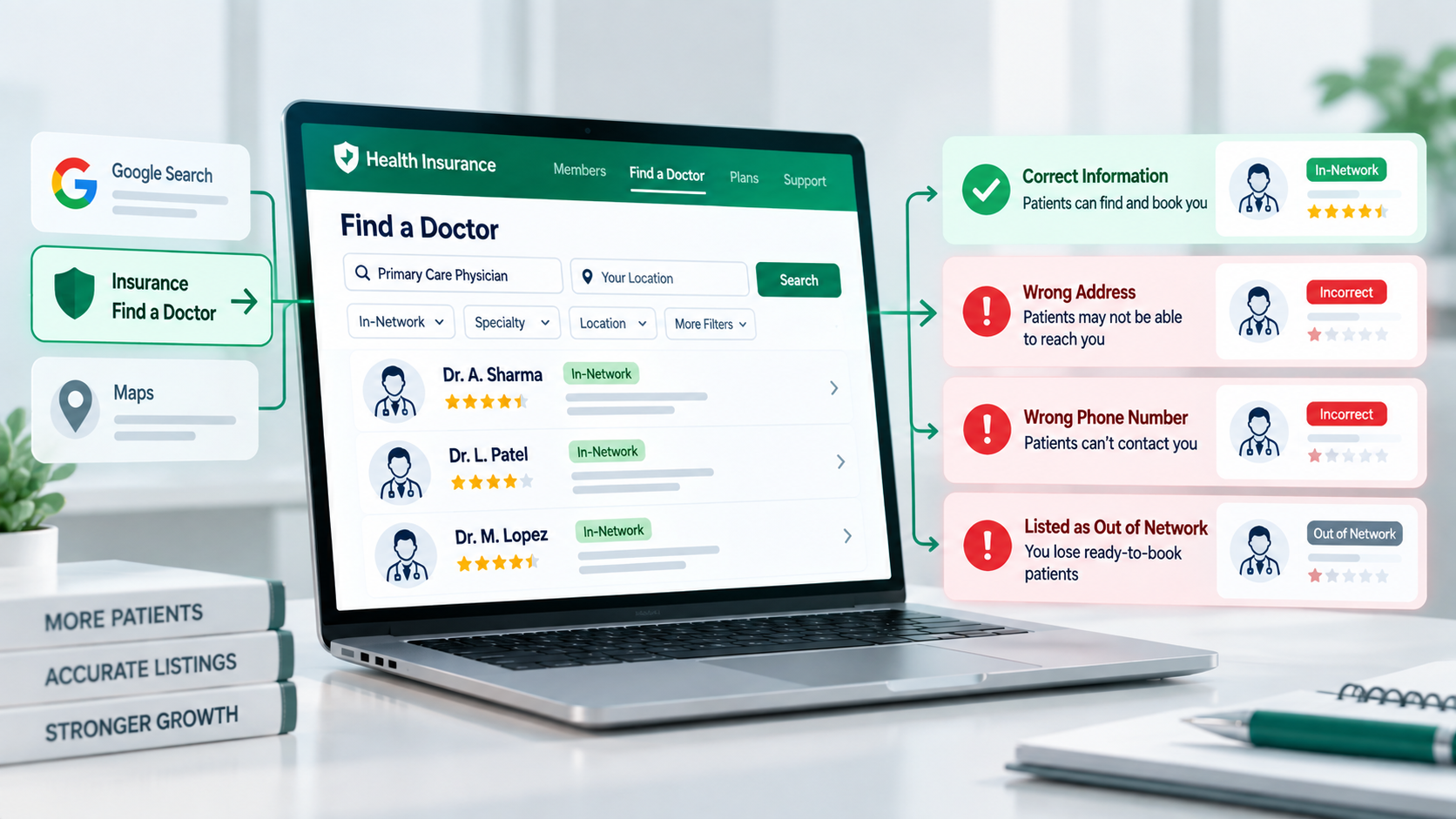
Most insured patients in the US start their search for a doctor inside their health plan's "find a doctor" directory, not on Google, and studies have found that up to half of those provider listings contain an inaccuracy, so a doctor can be effectively invisible or wrongly listed to the exact patients most ready to book. This is the highest-intent channel in US patient acquisition, because a patient using an insurer's directory already has coverage, already wants an in-network provider, and is minutes from choosing one. Yet it is the channel almost no independent practice actively manages. This guide explains why these directories matter so much, how inaccurate they really are, what the No Surprises Act now requires of you, and how to audit and fix your listings. It is written for US practices that want to stop losing insured, ready-to-book patients to a data error.
Why insurance directories are a separate, high-intent channel
A patient with insurance behaves differently from a patient searching cold on Google. Before or alongside a Google search, they open their health plan's website or app and use its "find a doctor" tool, because they need someone in-network to avoid a large out-of-pocket bill. That single motivation makes this the most commercially valuable channel there is, because the patient is pre-qualified: they have coverage, they intend to use it, and they are choosing from whoever the directory shows them.
The scale of in-network preference is easy to underestimate. In-network care rose to roughly 90% of all claims nationally by late 2023, up from about 84%, as surprise-billing protections pushed patients toward in-network providers. Patients pay substantially less in-network, so the directory is not a nicety, it is the gate through which most insured patients pass to reach a doctor. If your listing in that directory is missing, wrong, or shows you as not accepting a plan you actually accept, you are cut from the choice set before Google or reviews ever enter the picture.
This is why treating insurance directories as an afterthought is a costly mistake. A practice can have a flawless Google presence and still lose insured patients at the payer directory, because that is where those patients actually look first.
The accuracy crisis: how wrong these directories are
The uncomfortable reality is that health plan directories are riddled with errors, and the data is stark. A CMS review of Medicare Advantage online provider directories found that nearly 49% of the provider directory locations examined had at least one inaccuracy. A broader analysis of directories covering a large share of US physicians found inconsistencies for 81% of doctors across five major insurers.
Worse, the errors persist. A 2024 secret-shopper study published in the American Journal of Managed Care recontacted more than 1,800 listings previously flagged as inaccurate, and found that after more than 500 days, over 40% of those listings were still incorrect, with only 13% fully corrected. These are not small typos. They include wrong addresses, wrong phone numbers, providers listed at locations they never worked, and incorrect statements about which plans a doctor accepts. Each of those errors sends a ready-to-book patient to a dead end or to a competitor.
For an independent practice the lesson is direct. You cannot assume the plan has your details right, because the evidence says the odds are close to a coin flip. The errors are the plan's to fix, but the consequence, a lost patient, is yours to bear, which is why active management beats passive trust.
What the No Surprises Act requires of you
The rules changed in your favour, and knowing them turns directory accuracy from a vague hope into a process with obligations on both sides. The No Surprises Act, in effect since January 1, 2022, put real requirements around provider directories.
Under the Act, plans must verify directory information on a regular cycle and update it quickly, with 90-day verification cycles and updates within two business days of receiving new information. Crucially, providers have obligations too: you must submit your directory information to a plan when you begin or end a network agreement, whenever there is a material change to your details, and at other required times, covering your name, address, specialty, phone number, and digital contact information. The direction of travel is toward more central oversight, with a 2025 CMS final rule set to require Medicare Advantage organisations to submit directory data directly to CMS for the Medicare Plan Finder by 2027.
The practical takeaway is that you have both a right and a responsibility here. You have standing to demand corrections, and you have a duty to submit accurate updates promptly. Practices that treat those submissions as a routine habit, rather than something they do once and forget, are the ones whose listings stay right.
How patients use "find a doctor" tools, and where you lose them
To fix the channel you have to see it as the patient does, because the patient loses you at specific, predictable points. The journey is short and unforgiving.
A patient logs into their plan, filters by specialty and location and sometimes by whether the provider is accepting new patients, and gets a list. They pick from that list, often checking the name against a quick Google and review search before calling or booking. You lose the patient at the first step if you are absent from the directory or filtered out because the plan wrongly shows you as not accepting new patients. You lose them at the second step if the directory address or phone is wrong and they cannot reach you, or if the details conflict with what they find on Google and the mismatch creates doubt. Consistency between your payer listings and your public listings matters as much here as anywhere, which is the same discipline covered in the NAP audit.
The point where most practices quietly bleed patients is the mismatch. A patient who finds you in the directory but then sees a different address or phone on Google hesitates, and a hesitating insured patient simply picks the next name on the in-network list. Alignment across the payer directory and your public presence is what keeps them moving toward you.
How to audit and fix your insurance directory listings
The fix is a repeatable audit, not a one-time cleanup, because these directories drift constantly. Work through it plan by plan.
Start by listing every plan you are in-network with, then find yourself in each plan's public "find a doctor" tool exactly as a patient would, without logging into any provider portal. For each listing, check five things: that you appear at all, that the address is correct, that the phone number is correct, that your specialty is right, and that it correctly shows you as accepting new patients if you are. Note every error. Next, submit corrections through each plan's provider-update process, which under the No Surprises Act they must act on, and keep a dated record of what you submitted, because persistence is often required. Then set a recurring reminder, quarterly at minimum and immediately after any change of address, phone, or network status, to repeat the check, since studies show errors reappear and linger. Finally, make sure the details you submit match your Google Business Profile and other public listings exactly, so a patient moving between them sees one consistent practice.
For group practices, this is more involved because each provider and location must be checked, the same structural care described in multiple doctors at one address. The effort is real, but so is the return, because these are the most ready-to-book patients you will find anywhere.
How this connects to your wider visibility
Insurance directories do not sit in isolation. They are one more surface where your practice's core facts must be correct and consistent, and they feed the same trust that drives the rest of your findability.
When your name, address, phone, and specialty match across your payer directories, your Google Business Profile, and the medical directories, that agreement is exactly the consistency that raises confidence everywhere, including in how AI systems describe you. A patient who cross-checks you between their insurer and Google should see the same practice, and a system trying to confirm who you are should find no conflict. This is why insurance directory accuracy belongs in the same overall picture that a doctor visibility score tracks, and why the local-ranking prominence discussed in distance versus prominence rests on the same consistent data. It also pairs naturally with removing friction at the booking step, covered in Reserve with Google and online booking.
Treated this way, the payer directory stops being a bureaucratic chore and becomes part of one coherent goal: that wherever an insured patient looks for you, they find the same correct, reachable, in-network practice.
A worked example: what a directory audit turns up
The problem becomes concrete when a practice actually looks. Take an internal medicine physician who accepts six major plans and assumes, as most do, that being credentialed means being listed correctly. She sits down and searches herself in each plan's public find-a-doctor tool, as a patient would.
Plan one lists her correctly. Plan two shows an old office address from a location she left two years ago, so patients using that plan are sent to the wrong building. Plan three has her correct address but the wrong phone number, routing calls to a disconnected line. Plan four does not show her as accepting new patients, even though she is, so the plan's default filter hides her from every searching patient. Plan five lists her twice, once correctly and once at a hospital she no longer visits, creating confusion. Plan six is accurate. In other words, four of her six highest-intent channels are quietly leaking patients, and she had no idea, because nothing in her office ever signalled a problem. The patients simply went elsewhere.
This pattern, most listings carrying at least one meaningful error, is exactly what the accuracy studies predict, and it is invisible until someone checks. The audit converts a vague sense that new-patient growth is soft into a specific list of corrections to submit, each of which reopens a channel of ready-to-book insured patients. Nothing about her practice changed. What changed is that she found the leaks.
Where to start
Insurance directories are the rare channel that is both the highest-intent in US healthcare and the least managed by independent practices. Insured patients are looking for you there first, and the data says there is close to a coin-flip chance your listing is wrong. The good news is that you have both the right and the process to fix it, and the fix is a plan-by-plan audit you can start today, then repeat quarterly.
The Free Audit checks how your practice appears across Google, AI assistants, and 6 directories, scores you on the 7 pillars, and shows exactly which consistency gaps to close first, the same gaps that undermine your payer listings. It takes about 90 seconds and needs no signup for the free score.
Run your free audit at thedocmirror.com
By the The Doc Mirror team