Doctor AI Visibility Statistics for 2026: What the Data Actually Says
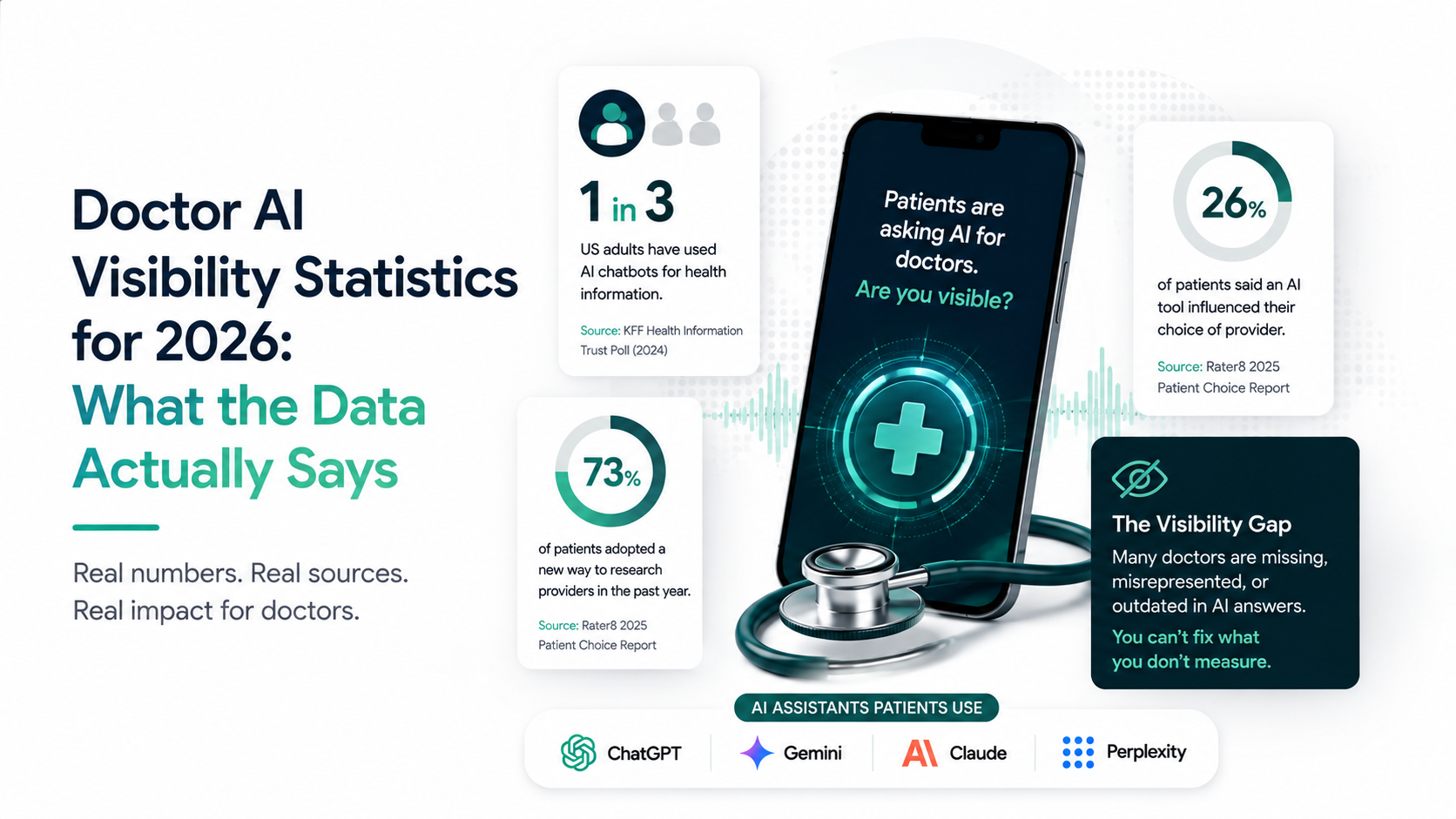
The clearest ai visibility statistics for 2026 point to one shift: patients now ask AI assistants for a doctor, and they act on the single answer they get. A KFF poll found that about 1 in 3 US adults have used AI chatbots for health information. A 2025 rater8 report found that 26% of patients said an AI tool influenced their choice of provider. This roundup gives you each real number, its source, and what it means for whether ChatGPT, Gemini, Claude, and Perplexity mention you when a patient searches.
What is AI visibility
AI visibility is the measure of whether AI assistants can find you, understand who you are, and recommend you correctly. It is not the same as a Google ranking, which is a position in a list of links. AI visibility is whether your name, specialty, and location appear inside a synthesized answer from ChatGPT, Gemini, Claude, or Perplexity.
You can rank first on Google and still be absent from every AI answer. The statistics below explain why that gap now matters, and who it costs.
How many patients use AI for health questions
Start with adoption, because it sets the stakes for everything else.
- About 1 in 3 US adults have used AI chatbots for health information. This is from a KFF poll, which found the share equals the share who use social media for health. That is not an early-adopter niche. It is a mainstream behavior a cardiologist in Denver or a dermatologist in New York should assume is already happening.
- 73% of patients adopted a new way to research providers in the past year. From the rater8 2025 report, this shows how quickly patient research habits are changing, with AI tools now part of the mix.
- India-specific adoption data: [Add a sourced statistic here before publishing.] Reliable India-only figures are limited today. The safe assumption for a clinic owner in Mumbai or Bengaluru is that the same behavior is arriving, given how fast Practo, JustDial, and AI use have grown.
The takeaway is simple. A meaningful share of patients now use AI to find doctors, so being absent from those answers is a real gap, not a hypothetical one.
What the data says about AI influencing provider choice
Adoption alone is not the point. The stronger signal is that AI now changes decisions.
- 26% of patients said an AI tool influenced their choice of provider. From the rater8 2025 report, this is the number that matters most for your practice. When the assistant names a competitor and not you, that influence works against you silently.
- The share is likely to rise, not fall. With about 1 in 3 US adults already using AI chatbots for health information, the pool of patients exposed to AI recommendations keeps growing. A number near 26% today is a floor to plan around, not a ceiling.
For a gynaecologist in Pune or an independent doctor in Austin, the practical reading is the same. If AI influences a quarter of choices, your presence inside those answers is now part of how patients find you.
The visibility gap most doctors cannot see
Here is where the data turns uncomfortable. Adoption is high and influence is real, yet most doctors have never checked what the assistants say about them.
- Doctors absent or misdescribed in AI answers: [Replace with your real audit figure before publishing.] In our own audits across ChatGPT, Gemini, Claude, and Perplexity, a large share of doctors are missing, listed with an outdated address, or attributed the wrong specialty.
- The reason for the gap: it is measurable but invisible from your own dashboard. Your website analytics count the patients who found you. They cannot count the patient who asked Gemini, received a competitor's name, and never visited your site.
This is the core problem the statistics expose. High patient adoption plus low doctor awareness equals a quiet loss that never shows up in your traffic reports. The only way to see it is to check the AI answers directly, which is exactly what a free AI visibility audit does.
What the research says you can actually change
The encouraging finding is that AI citation is not random. It responds to how your information is structured.
- Content choices can raise AI-answer citation by up to 40%. A GEO research paper from researchers at Princeton, Georgia Tech, the Allen Institute for AI, and IIT Delhi found that specific presentation choices, such as clear citations and quotable, well-structured content, measurably increased how often a source was cited in AI answers. GEO here means Generative Engine Optimization, the practice of structuring content so AI engines cite it.
- The levers are information hygiene, not advertising. Making your name, specialty, and city consistent across Google Business Profile, Practo, JustDial, Healthgrades, and Zocdoc is administrative work. For doctors in India this stays firmly within NMC guidance, because you are making existing, factual information consistent and findable, not soliciting.
The data does not just describe a problem. It points to a fixable one, and structured, consistent, quotable information is what models reward.
What most doctors get wrong about these numbers
The common mistake is treating these statistics as interesting but distant. A busy doctor reads "26%" and files it under "someday." The data says otherwise.
Adoption is already at roughly 1 in 3 US adults. Influence is already at about 26% of choices. The GEO research already shows the fix works. The only variable left is whether you act before or after your competitors in Chennai, Hyderabad, or Delhi do.