Digital Marketing for Doctors: A 2026 Playbook for Search, Maps, Reviews, and AI
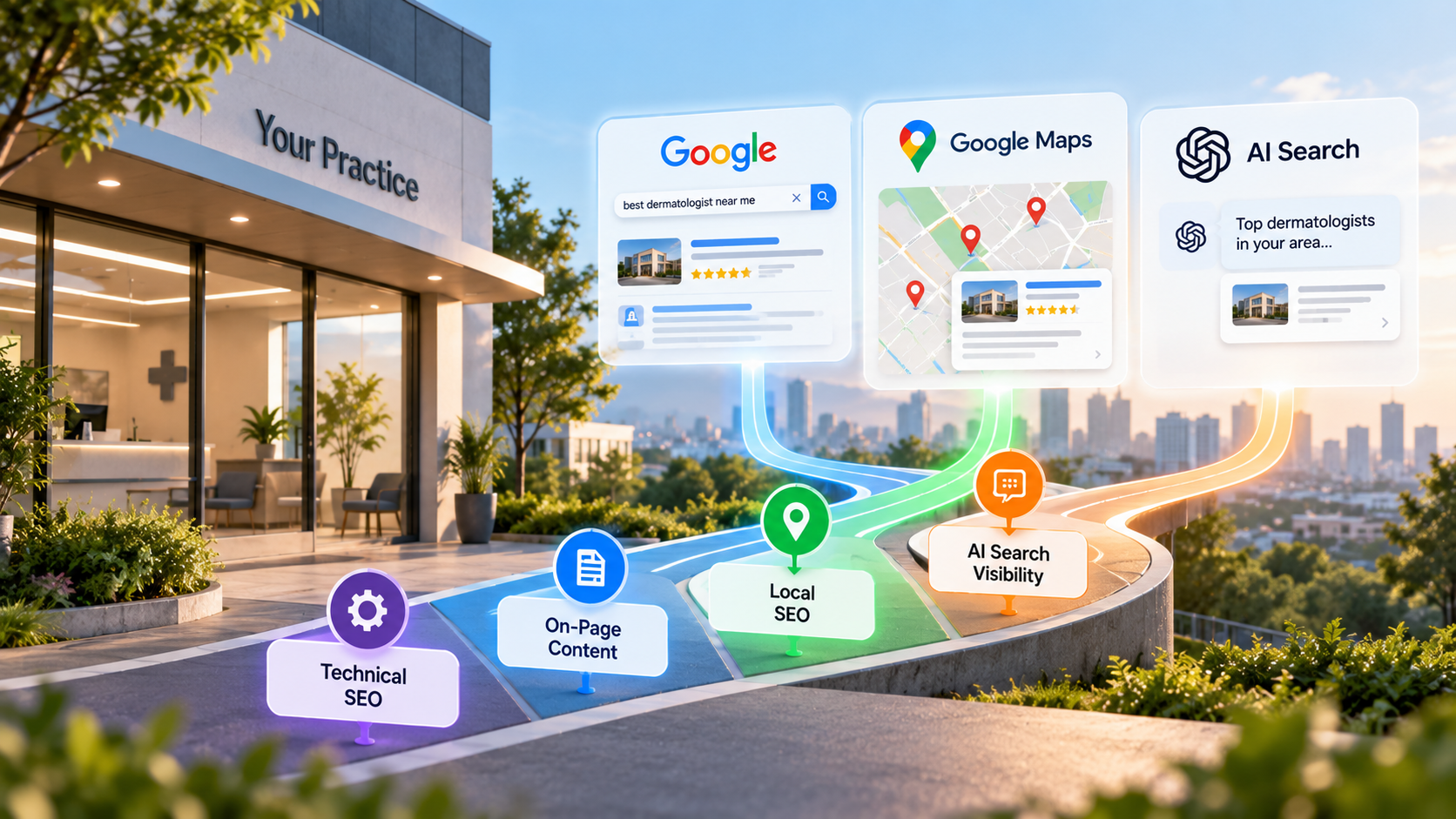
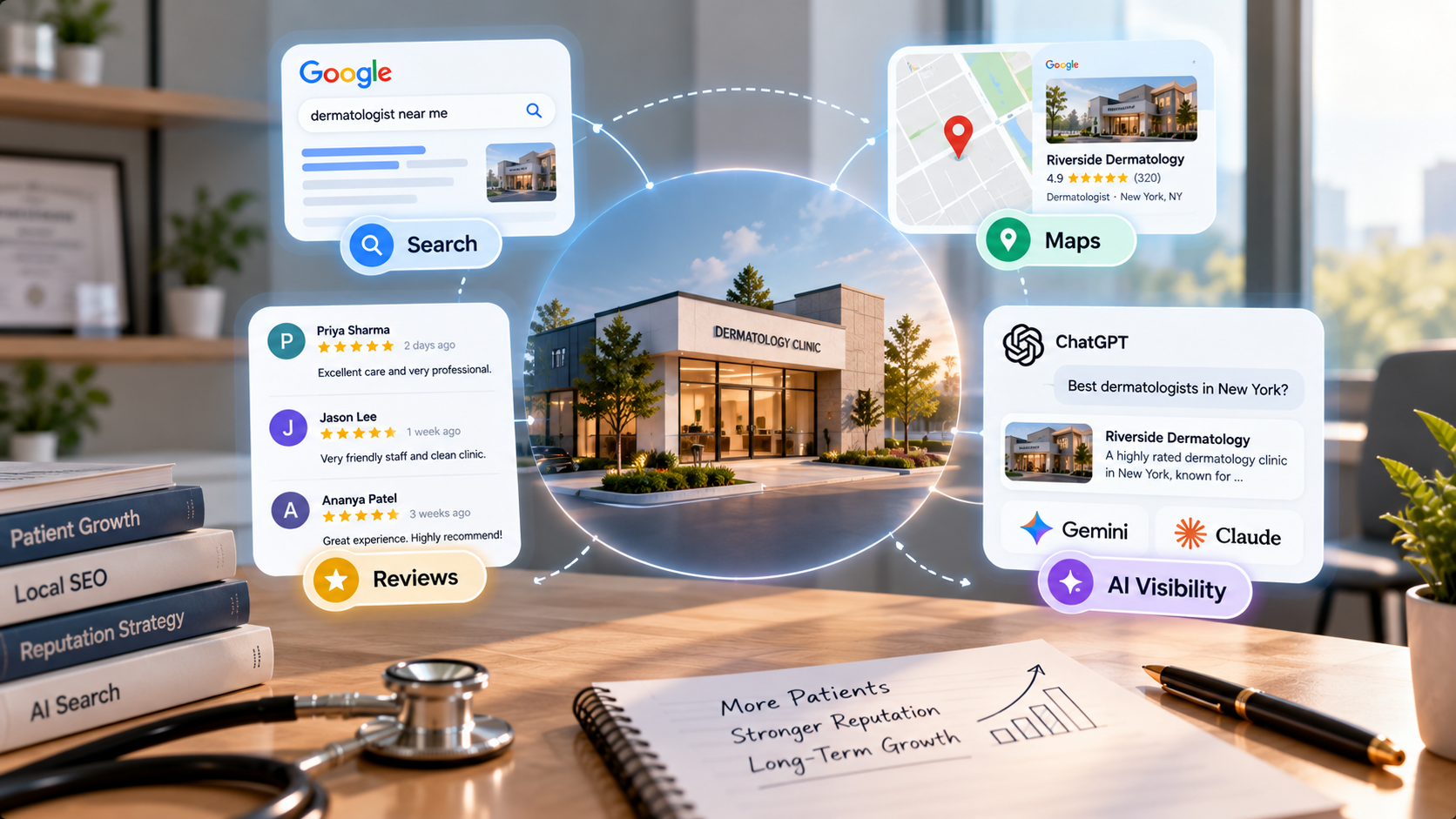
Digital marketing for a doctor means building visibility in four connected places: search results, Google Maps, patient reviews, and AI assistants like ChatGPT and Google Gemini. These four areas reinforce each other rather than working in isolation. A strong Google Business Profile means little if the reviews attached to it are three years old. A high star average means just as little if ChatGPT cannot find the practice at all when a patient asks for a recommendation.
This playbook lays out the full picture at a level you can act on today, then points to a deeper resource for each individual piece. 82% of patients research their doctor online before booking, and patients check an average of 3 sources before choosing one. A practice that looks strong in one place but weak everywhere else is still losing patients to a competitor who shows up consistently across all of them.
Most practices approach marketing in the wrong order. They spend on ads before fixing what costs nothing: an accurate Google Business Profile, recent reviews, and a website that actually answers the questions patients are typing into search bars. This guide sets out the right sequence, what to expect at each stage, and where to go deeper on each topic once you understand how the pieces fit together.
In This Guide
- Search visibility: the foundation
- Google Maps and local presence
- Reviews and reputation
- AI search visibility: the newest frontier
- How patients actually decide
- Agency vs. DIY: making the call
- How to sequence this from zero
- What most practices get wrong about marketing
- A starting point checklist
- FAQ
Search Visibility: The Foundation
Search visibility is whether a practice's website and listings actually appear when someone searches for a doctor, a condition, or a treatment in their area. 77% of patients use search engines to find a doctor, which makes organic search the single largest channel most practices are not fully using.
Search visibility depends on a website built around the terms patients actually search, a technical setup Google can read cleanly, and content that answers real patient questions rather than describing services in vague marketing language. It also depends on how well Google trusts the practice as an accurate, credible source, something Google evaluates through consistency across the web, not just the words on one page.
This is a deep topic on its own, covering keyword targeting, page structure, technical SEO, and the trust signals Google looks for from a medical practice. Rather than repeat that ground here, the SEO half of this playbook covers it in full. Treat search as the base layer: nearly everything else in this guide either draws traffic into it or gets discovered because of it.
Google Maps and Local Presence
For most specialties, Google Maps is where the booking decision actually happens. When someone searches "dermatologist near me" or "pediatrician in [city]," Google shows a map pack of three practices before it shows any website links at all. Landing in that pack, or not, has an outsized effect on how many patients ever reach a practice's website.
Local presence is driven by three factors working together: profile completeness, proximity, and review strength. How accurate the Google Business Profile is, how close the practice sits to the searcher, and how the practice's reviews and local citations compare to nearby competitors all shape the result. A profile with the wrong category, an outdated phone number, or hours that do not match reality actively works against a practice in these results.
Getting this right involves choosing the correct primary category, keeping listing details current across the web, and building the kind of consistent local footprint Google rewards. The practices that show up reliably in map results tend to be the ones that treat their Google Business Profile as a living asset, updated regularly, not a form filled out once and forgotten.
Reviews and Reputation
Reviews affect two separate things at once: whether Google ranks a practice highly in local results, and whether a patient who finds that listing actually decides to call. Doctors with 50+ reviews rank significantly higher than those with under 10, and volume alone does not tell the whole story. Recency, response rate, and how a practice handles a negative review all shape how trustworthy it looks to a patient scanning results in real time.
A practice with 200 reviews and no activity in the last year reads very differently than one with 60 reviews and five new ones this month. Patients notice the gap, and so does Google. Responding to reviews, both positive and negative, signals an active, attentive practice rather than one that stopped paying attention after the listing was claimed.
Reputation management covers review generation, monitoring, response strategy, and how a practice recovers from an unfair or inaccurate review. It is a large enough topic to warrant its own dedicated resource. Building a consistent system here pays off across every other channel in this guide, since reviews feed directly into both local rankings and AI visibility.
AI Search Visibility: The Newest Frontier
AI search visibility is whether ChatGPT, Google Gemini, Perplexity, and similar assistants recommend a practice when a patient asks directly. A question like "who is a good cardiologist in [city]" or "find me a dentist near [area]" now gets a synthesized answer, not just a list of links. This is a separate problem from traditional search rankings, and it is growing fast enough that most practices have not caught up to it yet.
AI assistants do not rank pages the way Google does. They synthesize an answer from a mix of sources: a practice's website, its reviews, third-party directories like Healthgrades and Vitals, and how consistently the practice's name, specialty, and location appear across the web. A practice that is strong in traditional search can still be invisible here if its information is inconsistent or thin across the sources these assistants pull from.
This is where most practices have the widest gap between where they are and where their competitors already stand, largely because almost nobody is actively managing it yet. The practices doing this well are the ones treating AI visibility as its own discipline rather than assuming good SEO automatically covers it. This channel is new and fast-moving, which makes tracking your AI visibility over time matter more here than in almost any other part of this playbook. What an assistant says about a practice today can shift within weeks.
How Patients Actually Decide
None of the four channels above operate alone in a patient's mind. A typical patient searches Google, glances at the map pack, reads a handful of reviews, and increasingly, asks an AI assistant for a second opinion before ever visiting a website directly. Each touchpoint either builds or erodes confidence in the next one.
This is why a practice that is strong in search but weak on reviews still loses patients. It is also why a practice with great reviews but no AI visibility is starting to lose a newer, fast-growing slice of them. The decision is not made at a single point. It accumulates across every place a patient looks, which is exactly why marketing has to be treated as one connected system rather than four separate projects.
Understanding the full shape of this decision process, and where practices most commonly lose patients along the way, is worth studying in more depth. How patients actually decide breaks down each stage and what a practice can do at each one to keep patients moving toward a booking instead of a competitor.
Agency vs. DIY: Making the Call
Once a practice understands what needs to happen across search, maps, reviews, and AI visibility, the next question is who does the work. Some of this, particularly claiming and updating a Google Business Profile or responding to reviews, is realistic to handle in-house with an hour or two a week. Other parts, particularly technical SEO and ongoing content, require either a dedicated staff member or outside help.
The right answer depends on practice size, current visibility, and how much time a doctor or office manager can realistically commit each week without it becoming another neglected task. A solo practice just getting started has different needs than a five-location group competing in a crowded metro market, and the honest answer is rarely all-in-house or all-outsourced.
This decision deserves its own framework rather than a quick guess, since the cost of getting it wrong is either wasted agency spend or months of internal effort that never gets finished. Hiring an agency vs doing it yourself walks through the tradeoffs in detail, including realistic pricing for each path. It also covers which tasks make sense to keep in-house regardless of which option a practice chooses.
How to Sequence This If You Are Starting From Zero
A practice with no prior marketing work should not try to do all four channels at once. Trying to launch ads, rebuild a website, chase reviews, and fix AI visibility in the same month usually means none of it gets done properly. The order below reflects what actually moves the needle first, based on what each channel depends on.
Step 1: Fix the free basics first. Claim and fully complete the Google Business Profile, correct any wrong hours, phone numbers, or addresses across existing listings, and make sure the practice name and category are accurate. This costs nothing and often produces the fastest visible improvement in local search.
Step 2: Build a review baseline. Set up a simple, repeatable way to ask satisfied patients for a review after a visit. A practice does not need hundreds of reviews to start seeing an effect, it needs a consistent, recent flow that shows the profile is active.
Step 3: Get the website search-ready. Make sure the site covers the specialties, conditions, and locations patients actually search for, loads quickly, and works on mobile. A website built years ago around outdated design norms is often the single biggest drag on organic visibility.
Step 4: Audit AI visibility. Once the basics above are solid, check how ChatGPT, Google Gemini, and Perplexity currently describe the practice, if at all. This tells a practice whether it has a genuine gap here or whether the work from steps one through three is already carrying over.
Step 5: Layer in paid and content work. Only after the free-visibility basics are solid does it make sense to invest in ads or a larger content program. Ads sending traffic to a page with a thin Google Business Profile and no recent reviews waste money that could have gone toward fixing the underlying gap first.
This order is not arbitrary. Each step makes the next one more effective, and skipping ahead to paid marketing before the basics are fixed is the single most common reason ad spend underperforms for medical practices.
What Most Practices Get Wrong About Marketing
The most common mistake is spending on advertising before fixing free visibility. A paid campaign that drives a patient to a Google Business Profile with three-year-old reviews and an incomplete listing converts far worse than the same click landing on a profile that looks current and trustworthy. Ads amplify whatever is already true about a practice's visibility, for better or worse.
A second mistake is treating marketing as a one-time project instead of an ongoing habit. A website built once and never updated, a Google Business Profile claimed once and never revisited, and a review flow that runs for two months and then stops all quietly decay. Competitors who keep working steadily pull ahead, not through a single dramatic move but through consistency compounding over months.
A third mistake is ignoring AI visibility entirely because it feels unfamiliar or unproven. Patients are already using these assistants to research doctors, and a practice that is invisible there is losing a share of patients it never even knew it was competing for. The cost of not doing this tends to be invisible precisely because a lost patient never shows up as a complaint, they simply book with someone else.
A fourth mistake is measuring the wrong things. Tracking website visits without tracking calls or booking requests, or tracking star rating without tracking review recency, gives a distorted picture of what is actually working. The metrics that matter are the ones tied to new patients showing up, not vanity numbers that look good on a dashboard.
A Starting Point Checklist
Use this as a first pass before deciding where to focus. It is not exhaustive, it is the minimum baseline every practice should be able to check off.
- Google Business Profile is claimed, verified, and shows the correct name, category, hours, and phone number
- Practice name, address, and phone number match exactly across the website, Google, and major directories
- At least one new review has come in within the last 60 days
- Website loads in under three seconds on mobile and lists every specialty and condition treated
- A recent test of ChatGPT or Google Gemini shows the practice being mentioned accurately, or shows a clear gap to close
- Someone on staff owns review response as a weekly task, not an occasional one
- There is a simple, repeatable way to ask patients for a review after a visit
A practice that can check every item here has the free-visibility basics in place and is genuinely ready to consider paid marketing or a larger content investment.
Conclusion
Digital marketing for a doctor is not four separate projects. It is one connected system, search, Google Maps, reviews, and AI visibility, and patients move across all four before they ever pick up the phone. Fixing the free-visibility basics first, then sequencing the rest deliberately, produces a stronger result than spending on ads before the foundation is solid.
The practices pulling ahead in 2026 are not necessarily the ones spending the most. They are the ones treating this as an ongoing habit rather than a one-time project. Increasingly, they are also the ones already paying attention to how AI assistants describe them, while most competitors have not.
Where to Start
A Free Audit from The Doc Mirror checks Google Business Profile accuracy, review health, website basics, and current AI visibility in one pass. It is the fastest way to see where to start, so the next move is based on real data instead of a guess.
By the The Doc Mirror team
Internal Links
| Target page | Anchor text used | Reason |
|---|---|---|
| /resources/seo-for-doctors | "the SEO half of this playbook" | Placed at the end of the "Search Visibility: The Foundation" section. Keeps this pillar at overview depth on search and routes readers who want the full technical breakdown (keyword targeting, technical SEO, E-E-A-T) to the dedicated SEO pillar instead of duplicating it here. |
| /resources/ai-rank-tracker-for-doctors | "tracking your AI visibility" | Placed at the end of the "AI Search Visibility" section. Introduces the need for ongoing measurement once the reader understands the AI-visibility gap, and routes commercial-intent readers to the tool-evaluation page rather than a generic product pitch. |
| /resources/online-patient-journey-doctors | "how patients actually decide" | Placed at the end of the "How Patients Actually Decide" section, which intentionally avoids the banned word "journey" in body prose while still linking to the dedicated patient-journey page. Ties the four channels together conceptually before sending readers deeper into the full decision-stage breakdown. |
| /resources/healthcare-marketing-agency-vs-diy | "hiring an agency vs doing it yourself" | Placed at the end of the "Agency vs. DIY: Making the Call" section. Hands off the resourcing decision, which deserves its own cost/tradeoff framework, to the dedicated commercial-investigation page. |
| /resources/why-most-doctors-ignore-online-visibility | "the cost of not doing this" | Placed in the "What Most Practices Get Wrong About Marketing" section, in the paragraph about ignoring AI visibility. Connects the narrower existing blog7 (cost of inaction) content to this broader pillar without re-explaining the same argument. |
| /free-audit | "where to start" | Placed in the closing "Where to Start" CTA section. Converts readers who now understand the full playbook into an audit signup, using the Free Audit CTA tier specified for this page and matching the /free-audit path used consistently elsewhere in the content set. |