SEO for Doctors: The Complete Guide to Ranking on Google, Maps, and AI Search
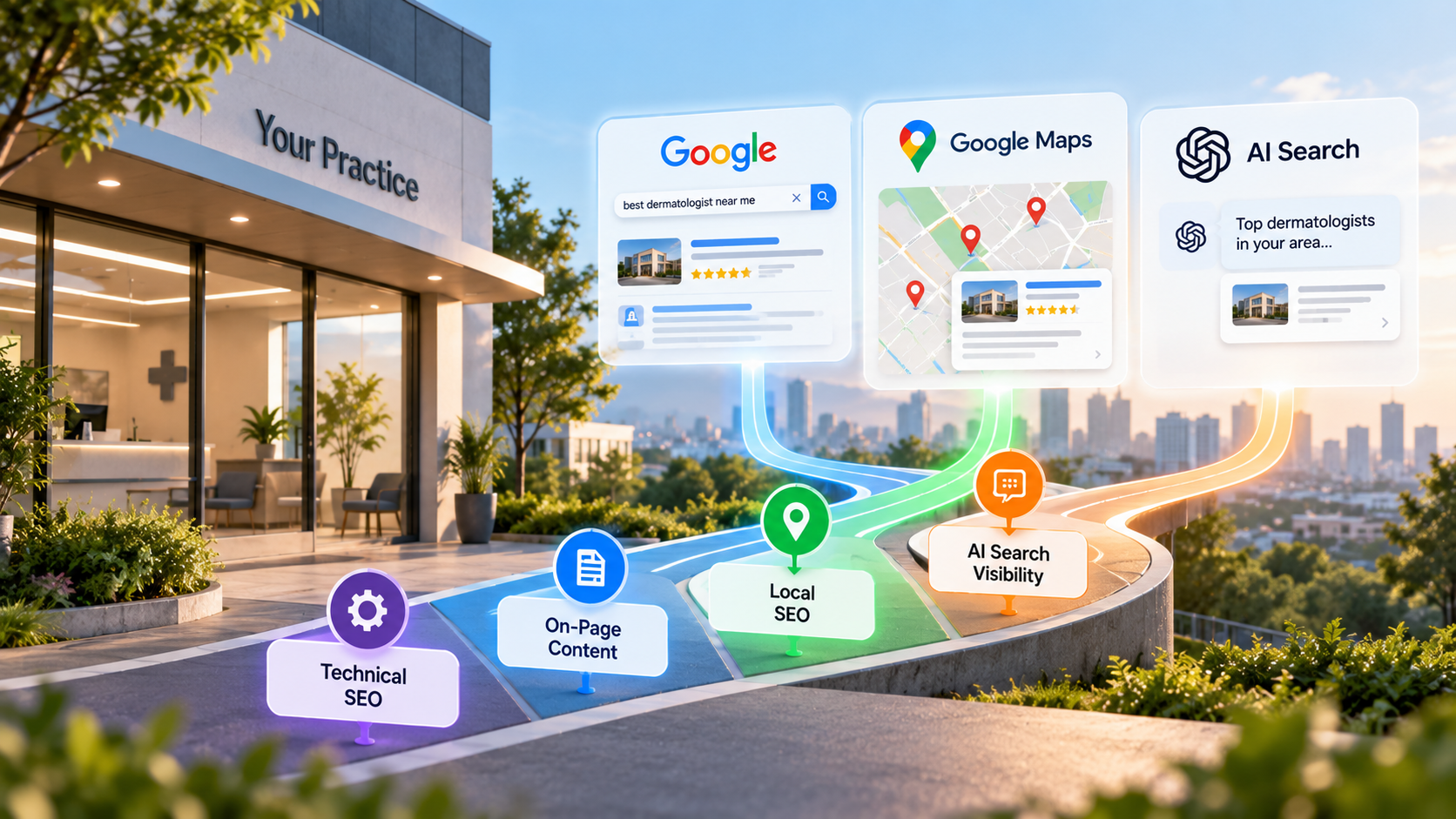
SEO for doctors means making sure your website, your Google Business Profile, and your presence across AI assistants like ChatGPT and Google Gemini all show up when a patient searches for care. It is not one technique. It is four separate disciplines working together: technical SEO, on-page content, local SEO, and AI search visibility. Most doctors treat SEO as a single project, handed to a web developer once and then forgotten. That approach misses how differently each layer works, and how much has changed in the last two years as AI assistants started answering patient questions directly instead of only linking to search results.
This guide focuses on the two layers most practices get wrong first: technical SEO and on-page content, since these form the foundation everything else depends on. It explains why local SEO and AI search visibility are separate disciplines with their own dedicated guides, rather than re-covering that ground here. It also gives you a practical way to think about hiring help versus doing this yourself, plus a starting checklist you can act on today.
82% of patients research their doctor online before booking. SEO is not a marketing extra. It is the mechanism by which most new patients decide whether to call.
What's in This Guide
- What SEO for Doctors Actually Means: Four Distinct Layers
- Technical SEO Basics for a Medical Website
- On-Page Content That Ranks
- Why Local SEO Is a Separate Discipline
- Why AI Search Is Now a Fourth Layer
- Hiring Help vs Doing SEO Yourself
- What Most Doctors Get Wrong About SEO
- A Practical Starting Checklist
- Frequently Asked Questions
What SEO for Doctors Actually Means: Four Distinct Layers
SEO for doctors breaks into four layers, and each one gets evaluated by a different system, using different signals.
Technical SEO is the foundation. It covers whether your site loads quickly, works on mobile, and lets Google and AI assistants read your pages without obstruction. A slow or broken site can undermine everything built on top of it, no matter how good the content is.
On-page content is what your website actually says, and how clearly it says it. Page titles, headings, service pages, and provider bios all fall here. This is where most of your direct control over what patients and search engines learn about your practice lives.
Local SEO governs whether you show up in Google Maps and the local map pack for searches like "dermatologist near me." It relies heavily on your Google Business Profile, your reviews, and consistent business information across the web. This is a distinct discipline with its own ranking factors, covered in full in the local SEO pillar guide, and this article does not re-cover it in depth.
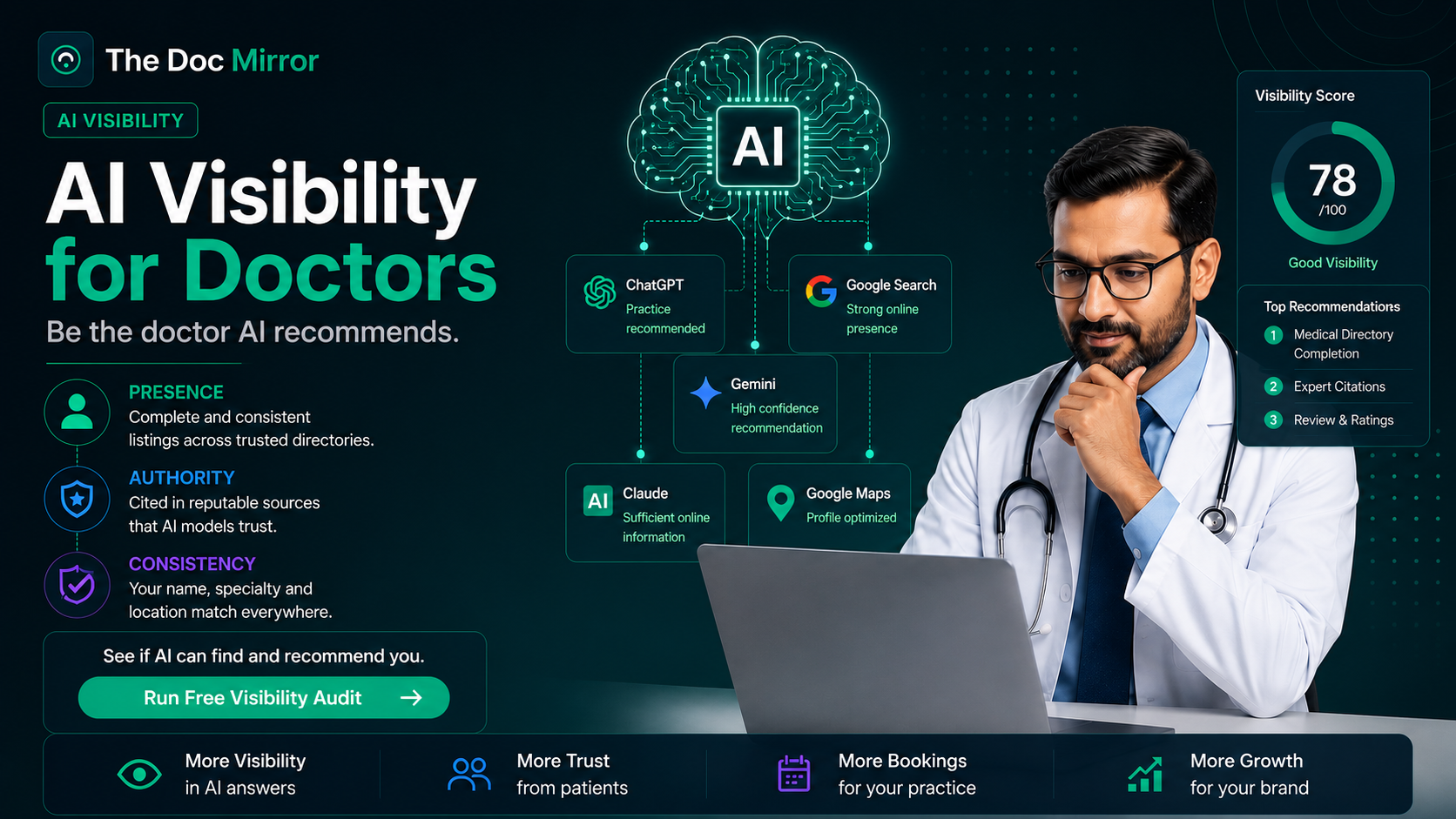
AI search is the newest layer. ChatGPT, Google Gemini, Claude, and Perplexity now answer patient questions directly, sometimes naming specific doctors and sometimes not. What earns a mention in an AI answer differs from what earns a top Google ranking. This is also its own discipline, covered separately.
These four layers overlap, but they do not substitute for one another. A practice can rank well locally and still be invisible in AI search. A practice can have a technically sound website and still lose patients because its content does not answer the questions they are actually asking.
Technical SEO Basics for a Medical Website
Technical SEO for a medical website means removing every obstacle between your pages and the people, and systems, trying to read them.
Page speed matters directly. A site that loads slowly on a phone loses patients before they read a word, and search engines factor loading speed into how they rank pages. Compress images, avoid unnecessary scripts, and choose hosting built for speed rather than the cheapest option available.
Mobile usability is not optional. Most patients search for a doctor on their phone, and Google evaluates the mobile version of a site as the primary version for ranking purposes. Text that requires zooming, buttons too small to tap accurately, and forms that break on smaller screens all cost you patients and ranking position.
Site structure should be simple enough that a new visitor, and a search engine, can find any service page within two or three clicks from the homepage. Clear navigation, a logical URL structure, and a sitemap submitted to Google Search Console all support this.
Structured data is one of the most overlooked technical elements on medical websites. It is code added to your pages that tells search engines and AI assistants exactly what a piece of information means, for example that a name refers to a physician, that a number is an address, or that a block of text is business hours. Getting your structured data right helps every other layer of SEO work better, since it removes ambiguity that both search engines and AI assistants would otherwise have to guess at. Doctor SEO teams often skip this step because it requires technical setup rather than writing.
Security matters too. Every medical website should run on HTTPS, both because Google treats it as a baseline ranking signal and because patients entering personal information deserve an encrypted connection.
On-Page Content That Ranks
On-page content is the writing, structure, and information on your actual pages, and it is where most of the ranking work for a medical website happens.
Start with service pages. Each condition or procedure you treat deserves its own dedicated page, written in plain language a patient would use, rather than one general services page listing everything in a bulleted list. A page titled "Knee Replacement Surgery in [City]," written to actually answer what a patient wants to know, outperforms a vague overview page.
Provider bios matter more than most practices realize. A bio that lists credentials, training, years of experience, and areas of focus gives both patients and search engines a clear signal of who is providing care. This connects directly to trust signals, which Google evaluates through its Experience, Expertise, Authoritativeness, and Trustworthiness guidance, published by Google Search Central as part of its Search Quality Rater Guidelines. Medical content sits under Google's "Your Money or Your Life" standard, meaning the bar for demonstrating real expertise is higher than it is for a typical business website.
Titles and headings should describe what a page is about in the words a patient would actually search, not internal clinical terminology. A patient searches "why does my knee hurt going up stairs," not "patellofemoral pain syndrome," even if the page eventually uses the clinical term too.
Entity signals also belong here. This means making sure your practice, your doctors, and your specialties are described consistently and clearly enough that search engines and AI assistants can connect them as the same entity signals across every page and every mention on the web. This increasingly determines whether a practice gets recognized correctly at all, not just whether it ranks.
Fresh, accurate content matters more in medical SEO than in most industries, because outdated medical information carries real risk. Review and update service pages regularly rather than publishing once and leaving them untouched for years.
Why Local SEO Is a Separate Discipline
Local SEO is not a subsection of general SEO. It runs on a different set of signals, centered on your Google Business Profile rather than your website alone.
Ranking in the Google Maps local pack depends on proximity, category accuracy, review volume, review content, and how consistently your business name, address, and phone number appear across the web. None of these factors are primarily about your website's content or technical setup. A practice can have excellent on-page content and still rank poorly on Maps if its Google Business Profile is incomplete or its listings are inconsistent across directories.
This matters because most "near me" searches, which make up a large share of how patients find a doctor, get answered by the local map pack before a patient ever reaches a normal list of website results. Ranking specifically in Google Maps requires a dedicated approach, covered fully in the local SEO pillar guide rather than here. This article focuses on the website-level SEO that supports local rankings, not the local ranking system itself.
Why AI Search Is Now a Fourth Layer
AI search is now a fourth layer because ChatGPT, Google Gemini, Claude, and Perplexity answer patient questions directly, often without sending the patient to any website at all.
A patient asking an AI assistant "what should I look for in a good orthopedic surgeon" or "is it normal to need a referral for this" may get a complete answer, sometimes naming specific practices and sometimes describing only general criteria. Whether a practice gets named depends on a different mix of signals than a traditional Google ranking, including how clearly a practice's information is structured, how consistently it appears across trustworthy sources, and how well its content answers specific questions.
This is not the same system as traditional Google ranking, and optimizing for one does not automatically optimize for the other. Ranking in AI search specifically requires understanding how each AI assistant sources and verifies information, which is covered in full in the AI visibility pillar guide. Treating AI search as an afterthought is one of the fastest ways a practice's SEO work falls behind, since patient research behavior is shifting toward these assistants faster than most practices are adjusting.
Hiring Help vs Doing SEO Yourself
Whether to hire help or handle SEO yourself depends mostly on time, technical comfort, and how competitive your market is.
A solo practice in a smaller market, with one doctor and some comfort with website tools, can reasonably handle on-page content and basic technical SEO without outside help. A larger practice, a competitive metro market, or a practice with no internal capacity to keep content updated usually benefits from bringing in dedicated help, since SEO is not a one-time project but ongoing maintenance.
The clearest sign you need outside help is not budget. It is whether anyone on your team has time to consistently update content, monitor rankings, and adjust as Google and AI assistants change how they evaluate sites. SEO work left untouched for a year rarely holds its position. What an agency actually does, and where that work earns its cost versus where a practice can reasonably do it alone, is covered in the dedicated guide on SEO services for doctors.
What Most Doctors Get Wrong About SEO
The most common mistake is treating SEO as a one-time project rather than ongoing maintenance. A website built and optimized three years ago, then left untouched, loses ground as competitors update their sites and as Google's evaluation criteria evolve.
A second mistake is focusing entirely on the website while ignoring reviews, local listings, and AI visibility. A technically excellent website connected to an inconsistent Google Business Profile or an inactive review pipeline still underperforms, because doctors with 50+ reviews rank significantly higher than those with under 10, and that trust signal reaches well beyond the local map pack.
A third mistake is writing content for search engines instead of patients. Keyword-stuffed pages that repeat a phrase without actually answering a question rank worse now than clear, direct writing that answers what a patient wants to know, and that gap has widened as AI-generated summaries reward clarity over repetition.
A fourth mistake is ignoring AI search entirely because a practice already ranks well on Google. Ranking well on Google does not guarantee visibility in ChatGPT or Google Gemini, since these systems draw on different signals and different sources.
A fifth mistake is underestimating how much the first page of Google results still controls visibility. The top 3 Google results get roughly 68% of all clicks, which means a practice ranking fourth or lower is competing for a small fraction of the patients who searched in the first place.
A Practical Starting Checklist
This is a starting point, not the complete picture. For a full, step-by-step audit covering every layer of a doctor's SEO, use the full checklist rather than working from a short list alone.
- Confirm your site loads quickly and works cleanly on a phone, since most patients search on mobile.
- Check that every service you offer has its own dedicated page, written in plain patient language.
- Confirm structured data is correctly set up so search engines and AI assistants can read your practice information without ambiguity.
- Review each provider bio for completeness: credentials, training, experience, and areas of focus.
- Confirm your practice name, specialties, and provider names appear consistently across your website and every external listing.
- Check whether your practice is currently named when patients ask common questions on ChatGPT and Google Gemini.
- Set a recurring schedule, quarterly at minimum, to review and update content rather than leaving it untouched.
Conclusion
SEO for doctors is not one task but four connected disciplines: technical SEO, on-page content, local SEO, and AI search visibility. Getting the technical foundation and on-page content right gives every other layer something solid to build on. Local SEO and AI search visibility then determine whether that foundation actually reaches patients where they are searching today.
82% of patients research their doctor online before booking, and that research increasingly happens across Google, Google Maps, and AI assistants like ChatGPT and Google Gemini, often within the same search. A practice that treats these as one project, checked once and forgotten, falls behind practices that treat them as ongoing, connected work.
The Doc Mirror shows exactly how your practice currently appears across Google, Google Maps, and the leading AI assistants, in one visibility score. See where your own site stands and run your free audit today.
By the The Doc Mirror team
Internal Links
| Target page | Anchor text used | Reason |
|---|---|---|
| /resources/medical-entity-seo | "entity signals" | Linked from the On-Page Content section where the pillar introduces entity consistency as a ranking factor at overview depth, then sends readers wanting the full mechanics to the dedicated medical entity SEO guide. |
| /resources/eeat-for-doctors | "trust signals" | Linked from the On-Page Content section, connecting provider bio quality and Google's E-E-A-T guidance to the dedicated guide that covers building those trust signals in depth. |
| /resources/medical-schema-markup-checklist | "structured data" | Linked from the Technical SEO section, where structured data is introduced as a commonly-skipped technical element, pointing readers to the full schema markup checklist for implementation detail. |
| /resources/seo-checklist-doctor-websites | "the full checklist" | Linked from the Practical Starting Checklist section, explicitly framing this pillar's short list as a starting point and directing readers to the complete, dedicated checklist page for the full audit. |
| /resources/seo-services-for-doctors | "what an agency actually does" | Linked from the Hiring Help vs Doing SEO Yourself section, scoping out a deep comparison of DIY vs agency work in favor of the dedicated services page. |
| /resources/local-seo-for-doctors | "ranking specifically in Google Maps" | Linked from the Why Local SEO Is a Separate Discipline section, explicitly scoping local SEO and Google Maps ranking out of this pillar and pointing to the sibling local SEO pillar instead of re-covering it. |
| /resources/ai-visibility-for-doctors | "ranking in AI search specifically" | Linked from the Why AI Search Is Now a Fourth Layer section, explicitly scoping ChatGPT and Gemini visibility out of this pillar and pointing to the sibling AI visibility pillar instead of re-covering it. |
| https://thedocmirror.com | "See where your own site stands" | Free Audit CTA placed in the conclusion, inviting the reader to run their own audit across Google, Google Maps, and AI assistants after reading the full pillar. |