Multi-Location Healthcare Digital Presence Management: A Governance Framework for Medical Groups
A single physician's office has one Google Business Profile, one set of reviews, one website to keep current. A medical group with 12, 40, or 150 locations has all of that multiplied, and almost none of it stays accurate on its own. Hours change. A location moves half a mile and nobody updates the listing. A physician leaves and three directories still list her at the old site. One location's reviews are excellent; another's are quietly sliding, and nobody on the marketing team notices until a patient complaint reaches corporate.
This is the real problem behind multi-location healthcare digital presence management: it's not a bigger version of single-location local SEO, it's a different kind of problem entirely. It's an operations and governance challenge that happens to live in marketing systems. Solving it requires less emphasis on "how do we rank" and more on "who owns this, how often do we check it, and what happens when something drifts."
What "Digital Presence" Actually Covers at Scale
For a single clinic, digital presence usually means a handful of things: the Google Business Profile, the website, a few directory listings, and patient reviews. For a medical group operating across multiple locations, the surface area expands in ways that are easy to underestimate:
- Location-level listings across Google, Bing, Apple Maps, and healthcare-specific directories (insurance networks, Healthgrades, Vitals, WebMD)
- Physician-level profiles, which move independently of location profiles when providers rotate between sites or leave the group
- Reviews and ratings, generated per location and sometimes per provider
- Website and landing page accuracy for each site (hours, services offered, insurance accepted, parking and accessibility notes)
- AI assistant visibility: how location and provider information surfaces when patients ask tools like ChatGPT or Google's AI Overviews about nearby care options, which depends on the same underlying data being consistent and current
Each of these layers can drift independently, and at 20+ locations, manual spot-checking simply does not catch it. One analysis of Google Business Profile management at scale found that listing errors (wrong hours, duplicate profiles, stale addresses) routinely go unnoticed in multi-location healthcare organizations until a patient complaint or a lost appointment surfaces the problem, precisely because there's no centralized monitoring layer catching the drift early (Pilot Practice, 2026). Keeping provider-level details correct is its own discipline, which is why physician profile monitoring tends to need a distinct workflow from location-level listing management: a departing or relocating physician can leave inaccurate profiles live across a dozen directories long after the group's own records are updated.
Why Governance Breaks Down Without a Framework
The failure mode in most multi-location groups isn't a lack of effort; it's a lack of clarity about ownership. A few patterns show up repeatedly:
No single owner per location. Front-desk staff, a regional manager, and a corporate marketing team may all assume someone else is watching the listing. Nobody is.
No standard cadence. Reviews get checked "when someone has time," which in practice means sporadically, and negative reviews sit unanswered for weeks.
No escalation path. Even when someone notices a problem (a wrong phone number, a cluster of 2-star reviews at one site), there's no defined process for who fixes it and by when.
Inconsistent standards across sites. One location responds to every review within a day; another never responds. One uses consistent photos and descriptions; another looks like it was set up by a different company. Patients comparing locations within the same group notice this inconsistency, and it undermines trust in the brand as a whole.
A workable governance model doesn't need to be complicated, but it does need to assign responsibility explicitly at three levels: corporate (sets standards, owns the benchmarking dashboard, defines escalation rules), regional or multi-site manager (owns a cluster of locations, handles first-line issues), and the individual location (owns day-to-day accuracy: hours, staff changes, immediate review responses). Writing this down, even in a simple one-page RACI chart, resolves most of the "I thought someone else was handling that" failures.
Benchmarking: Turning Inconsistency Into a Visible Problem
Governance only works if the group can actually see where things stand. This is where benchmarking comes in: comparing locations against each other and against reasonable reference points, rather than evaluating each site in isolation.
Industry research gives some useful reference points, though the real numbers tend to be more modest than many groups assume. Soci's 2026 healthcare benchmarking data found that the average business responds to only 46.9% of its Google reviews, with response times averaging 4.3 days, and that healthcare locations recommended by AI assistants tend to carry star ratings in the high-3s to low-4s depending on the platform (an average of 4.3 on ChatGPT, 3.9 on Gemini, and 4.2 on Perplexity in their dataset) (Soci, 2026). The gap between what's typical and what's actually competitive is itself a useful reference point: a location with a review response rate well under the average, or a rating meaningfully below 4 stars, is a location with a real, visible problem, not just bad luck.
The consumer research behind these numbers helps explain why they matter. Birdeye's 2026 research on healthcare reputation found that 87% of patients read reviews before selecting a provider, that 72% prefer a provider with a 4-star rating or higher, and that 81% of patient-facing reviews surface on Google specifically, which is part of why Google Business Profile accuracy tends to carry more weight than any single directory (Birdeye, 2026). The same research found that 71% of consumers reported a negative experience caused by incorrect local business information found online. These are the publisher's own survey findings rather than independently audited data, but directionally they support a simple governance rule: listing accuracy and review visibility aren't vanity metrics, they're inputs patients act on before they ever call a location.
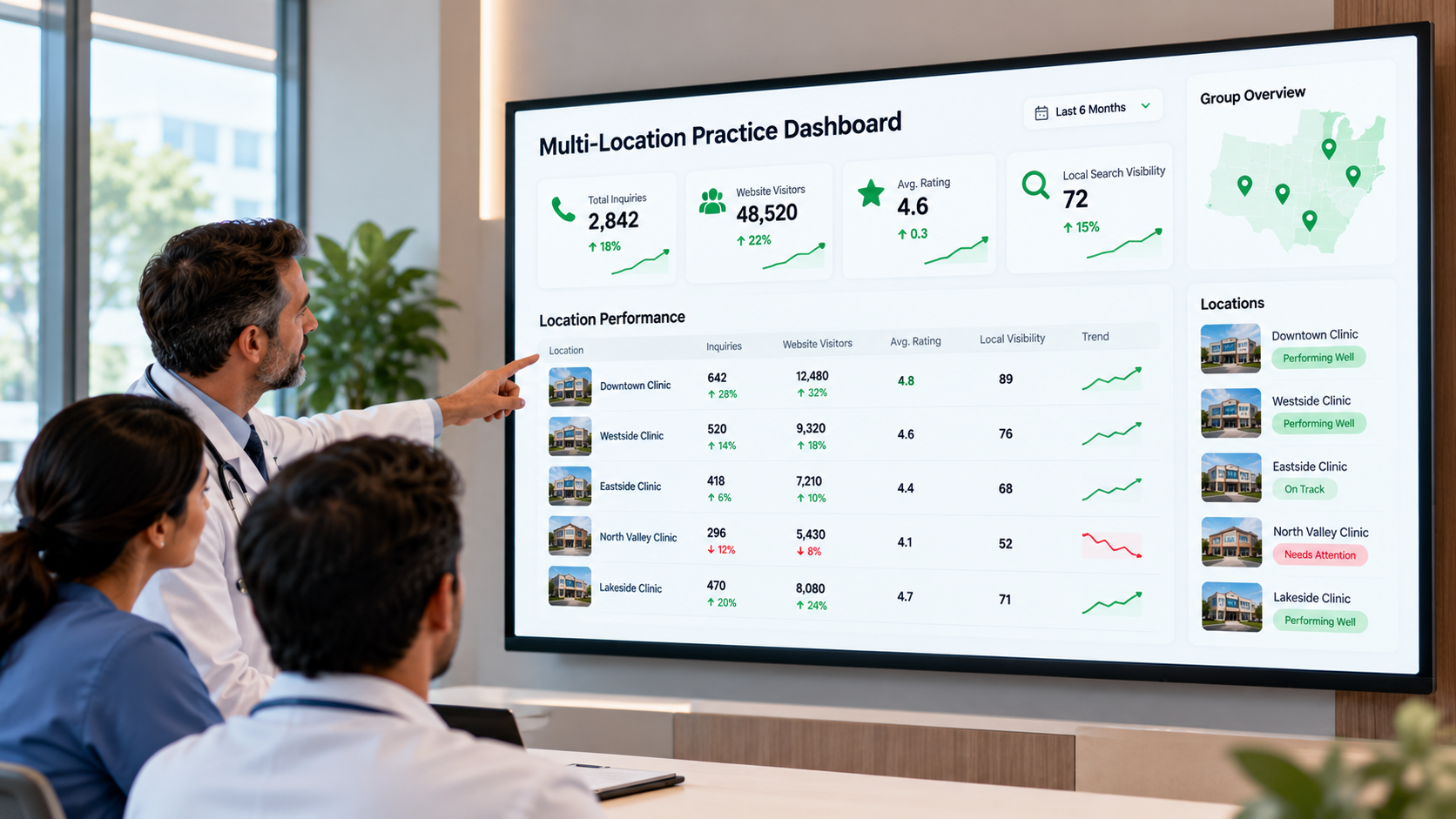
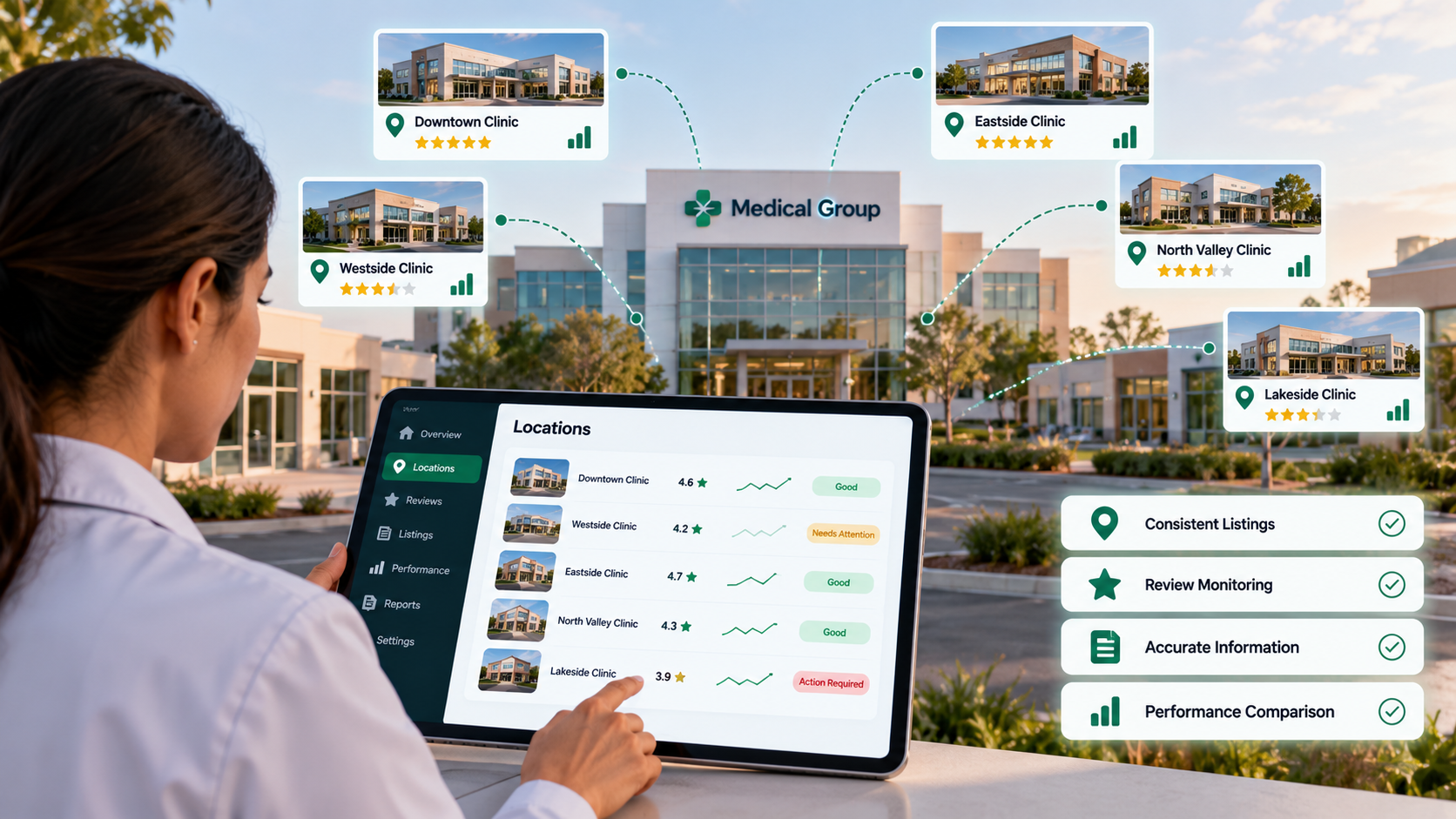
For a group with multiple sites, the useful move is a medical group location benchmarking dashboard that ranks every site against these reference points side by side, not to shame underperforming locations, but to make the gap visible enough that it gets addressed. This is the practical core of online reputation benchmarking for multi-location clinics: consistent measurement across sites turns "that location seems fine" into an actual, comparable number.
Dashboards and Reporting Cadence
Benchmarks only change behavior if someone is actually looking at them on a schedule. A recurring complaint from multi-site healthcare operators is that reporting exists but lives in scattered spreadsheets, different logins per platform, or a quarterly PDF nobody reads until something's already gone wrong.
The alternative is a single per-location view: a multi-location medical practice digital performance dashboard that pulls listing accuracy, review volume, star rating, and response rate into one place per site, refreshed on a predictable schedule. One analysis of multi-site healthcare reporting structures frames this less as a software choice and more as a governance rhythm: a dashboard only functions as a real operating system when metrics are defined the same way across every site and someone is actually accountable for acting on what it shows, rather than each location using its own definition of the same number (MyBCAT, 2026). In practice, that usually means setting a specific cadence, commonly weekly for location-level issues and monthly for cross-location benchmarking, which is a decision the group makes for itself rather than a fixed industry standard. Without that rhythm, even well-built digital performance reporting for multi-location physician groups becomes another report that gets generated and ignored.
In practice, this reporting rhythm tends to work best when it mirrors the governance structure already described: a corporate-level monthly view for trend and benchmarking, a regional weekly view for emerging issues, and location-level real-time alerts for anything that needs immediate action (a one-star review, a listing suspension, a sudden ratings drop). The goal isn't more dashboards, it's fewer dashboards that the right person actually checks.
Consistency Without Losing Local Nuance
A tempting but mistaken response to inconsistency is to standardize everything: identical descriptions, identical photos, identical response templates across every location. This tends to backfire. Patients searching for care are usually looking for a specific, nearby option, and listings that read as obviously templated (identical wording across ten locations in a metro area) can look generic or even suspicious.
The more durable approach separates what should be standardized from what shouldn't be:
- Standardize: brand name formatting, category selection, response-time targets, escalation rules, core service descriptions, compliance language in review responses
- Leave local: specific staff mentioned in responses, photos reflecting the actual location, community-specific details (nearby landmarks, parking notes), and the particular tone used when addressing a location's own patient base
This is really a medical group digital presence question as much as a technical one: healthcare location management works best when corporate owns the floor (minimum standards, compliance, monitoring) and local staff owns the ceiling (how a specific location's profile and responses actually read to its own patients).
Measuring Whether It's Working
Governance and dashboards are inputs; the output that matters is whether patients actually trust what they find. That's a slightly different question than whether star ratings clear a single average. It's about whether the overall pattern of reviews, responses, and listing accuracy adds up to something a patient would read as credible. This is the layer covered in more depth in healthcare reputation analytics: tracking not just raw scores but trend direction, response quality, and how a location's reputation signals compare to patient expectations over time. For a multi-location group, running this analysis per site and rolling it up to a corporate view is what turns benchmarking data into an actual quality signal rather than a vanity metric.
The Agency Angle: White-Label Reporting for Physician Groups
Marketing and SEO agencies serving multiple physician groups face a scaled-up version of the same problem: they need to audit and report on digital presence consistently across many clients, each with many locations, without rebuilding a reporting process from scratch every time. A white label digital presence audit for doctors, a standardized audit template an agency can run across any client's location footprint and present under its own branding, solves this by making the governance framework described above repeatable rather than bespoke. The underlying checks (listing accuracy, review benchmarks, response-rate tracking) don't change between clients; what changes is the branding and the specific thresholds a given client cares about.
For agencies, the practical value of digital presence management software for medical groups and a clinic digital presence monitoring platform isn't just the automation. It's that it turns an otherwise manual, client-by-client audit process into something that scales across an entire book of healthcare clients.
Getting Started Without Overbuilding
A group just starting to formalize this doesn't need to build the full system on day one. A reasonable sequence:
- Inventory first. List every location's profiles across Google, Bing, and major directories, and note where information is already wrong.
- Assign ownership at the corporate, regional, and location level using a simple written document.
- Pick two or three reference points (star rating, response rate, listing accuracy) rather than trying to track everything at once.
- Set a reporting cadence that someone is actually accountable for reviewing: weekly at the location level, monthly at the corporate level.
- Review and adjust standards after the first quarter, based on what the benchmarking data actually shows.
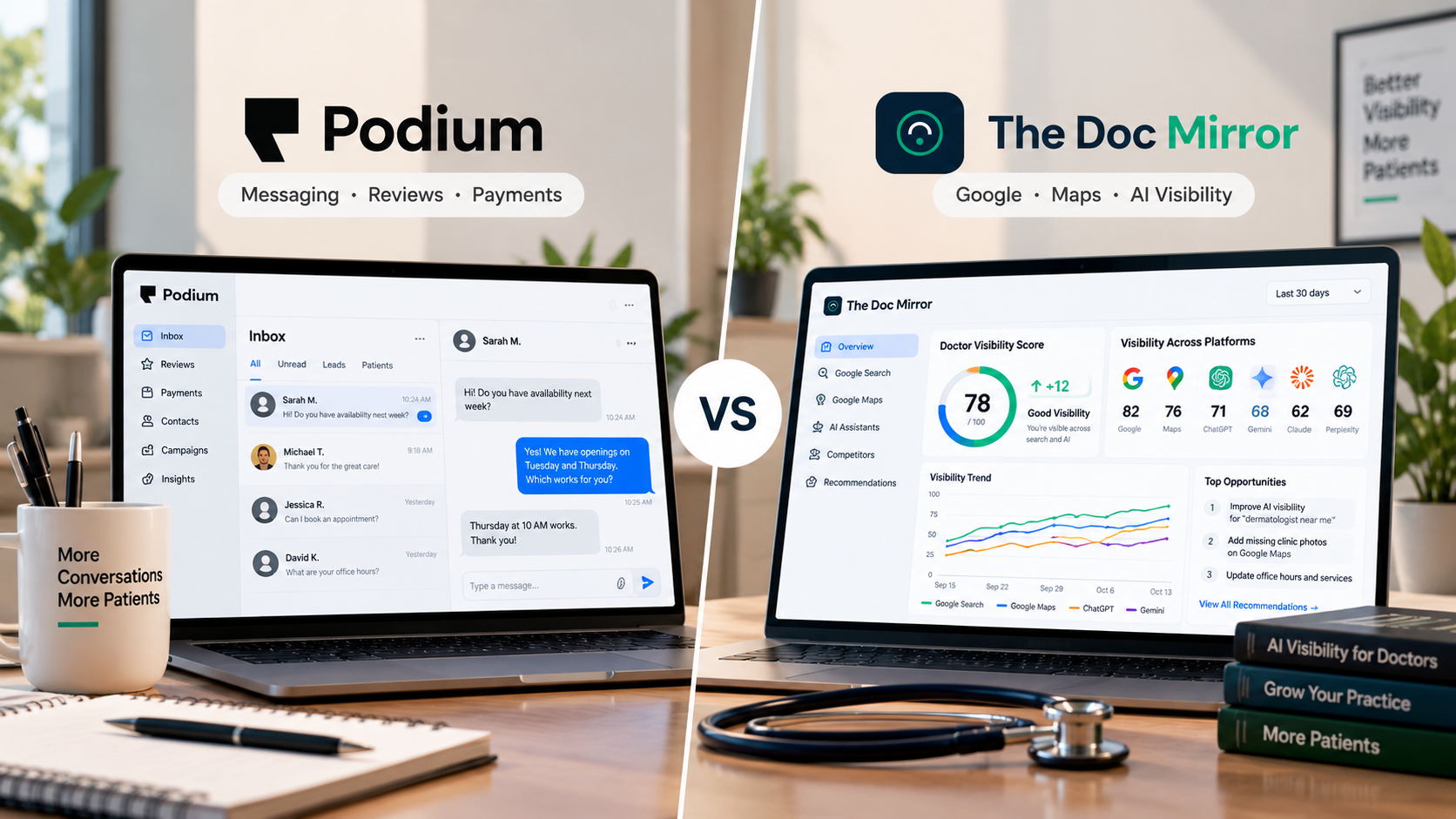
If you're not sure where your own locations currently stand, a straightforward first step is simply checking what's publicly visible for each site right now. The Doc Mirror can help surface how a practice's listings, reviews, and overall visibility look across Google, directories, and AI assistants, which is a useful starting point before building out a full governance process.
Sources
- Soci, "Local Visibility Benchmarks for Healthcare: 2026 Data": https://www.soci.ai/blog/healthcare-local-visibility-benchmarks/
- Birdeye, "Healthcare online reputation management in 2026: Best practices for growth": https://birdeye.com/blog/healthcare-reputation-management/
- Pilot Practice, "Google Business Profiles at 20+ Locations: Management, Sync, Anomaly Detection (2026)": https://pilotpractice.com/enterprise/gbp-at-scale/
- MyBCAT, "Reporting Dashboard Multi-Site Healthcare Operations": https://mybcat.com/blog/reporting-dashboard-multi-site-healthcare-operations/
(Note: sources 1, 2, and 4 are vendor/agency industry research and commentary rather than peer-reviewed studies; specific percentage figures are attributed to the originating publisher in the text rather than presented as independently audited data.)