Physician Profile Monitoring: Keep Doctor Listings Accurate Online
Patients rarely call a clinic to ask if Dr. Patel still takes new patients or still practices at the Elm Street location. They check a listing — Google, their insurer's directory, Healthgrades, the hospital system's "Find a Doctor" page — and they trust what they see. When that listing is wrong, the result isn't a minor inconvenience. It's a missed appointment, a surprise out-of-network bill, or a patient who simply gives up and calls the next practice on the list.
This is the problem physician profile monitoring exists to solve. Not a one-time cleanup of your Google Business Profile, but an ongoing process for catching and correcting inaccurate physician information across every place patients and payers look for it.
Why One-Time Listing Fixes Aren't Enough
Most practices have, at some point, gone through a "listing optimization" exercise: claim the Google Business Profile, update the NPI record, make sure the phone number matches across directories. That work matters, but it has a shelf life.
The data on physician directory accuracy backs this up more than most practice managers expect, and it is a big part of why doctor listing monitoring has to be treated as an ongoing habit rather than a one-time fix. A CMS review of Medicare Advantage online provider directories found that roughly 48.7% of listings reviewed contained at least one inaccuracy — wrong location, wrong phone number, incorrect specialty, or inaccurate information about whether the provider was accepting new patients (CMS, Online Provider Directory Review Report). A more recent CAQH issue brief puts the figure in a similar range, citing that 40–50% of provider directory listings contain at least one error related to address, specialty, or network status (CAQH, Provider Directories Issue Brief, May 2024).
What's more telling is how long these errors persist. Research published in the American Journal of Managed Care found that provider directory inaccuracies often remain uncorrected for well over a year — in some cases 400 to 575-plus days — even after the error has been reported and the provider re-contacted (AJMC, Persistence of Provider Directory Inaccuracies After the No Surprises Act). And underlying registry data itself decays: one industry survey found roughly 20% of NPI/NPPES records contained inaccuracies, which then propagate downstream into every directory that pulls from that registry (Healthcare Finance News, Survey contends 20 percent of NPI data is inaccurate).
Put together, these numbers describe a system where errors are common, sticky, and self-replicating. A single bad data point in a source registry can quietly spread to a dozen directories before anyone notices. That's the case for treating this as monitoring — a recurring check — rather than a project with a defined end date.
What Physician Profile Monitoring Actually Covers
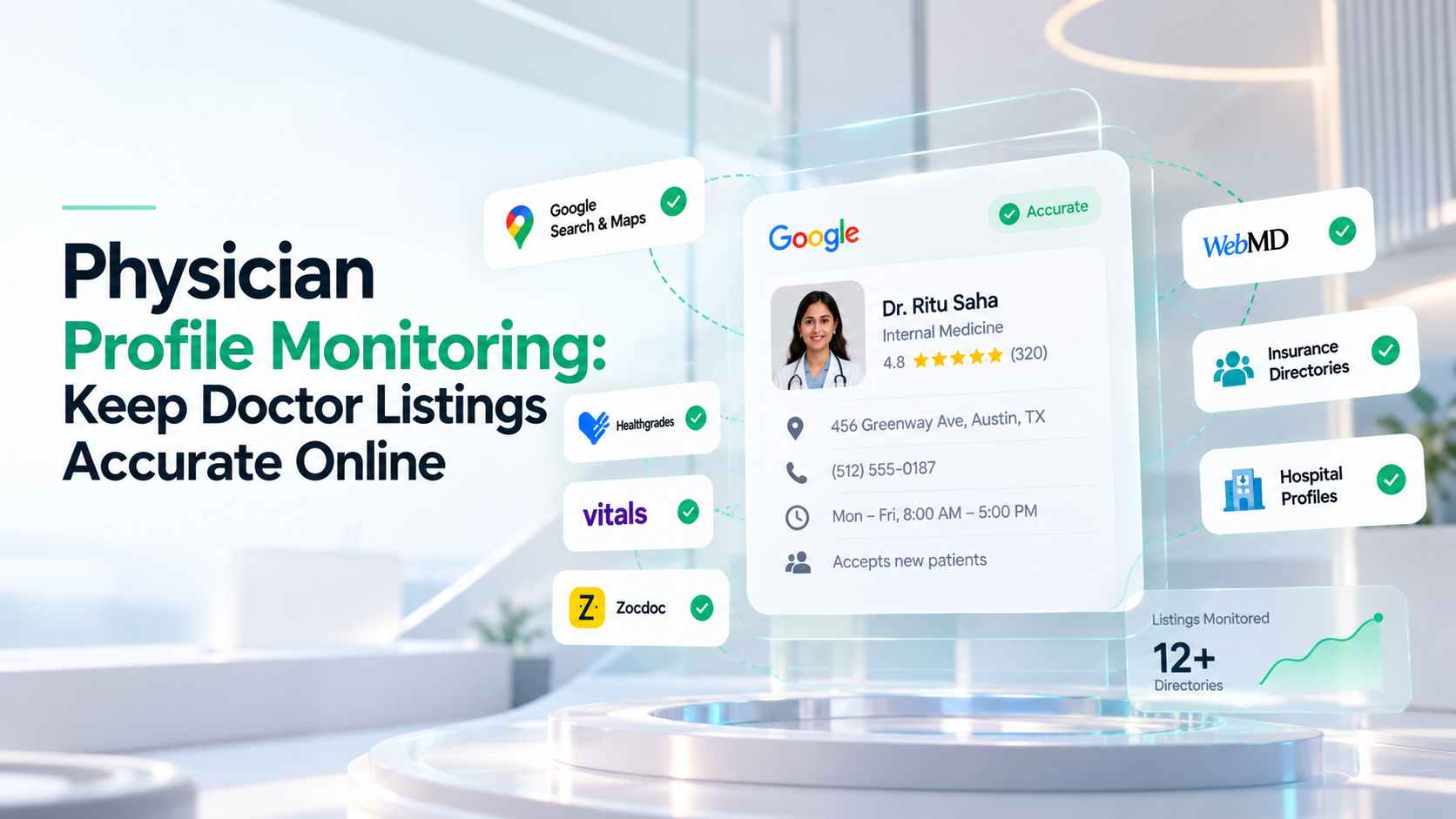
Physician profile monitoring means regularly checking the accuracy and consistency of individual provider information across the places patients, payers, and referring providers encounter it. For most practices, that includes:
- Search and map listings — Google Business Profile, Bing Places, Apple Maps
- Payer and insurer directories — the "find a provider" tools on major insurer websites, which are the directories most tied to patient trust and regulatory scrutiny under the No Surprises Act
- Healthcare-specific directories — Healthgrades, Vitals, WebMD, Zocdoc, and similar sites
- Hospital or health system bio pages, if the physician is affiliated with a larger system
- NPPES/NPI registry data, since this is often the upstream source other directories pull from
- The practice's own website — provider bio pages, credential lists, location assignments
For each of those, the fields that matter most are name and credentials, practice location(s), phone number, specialty and subspecialty, accepted insurance plans, whether the provider is accepting new patients, and office hours. Those are precisely the fields the CMS and CAQH research flagged as most commonly wrong — which is a useful starting checklist for what to monitor first.
Monitoring vs. Benchmarking vs. Brand Monitoring
It's worth separating three related but distinct activities, because practices sometimes conflate them:
- Physician profile monitoring is about factual accuracy — is the information correct and consistent everywhere it appears?
- Physician benchmarking is about comparative standing — how does a given provider's online reputation and visibility compare to peers in the same specialty or market? If you're building out a scorecard across providers or locations, our guide to benchmarking reputation across medical group locations walks through how to structure that comparison.
- Medical brand monitoring is broader still — it tracks what patients are actually seeing and saying about the practice as a whole, including reviews, social mentions, and how the practice shows up in AI-assisted search results. For a deeper look at that layer, see tracking what patients see about your practice.
Profile monitoring feeds into both. Accurate profiles are the foundation; benchmarking and brand monitoring are what you build on top of that foundation once it's solid.
Building a Monitoring Workflow
A workflow needs an owner, a cadence, and a set of triggers. Here's a practical structure for a small-to-midsize practice or medical group.
1. Assign ownership. Someone — often a practice manager, credentialing coordinator, or marketing lead — needs to own profile accuracy the same way someone owns scheduling or billing. Without a named owner, "we should check our listings" tends to never happen.
2. Set a baseline cadence. A quarterly check across all core directories is a reasonable default for a stable, single-location practice. Multi-location groups or practices with frequent provider turnover should move to a monthly cadence for at least the highest-traffic directories (Google, top two or three insurer directories, and the practice website).
3. Define event-based triggers that override the cadence. Certain events should trigger an immediate re-check regardless of where you are in the quarterly cycle:
- A physician joins, leaves, or changes locations
- A change in accepted insurance plans
- A change in whether a provider is accepting new patients
- An NPI record update
- A specialty or board certification change
- Credentialing with a new payer
4. Document what "accurate" means per field. Decide on a canonical source of truth — usually your credentialing or practice management system — so staff checking directories know what they're comparing against, rather than relying on memory.
5. Log discrepancies and resolution time. Given how long directory errors tend to persist once reported, tracking how long it actually takes to get a correction live (sometimes weeks, given payer and directory update cycles) helps you plan realistically and escalate when needed.
Where Software Fits In
Manually checking dozens of directories for every physician in a group doesn't scale much past a handful of providers. This is where physician profile monitoring software for clinics becomes relevant — tools that periodically scan listings across search, maps, directories, and review platforms and flag inconsistencies automatically, rather than requiring staff to check each source by hand.
When evaluating a clinic digital presence monitoring platform or medical group online reputation monitoring software, the practical questions to ask are:
- Does it cover the specific directories that matter for your payer mix and specialty, not just the generic ones?
- Can it track at the individual-provider level, not just the practice level, which matters once you have more than a few physicians?
- Does it surface discrepancies with enough detail to act on (which field, which source, when it was last correct)?
- Does it integrate with or complement a broader review and reputation monitoring layer, since profile errors and reputation issues often need the same staff to respond?
Not every practice needs dedicated software immediately. A solo practitioner or two-physician practice can often manage a quarterly manual check with a shared spreadsheet. Groups with ten-plus providers across multiple locations, or agencies managing multiple client practices, generally reach a point where medical brand monitoring tools for healthcare organizations become worth the investment simply because the volume of listings to track exceeds what manual review can reliably catch.
If you haven't done a full inventory of where your practice appears online, it's worth starting there before setting up recurring monitoring — our walkthrough on auditing your practice's digital footprint covers how to build that starting inventory so you know exactly what you're monitoring going forward.
Physician Benchmarking and Market Research
For medical groups managing multiple providers or locations, profile monitoring data becomes more useful once you can compare it across the organization. This is where physician benchmarking and healthcare market research software for physician groups come in — using the same underlying data (listing accuracy, review volume and sentiment, directory presence) to see which providers or locations are performing well versus which ones need attention.
This comparative view also helps prioritize monitoring effort. A newer provider building their patient panel, or a location in a competitive market, may warrant more frequent checks than an established provider at a stable, low-turnover site. Benchmarking turns monitoring from a uniform checklist into a prioritized one.
Common Mistakes Practices Make
Treating it as a one-time project. The research above is unambiguous: directory errors recur and persist. A "set it and forget it" cleanup will decay within months.
Only checking Google. Google Business Profile matters, but insurer directories carry regulatory weight under the No Surprises Act and are often where "network status" errors cause the most patient harm — a surprise bill from an out-of-network visit the directory said was in-network.
No single source of truth. If different staff members update different systems (practice website, EHR provider record, credentialing file) independently, drift is inevitable. Pick one canonical record and treat everything else as downstream of it.
No owner. Monitoring tasks without a named, accountable owner get deprioritized the moment something more urgent comes up, which is most weeks in a busy practice.
Conclusion
Physician profile monitoring isn't a box to check once during onboarding or a rebrand. The data on directory accuracy makes clear that errors are common, slow to resolve, and tend to reappear even after correction. Treating accuracy as an ongoing workflow, with a clear owner, a set cadence, and defined triggers for off-cycle checks, is what actually keeps doctor listings reliable for the patients and payers depending on them.
Where The Doc Mirror Fits
Keeping physician listings accurate across dozens of directories, insurer sites, and review platforms is exactly the kind of ongoing visibility work that's hard to do manually once a practice grows past a few providers. The Doc Mirror helps practices audit and track how they appear across Google, review platforms, and increasingly, the AI-assisted search tools patients now use to find care. If you're not sure where your current listings stand, it's worth running a visibility check to see what's accurate and what isn't before building out a full monitoring cadence.
Sources
- CMS — Online Provider Directory Review Report (Medicare Advantage directory audit): https://www.cms.gov/Medicare/Health-Plans/ManagedCareMarketing/Downloads/Provider_Directory_Review_Industry_Report_Year2_Final_1-19-18.pdf
- CAQH — Provider Directories Issue Brief, May 2024: https://www.caqh.org/hubfs/Insights%20-%20Provider%20Directory%20Accuracy%20Issue%20Brief_vf.pdf
- AJMC — Persistence of Provider Directory Inaccuracies After the No Surprises Act: https://www.ajmc.com/view/persistence-of-provider-directory-inaccuracies-after-the-no-surprises-act
- Healthcare Finance News — Survey contends 20 percent of NPI data is inaccurate: https://www.healthcarefinancenews.com/news/survey-contends-20-percent-npi-data-inaccurate