How to Track Patient Acquisition Channels for Your Clinic
If you asked five people on your staff which marketing channel brings in the most new patients, you'd probably get five different guesses. Maybe it's "the website," maybe it's "Google," maybe it's "word of mouth." Guessing is expensive. Every dollar spent on a channel that isn't converting is a dollar not spent on one that is.
Learning to track patient acquisition channels isn't about installing one piece of software and calling it done. It's about building a measurement system that accounts for how healthcare patients actually behave - long decision cycles, a strong preference for calling instead of filling out a form, and real privacy expectations around their health information. At its core, this is about learning to track marketing channels that bring new patients rather than channels that simply generate clicks. Done well, this kind of tracking gives you a clear, defensible picture of what's working without turning your practice into a data-collection operation that makes patients or compliance officers uneasy.
This guide walks through what to measure, how to set up patient source tracking in a privacy-conscious way, how to calculate patient acquisition cost, and how to read the resulting data so it actually changes your marketing decisions.
Why Tracking Patient Acquisition Channels Is Harder Than Standard Retail Attribution
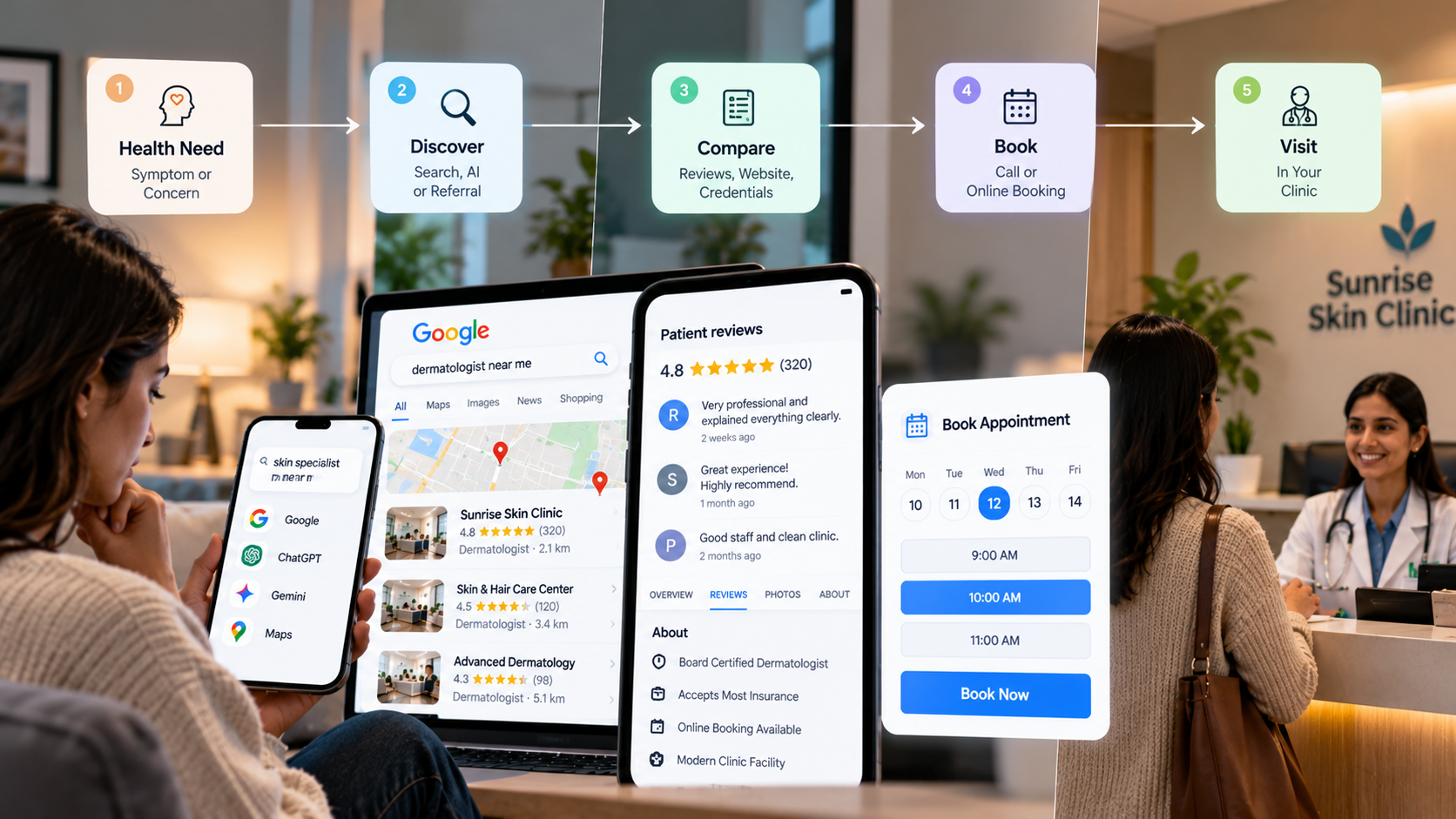
Most attribution advice is written for ecommerce, where someone clicks an ad and buys a product in the same session. Healthcare doesn't work that way. A patient might see a Facebook ad in January, read three blog posts in February, ask a friend for a recommendation in March, and finally call the office in April. By the time they call, the original ad click is long gone from most analytics tools' default lookback windows.
This is one of the core reasons generic Google Analytics setups underperform for medical practices: they're tuned for short conversion windows, not the extended consideration periods typical of elective procedures, specialist care, or even routine primary care switches. Research on healthcare marketing attribution points to the same conclusion - practices need extended attribution windows, often 12 months or longer, and reliance on first-party data rather than third-party cookies, which are increasingly unreliable or blocked outright (Siteimprove).
The practical implication: if your tracking setup only looks at the last 7 or 30 days before a conversion, you are systematically undercounting the channels that build awareness early in the patient journey, like SEO content and social media, while overcrediting last-touch channels like branded search or direct visits.
What to Measure: Building a Simple Patient Inquiry Tracking Dashboard
Before adding tools, define what counts as a "lead" at your practice. For most clinics, that's some combination of:
- Phone calls to the main line or a tracked marketing number
- Online form submissions (contact forms, appointment requests, new patient intake)
- Chat or chatbot conversations that result in contact information
- Walk-ins who mention where they heard about you
- Online scheduling completions
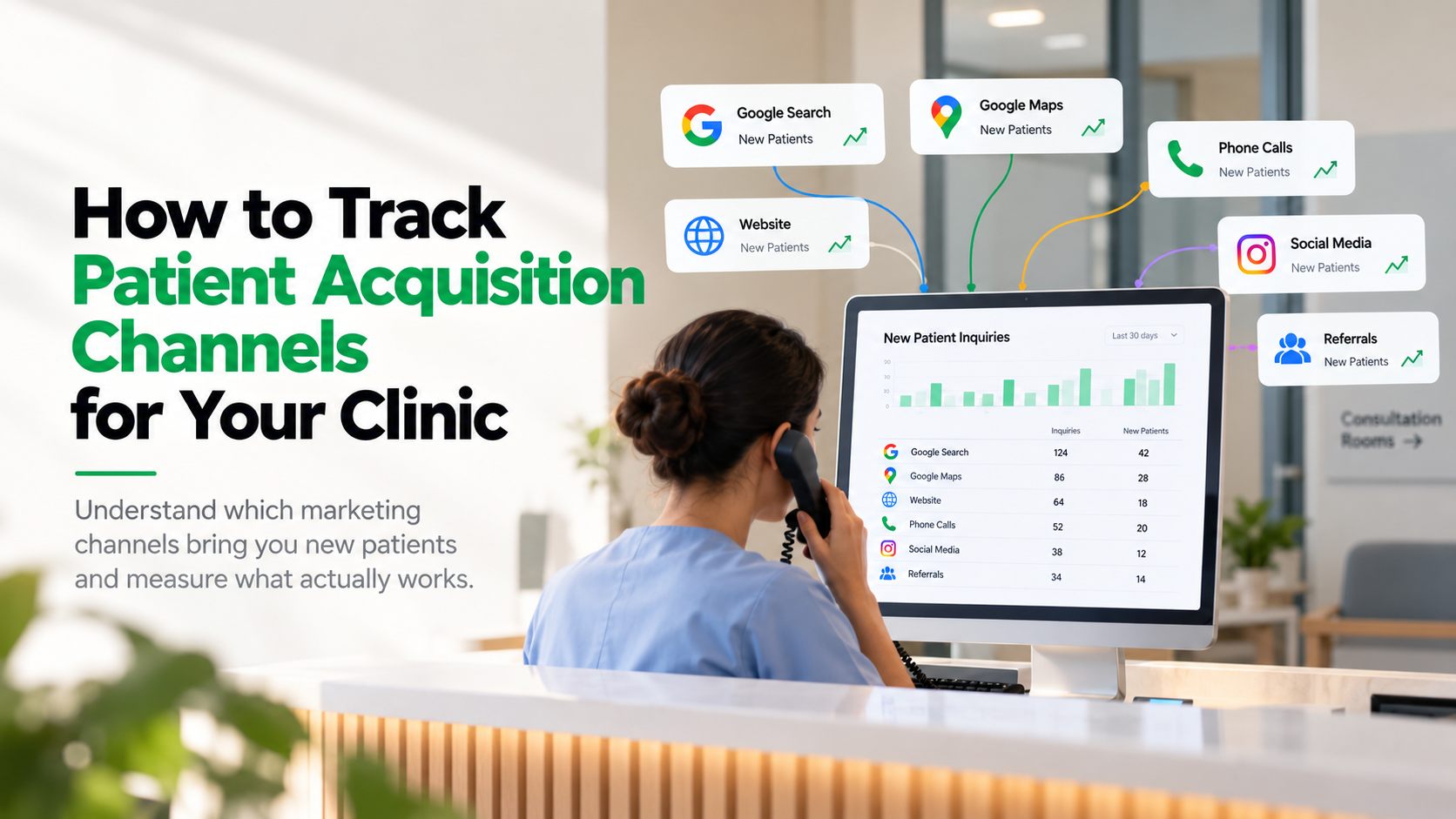
A patient inquiry tracking dashboard for healthcare doesn't need to be complicated. At minimum, it should show, per channel, per month: number of inquiries, number of those inquiries that became scheduled appointments, and number that became kept, paying patients. That third column is often missing, and it's the one that matters most - a channel that generates a lot of calls but few actual patients is not necessarily a good channel.
If your practice already struggles with inquiries that don't convert to bookings, it's worth reading up on why medical practices get website traffic but few appointment bookings before you even start attributing traffic to channels - a tracking system built on top of a leaky conversion funnel will just confirm the leak exists without telling you why.
How to Track Phone Calls From Medical Marketing Campaigns
Phone remains the dominant channel for new patient inquiries in healthcare. Industry data cited by HIPAA-compliant analytics vendors puts the share of new patient leads starting with a phone call at around 80% (Liine). If your tracking setup only captures web form fills, you are likely missing the majority of your actual lead volume.
To track phone calls from medical marketing campaigns without compromising patient privacy:
- Use dynamic number insertion (DNI) so each marketing channel (Google Ads, organic search, a specific print ad, a referral partner's website) displays a unique tracking number. When a call comes in on that number, you know exactly which channel sourced it.
- Disable or restrict call recording and transcription for lines that are likely to involve protected health information, or ensure any recording/transcription is handled by a vendor that will sign a Business Associate Agreement (BAA) and store data accordingly.
- Choose a call tracking vendor that supports HIPAA safeguards directly - role-based access controls, audit logging, multi-factor authentication, and the ability to turn off automatic recording for sensitive lines (Improvado).
- Confirm the BAA explicitly. Any vendor that touches call data containing PHI - including recordings, transcripts, or caller metadata tied to a specific patient inquiry - needs a signed BAA before you send them a single call (Liine).
This is also where many practices realize they need a more structured approach to healthcare lead tracking generally, not just for calls. If you haven't yet built out a consistent way to measure calls, forms, and appointment requests together, that's a natural next step once call tracking is in place - calls alone won't give you the full picture.
Privacy-Conscious Patient Acquisition Analytics: What to Avoid
It's tempting to bolt on every available tracking pixel and tag to get maximum visibility. Resist that instinct. A privacy-conscious approach to patient acquisition analytics for clinics means:
- Minimizing what you capture. Track that a call or form came from a specific channel and campaign - you don't need to capture the content of a symptom description in your ad platform's dashboard.
- Separating marketing data from clinical data. Your marketing attribution system should never touch your EHR directly in a way that exposes PHI to ad platforms or analytics tools that aren't covered by a BAA.
- Being transparent on your website. A clear, accurate privacy policy describing what tracking occurs (cookies, call recording, form data use) is both a compliance good practice and something patients increasingly expect to see.
- Auditing third-party pixels regularly. Ad platform pixels (Meta, Google, TikTok) can inadvertently capture more than intended if placed on pages like appointment confirmation screens. Review what data each pixel fires on and where.
The goal isn't to avoid measurement - it's to measure in a way that would hold up if a patient, a regulator, or your own compliance officer asked exactly what data you're collecting and why.
How to Calculate Patient Acquisition Cost for a Medical Practice
Once source tracking is in place, patient acquisition cost (PAC) turns raw traffic and lead numbers into a business metric you can actually act on.
The standard formula, consistent across several industry sources, is:
PAC = Total Marketing Spend ÷ Number of New Patients Acquired
So if you spent $6,000 on a channel in a month and it produced 20 new patients, your PAC for that channel is $300 (Patient Prism; Zocdoc).
A few things to get right when you calculate patient acquisition cost for a medical practice:
- Include the full cost stack, not just ad spend. That means ad spend, SEO/content costs, marketing staff time, software and call tracking tools, and agency fees where applicable (Zocdoc).
- Calculate PAC per channel, not just overall. A blended, practice-wide PAC hides which specific channels are efficient and which are dragging the average down.
- Consider "Effective PAC." Because not every inquiry becomes a patient, some practitioners calculate an effective PAC that factors in the inquiry-to-patient conversion rate, giving a more honest picture of what it actually costs to land a kept, paying patient rather than just a lead (Patient Prism).
- Compare PAC to patient lifetime value. A commonly cited healthcare marketing benchmark is a 3:1 ratio of patient lifetime value to PAC - spending that produces patients worth roughly three times what it costs to acquire them is generally considered a healthy return (WebFX). Treat this as a general benchmark to sanity-check your numbers against, not a guarantee or a target that applies identically to every specialty.
Putting It Together: Patient Acquisition Reporting for Medical Practices
A workable monthly or quarterly report doesn't need to be elaborate. At minimum, structure patient acquisition reporting for medical practices around four columns per channel:
- Spend
- Inquiries (calls + forms + chat, by source)
- Scheduled appointments
- Kept/new patients
From there, two derived numbers do most of the analytical work: conversion rate (inquiries to kept patients) and PAC (spend divided by kept patients). Reviewing both side by side, channel by channel, usually reveals patterns that raw traffic numbers hide - for instance, a channel with modest volume but a high conversion rate may be quietly outperforming a high-volume channel with poor follow-through.
This is also where medical marketing attribution becomes more than a spreadsheet exercise. If two channels appear to contribute to the same patient's journey (say, a social ad for awareness and a branded search for the final decision), a longer attribution window and a documented multi-touch view - even a simple first-touch/last-touch comparison - will give you a far more useful read than last-click data alone. For a deeper look at how multi-touch patterns typically play out in healthcare marketing specifically, it's worth reviewing what actually drives new patient decisions across touchpoints before finalizing how you weight each channel in your reports.
A Simple Starting Checklist
If you're setting this up from scratch, a reasonable sequence is:
- Define what counts as a lead at your practice (call, form, chat, walk-in).
- Set up dynamic number insertion for your top 3-5 marketing channels.
- Choose a call tracking and analytics vendor willing to sign a BAA and configure privacy safeguards accordingly.
- Build a simple dashboard or spreadsheet tracking spend, inquiries, appointments, and kept patients per channel.
- Calculate PAC per channel monthly, and effective PAC where conversion data allows.
- Extend your attribution lookback window to reflect realistic decision timelines for your specialty, rather than defaulting to a 30-day window.
- Review the report quarterly and reallocate spend based on PAC and conversion rate, not raw lead volume alone.
Conclusion
Tracking which marketing channels bring patients to your clinic isn't a one-time setup - it's an ongoing discipline that combines call tracking, form tracking, honest PAC math, and privacy-conscious data handling. The practices that get the most value from this work aren't the ones with the most sophisticated tools; they're the ones that consistently measure the same things the same way, month over month, and use that data to make real budget decisions rather than letting the data sit in a dashboard no one reviews.
If you're not sure where your practice currently stands on any of this - whether your Google Business Profile, reviews, and online presence are even generating the visibility needed to produce trackable inquiries in the first place - a straightforward way to start is checking your current online visibility before investing further in channel-level tracking. The Doc Mirror's visibility auditing covers how your practice shows up across Google, reviews, and increasingly AI-based assistants, which is a useful baseline before layering on more granular attribution work.
Sources
- Patient Prism - "Patient Acquisition Cost: Benchmarks, Variables, and the Conversion Optimization Opportunity" - https://www.patientprism.com/blog/patient-acquisition-cost-benchmarks-conversion-optimization-2026/
- Zocdoc - "Patient acquisition cost: How to calculate and lower your CAC" - https://www.zocdoc.com/resources/blog/article/how-to-find-the-cost-to-acquire-a-new-patient-lead/
- WebFX - "What Is Patient Acquisition Cost & How Do You Calculate It?" - https://www.webfx.com/industries/health/doctors-offices-medical-practices/marketing/patient-acquisition-cost/
- Liine - "How To Track HIPAA-Compliant Marketing Analytics" - https://www.liine.com/how-to-track-hipaa-compliant-marketing-analytics/
- Improvado - "11 Best HIPAA-Compliant Call Tracking Platforms (2026 Guide)" - https://improvado.io/blog/healthcare-call-tracking-hipaa-compliant-platforms-guide
- Siteimprove - "How to Prove Healthcare Marketing Attribution in a Privacy-First World" - https://www.siteimprove.com/blog/proving-healthcare-marketing-attribution/