Review Monitoring for Doctors: What to Track Every Week
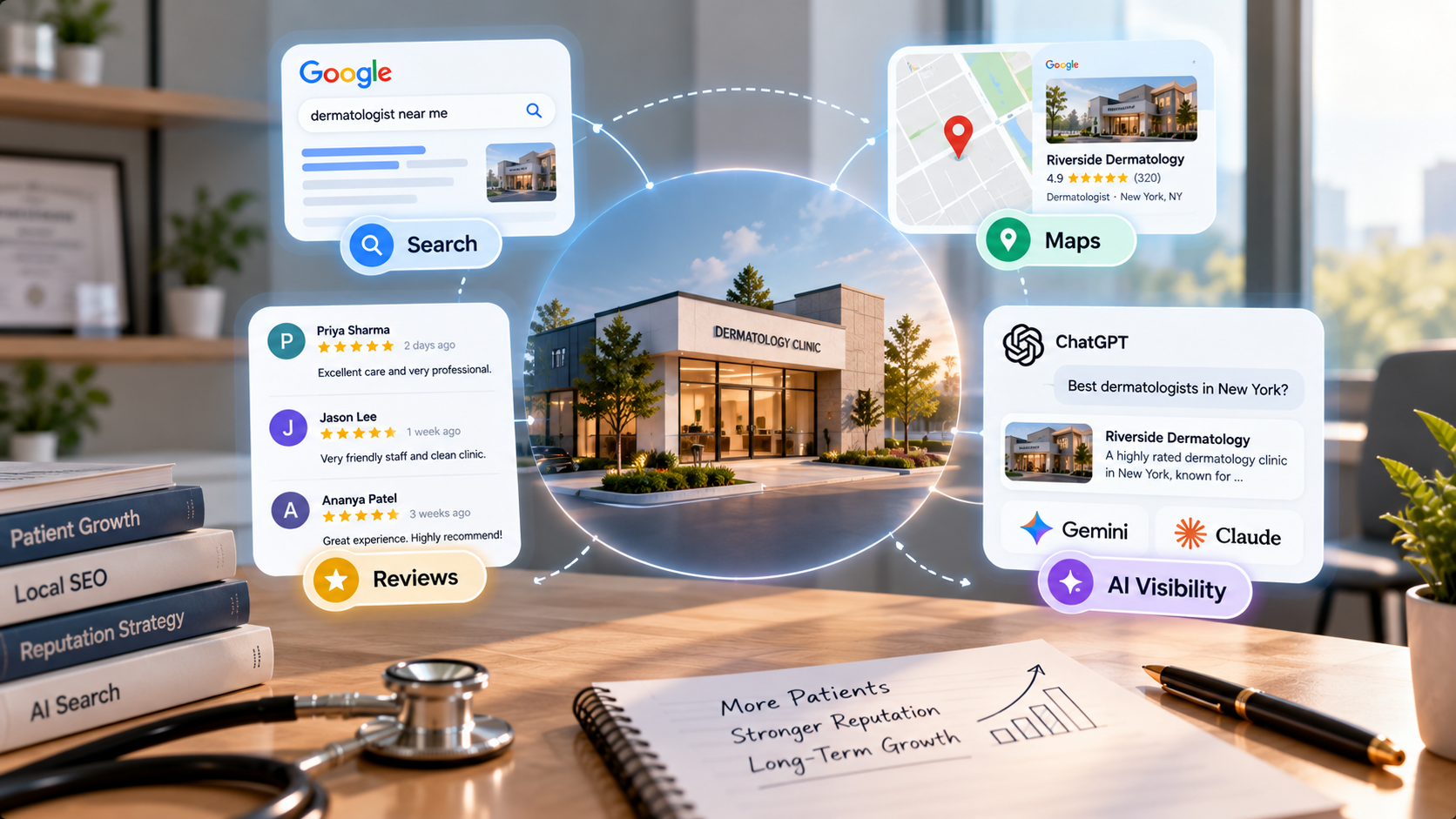
Review monitoring for doctors means checking new reviews, rating changes, response times, and competitor activity on a fixed weekly schedule, not whenever you happen to remember. Most practices treat reviews as a once-a-quarter chore. They log in, skim the last few comments, maybe reply to one, and move on. That gap between what patients are saying right now and what the practice actually sees is where visibility quietly erodes.
Patients research before they book. 82% of patients research their doctor online before booking, and 72% of patients trust online reviews as much as personal recommendations from friends or family. That means your review profile is doing sales work every single day, whether anyone at the practice is watching it or not. A single unanswered negative review sitting at the top of your Google Business Profile for three weeks does more damage than most practices realize, simply because nobody checked.
This article covers what monitoring actually means beyond collecting reviews, what to track each week, how often is often enough, and what tends to happen when nobody is watching. It ends with a practical weekly checklist you can start using today.
What "Monitoring" Means Beyond Just Getting Reviews
Getting reviews and monitoring reviews are two different jobs, and most practices only do the first one. Getting reviews is about asking patients to leave feedback after a visit. Monitoring is about what happens after that review is posted.
A lot of practices invest time and money in actually getting more reviews, then never look at the review profile again until a patient mentions something they saw online. That's the workflow gap. Reviews accumulate, ratings drift up or down, and nobody at the practice notices until it shows up as fewer new patient calls.
Monitoring closes that gap. It means someone at the practice, or a system working on the practice's behalf, checks the same core signals on a fixed schedule. Not "whenever there's time." A schedule. Without one, review management becomes reactive: you only find out about a problem after a patient walks in referencing a one-star review from six weeks ago.
This is also different from managing your reputation day to day, which covers the broader set of decisions around how a practice responds to feedback, sets tone, and builds trust over time. Monitoring is the input to those decisions. You cannot manage what you have not tracked.
What to Actually Track Every Week
A monitoring routine only works if it covers a small, consistent set of signals. Here is what matters most.
New reviews. Check every platform where patients can leave a review, not just Google. A new review sitting unread for two weeks is a missed chance to respond while it's still relevant, and an unanswered negative review left in place signals to future patients that nobody is paying attention.
Rating trend. A single review does not tell you much. The trend across the last 30, 60, and 90 days does. A practice with 4.8 stars that is quietly sliding toward 4.5 has a different problem than one holding steady, even if today's snapshot looks fine.
Response time. How long between a review posting and someone from the practice replying. Fast, thoughtful responses to both positive and negative reviews show patients the practice is actively engaged. Slow or missing responses read as neglect, even when the care itself was excellent.
Review volume by source. Track where reviews are coming from, Google Business Profile, Healthgrades, Facebook, and any other platform relevant to the specialty. A practice with 50+ reviews ranks significantly higher than one with under 10, and volume matters as much as the average score.
Competitor review counts. Patients comparing two doctors in the same area often default to whoever has more reviews and a stronger recent rating. If a nearby competitor's review count is climbing faster than yours, that is worth knowing before it shows up in lost bookings, not after.
How Often Is Often Enough
Weekly is the minimum cadence that keeps a practice ahead of problems instead of reacting to them. Monthly checks leave too much room for a bad review, a rating dip, or a competitor's surge to go unnoticed for four or more weeks, which is long enough to affect real booking decisions.
Daily monitoring is unnecessary for most solo and small group practices. It adds effort without adding much benefit, since review activity for most practices does not move fast enough to justify checking every single day. Weekly hits the right balance: frequent enough to catch problems early, infrequent enough to stay sustainable as a habit.
Larger practices or those with multiple locations may need a tighter cadence, since review volume and competitive pressure both scale with patient volume. The principle stays the same regardless of size: pick a fixed day, check the same signals, every time.
What Happens When You Don't Monitor
Consider a practice that reviews its Google Business Profile once a quarter. A patient leaves a two-star review describing a long wait and a rushed appointment. Nobody responds, because nobody sees it until the next quarterly check-in, ten weeks later.
In the meantime, that review sits at or near the top of the profile, since it's recent and unanswered. Prospective patients researching the practice, remember, 82% of patients research their doctor online before booking, see a fresh complaint with no reply. Some choose a different doctor instead. The practice never finds out why fewer new patients called that month, because the cause was invisible without regular tracking.
Meanwhile, a competitor two blocks away has been collecting five new reviews a month and responding to each one within a few days. Over a quarter, that gap in review count and responsiveness compounds. By the time the original practice notices its rating has slipped, the competitor already has the volume and the trend on its side.
None of this required a crisis. It just required nobody watching for ten weeks.
The Weekly Review Monitoring Checklist
Use this each week, on the same day, so it becomes routine rather than something you remember to do only when a patient brings it up.
- Check all review platforms for new reviews since the last check, including Google Business Profile, Healthgrades, Facebook, and any specialty-specific directories.
- Read every new review in full before responding, including the ones that look routine.
- Reply to new reviews, positive and negative, within a few days of posting.
- Note the current overall rating and compare it to last week's number.
- Log total review count and compare the week-over-week change.
- Check response time on any reviews still awaiting a reply from a previous week.
- Look up one or two local competitors and note their current review count and rating.
- Flag any review that mentions a specific, addressable issue, wait times, billing, communication, for the practice to discuss internally.
- Confirm the Google Business Profile listing itself is still accurate, hours, phone number, and address, since incorrect listing details often surface first in reviews.
Conclusion
Review monitoring is not a one-time project. It's a weekly habit that keeps a practice ahead of problems instead of discovering them after a patient mentions it in the exam room. Checking new reviews, rating trends, response times, and competitor counts every week takes a fraction of the time a quarterly scramble does, and it catches issues while they're still small.
The practices that stay visible are the ones that treat this as routine, not as a reaction to a bad week.
Start your weekly Monitor ($49/month) and get a weekly visibility monitor that tracks new reviews, rating trends, and competitor shifts automatically, so nothing sits unnoticed for ten weeks.
By the The Doc Mirror team
Internal Links
| Target Page | Anchor Text Used | Reason |
|---|---|---|
/resources/doctor-online-reputation |
"managing your reputation day to day" | Links the narrower weekly-monitoring workflow described in this article to the broader reputation management hub, positioning monitoring as the input data that feeds day-to-day reputation decisions. Placed in the "What Monitoring Means Beyond Just Getting Reviews" section to clarify the distinction between the two topics. |
/resources/get-more-google-reviews-doctors |
"actually getting more reviews" | Distinguishes acquisition (getting reviews) from tracking (monitoring reviews), the core conceptual split this article is built around. Placed early in the "What Monitoring Means" section so readers understand this page is not a duplicate of the review-acquisition content. |
/resources/best-review-tools-for-doctors |
"the tools that can track this automatically" | Referenced in the FAQ answer on whether monitoring can be automated, pointing readers who want a tool comparison to the dedicated tools page rather than duplicating that content here. |
/monitor |
"a weekly visibility monitor" | Product CTA link placed in the closing CTA paragraph alongside the "Start your weekly Monitor ($49/month)" phrasing, converting readers who now understand the weekly-tracking gap into Monitor trial or signup traffic. |