Entity SEO for Doctors: How to Make AI Recognize Who You Are
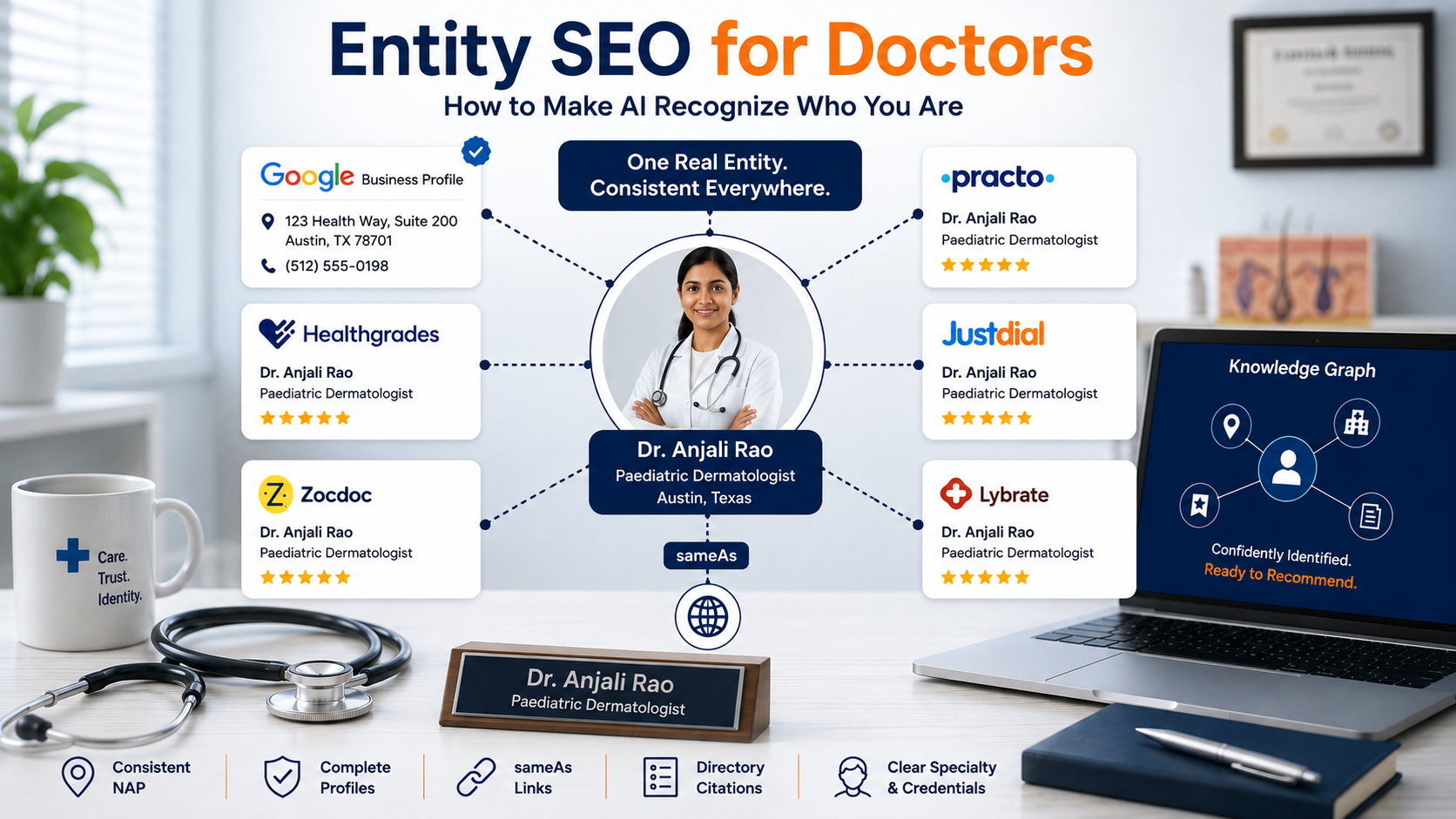
Entity SEO for doctors is the work of making AI and search engines recognise you as one specific, real practice rather than a scatter of unlinked mentions. Before ChatGPT or Google can recommend Dr. Anjali Rao, it has to be certain who she is: the same person across every profile, at one verified address, with one clear specialty. When your identity is consistent and connected, machines file you as a confident "entity" and surface you by name. When it is fragmented, they hedge, blur you with a namesake, or leave you out.
What is entity SEO for doctors
An entity is a distinct, real thing that a knowledge system can identify and describe with confidence: a person, a clinic, a place. Entity SEO is the practice of making your identity so consistent and well-linked that AI models and Google's Knowledge Graph resolve you to a single, unambiguous record.
The Knowledge Graph is Google's internal database of entities and how they relate. AI assistants lean on similar structured knowledge to decide who is real, who is credible, and who to name. Entity SEO is the recognition layer beneath everything else. It sits apart from your schema markup, which is the code that describes you, and from your directory citations, which are the depth of your footprint. This post is about identity: making sure every system agrees on who you are.
Why AI has to recognise you before it can recommend you
Patients now ask AI who they should see. About 1 in 3 US adults have used AI chatbots for health information, and in the rater8 2025 patient-choice report, 26% of patients said an AI tool influenced their choice of provider. An assistant will only put your name in that answer if it is sure the name maps to a real, verifiable practice.
Recognition is a confidence threshold. A cardiologist in Denver with matching details everywhere reads as one trusted entity. The same cardiologist whose name appears at three slightly different addresses reads as noise, and the safe move for the model is to name someone else. The same logic runs across ChatGPT, Gemini, Claude, and Perplexity, which is why entity work is foundational to your broader AI visibility.
The building blocks of a recognisable medical entity
AI entity recognition is built from a small set of signals that must agree with each other. Get these consistent and you move from "maybe real" to "confidently identified."
- One exact NAP. Your Name, Address, and Phone number must be byte-for-byte identical everywhere. "Suite 200" in one place and "Ste. 2" in another reads as two different locations.
- A claimed, complete Google Business Profile. This is the anchor record for your practice. Claim it, verify it, and fill every field: category, hours, services, and photos.
- sameAs links. These are the connective tissue that tells search engines "all of these profiles are the same entity." They point from your website to your authoritative profiles.
- Matching directory profiles. Your listing on Healthgrades, Zocdoc, and Vitals in the US, or Practo, JustDial, and Lybrate in India, should mirror your primary details exactly.
- A clear, single specialty statement. Describe yourself the same way across every surface: "paediatric dermatologist," not "dermatologist" here and "skin specialist" there.
- Consistent naming. Decide on one form of your name and credentials, then use it everywhere without variation.
How to connect your profiles with sameAs links
The sameAs property is the single most useful entity signal most doctors have never heard of. It lives inside your website's structured data and lists the URLs of every profile that represents the same real you. It is how you tell a machine that your website, your Google Business Profile, your Healthgrades page, and your hospital bio all describe one person.
To build it well, do this in order:
- List your authoritative profiles: your Google Business Profile, your primary directory listings, your hospital or group page, and any professional-body listing.
- Confirm each of those profiles uses your exact NAP and specialty.
- Add a
sameAsarray to your Physician or MedicalClinic schema that links out to each one. The medical schema markup guide covers the code itself. - Make sure each linked profile, where possible, links back toward your site so the connection is mutual.
Google's own documentation notes that no special markup is required to appear in AI features, so treat schema as clarification, not a magic switch. The recognition comes from the details agreeing. The markup just makes agreement legible.
What most doctors get wrong about entity identity
The common failure is not neglect. It is drift. A busy gynaecologist in Pune builds a website, claims a Practo profile, gets listed by her hospital, and updates a Google Business Profile over five years, each filled in slightly differently. Every small mismatch is a reason for a machine to lower its confidence.
Three patterns cause most of the damage:
- Address variants after a move or a new suite. Old addresses linger on directories and split your identity in two.
- Name and credential inconsistency. "Dr. A. Rao," "Dr. Anjali Rao, MD," and "Anjali Rao" can read as up to three people.
- An unclaimed Google Business Profile. If you have not claimed it, you cannot control the anchor record, and anyone can suggest edits.
None of this is about advertising. For a doctor in India working under NMC rules, this is purely making existing, factual information consistent and findable, not self-promotion. Fixing drift is housekeeping, and it is the highest-leverage housekeeping you can do.
How to disambiguate yourself from doctors with the same name
Shared names are common in medicine, and AI genuinely struggles with them. There may be four physicians named Dr. Sharma in Delhi and several Dr. Patels across Ahmedabad and Austin. If the model cannot tell you apart, it will either merge you or skip all of you.
You disambiguate by adding stable, distinguishing attributes and keeping them consistent:
- Always pair your name with your specialty and your city: "Dr. Priya Sharma, endocrinologist, Bengaluru."
- Anchor yourself to a unique, verified address and one primary phone number.
- Use a consistent clinic or practice name that only you use.
- Where a professional registry ID exists, cite it consistently, because a unique identifier is the cleanest possible signal.
Every one of these gives the model a distinguishing feature to lock onto. The goal is to make your combination of attributes unique even when your name is not.
How a doctor Knowledge Panel gets built
A Knowledge Panel is the boxed profile that appears beside search results when Google is confident an entity is real and notable. You cannot buy one or directly create one. It is generated when the Knowledge Graph has enough consistent, corroborated information to trust the entity.
To improve your odds:
- Get the entity basics right first: NAP, a claimed Google Business Profile, and matching directories.
- Earn corroboration from sources Google already trusts, such as a hospital staff page, a medical-board listing, or reputable directories.
- Keep your specialty, name, and location identical across all of them.
- If a panel appears, verify it through Google and correct any errors.
A knowledge graph for doctors rewards agreement over volume. Ten profiles that match beat 30 that conflict. This is the identity layer of E-E-A-T, which stands for Experience, Expertise, Authoritativeness, and Trust, and it is what makes GEO, or Generative Engine Optimization, and AEO, or Answer Engine Optimization, actually work for you.
Where to start
Entity SEO is not glamorous, but it is the reason an AI names you instead of the cardiologist two suites down. The fix is consistency: one name, one address, one specialty, connected everywhere and claimed at the source. Once machines are certain who you are, every other piece of your visibility starts to compound.
The fastest way to see where your identity is drifting is to look at it the way a machine does. The Free Audit runs your practice across Google, ChatGPT, Gemini, Claude, Perplexity, and 6 directories, scores you on the 7 pillars to give you a visibility score out of 100, and shows which gaps to close first. [Replace with your real audit figure before publishing.]
Run your free audit at thedocmirror.com
By the The Doc Mirror team