Healthgrades, Zocdoc, Vitals: Which Actually Drives Patients?
Zocdoc drives the most direct bookings because patients use it to schedule an appointment on the spot, while Healthgrades and Vitals drive more research-stage visibility, patients comparing doctors before they choose. If you want new patients booking now and you can support online scheduling, Zocdoc is the strongest direct-response channel of the three; if you want to be found and trusted while patients compare options, Healthgrades has the widest reach and Vitals adds another consistent citation. But the more important truth is that all three feed the same signal Google and AI rely on, so a consistent, claimed listing on each matters more than picking a single winner. This guide compares what each platform actually does and how to decide where to spend effort.
For most independent practices this is not an either-or. The question is which to prioritize, and how to make sure that whichever you use is not quietly working against you with wrong details.
What each platform is for
The three sit at different points in how a patient chooses a doctor.
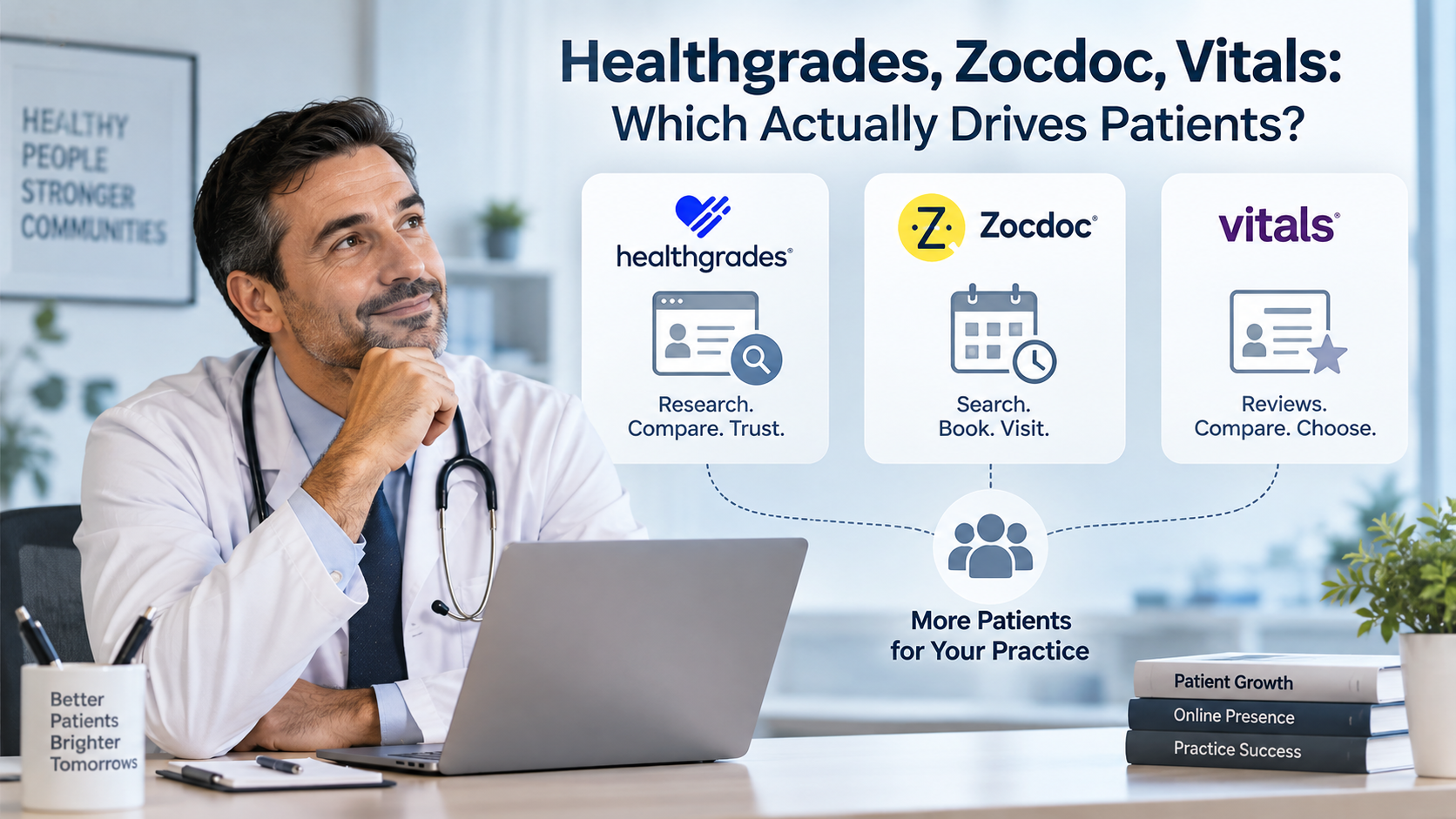
- Zocdoc is a booking marketplace. Patients search by insurance, specialty, and availability, then book an appointment directly, often for a specific open slot. It is transactional and closest to a booking. Zocdoc typically charges providers, historically on a subscription or per-booking basis, so it is a paid channel with a clearer line to new appointments.
- Healthgrades is the largest doctor-research destination. Patients use it to look up credentials, read reviews, check background and hospital affiliations, and compare providers. Its reach is broad, and a strong Healthgrades profile influences the research stage even when the booking happens elsewhere. A basic listing is free, with paid options for practices.
- Vitals is another research and reviews directory in the same family of comparison sites. Its independent traffic is smaller than Healthgrades', but it remains a recognized citation source that reinforces your details across the web.
Read simply: Zocdoc for the booking, Healthgrades for the research and reach, Vitals for the additional consistent citation.
Which drives patients
If "drives patients" means booked appointments this month, Zocdoc is the most direct, because the patient's intent on the platform is to book, and the flow ends in a scheduled visit. The trade-off is cost and the need to support online scheduling and keep availability current.
If "drives patients" means being found, trusted, and shortlisted, Healthgrades has the broadest research reach of the three, and it often appears high in Google results for a doctor's name, so it shapes the impression a patient forms before they ever reach your website. Vitals contributes less independent traffic but still adds a trusted, consistent record.
There is no single answer for every practice. A specialist with limited slots and strong word of mouth may get more from Healthgrades reach than from Zocdoc volume, while a growing primary-care practice with open availability may find Zocdoc fills the schedule. Match the channel to whether your constraint is being found or being booked.
The point most doctors miss: they all feed the same trust signal
Whichever you choose, every one of these listings is a citation, a place your name, address, and phone appear that Google and AI systems cross-check to confirm you are a real, stable practice. That makes consistency across them more valuable than the platform you favor. A claimed, accurate Healthgrades, Zocdoc, and Vitals listing, all matching your Google Business Profile exactly, strengthens your local prominence regardless of which one a given patient clicks.
The reverse is the hidden cost. An unclaimed or stale listing with an old address or a disconnected phone does not just fail to help; it actively conflicts with your other records and drags on your ranking. Reconciling these is the job of a NAP audit, and it is why claiming each profile matters even if you never pay for the premium tier.
How to prioritize your directories
A practical order for an independent practice:
- Claim and verify all three, even the free tiers. Claiming lets you control the details and correct mismatches.
- Make every listing match your canonical name, address, and phone exactly. Consistency first, features second.
- Invest in the channel that fits your constraint. If you need bookings and can support scheduling, prioritize Zocdoc. If you need reach and reputation, prioritize a strong Healthgrades profile with complete credentials and reviews.
- Keep them current. Update hours, insurance, and availability when they change, since a wrong detail on a high-traffic directory costs you a patient directly.
What most doctors get wrong about directories
Two mistakes are common. The first is treating directories as a paid-versus-free decision and ignoring the free listings, which leaves unclaimed profiles with wrong details working against them. The second is chasing every directory at once, spreading thin instead of getting the core three claimed, consistent, and complete. Claim the important ones, make them agree with your Google listing, then decide where a paid tier earns its keep.
A note on AI: directories are where AI reads about you
For AI answers, directories carry outsized weight. When a patient asks ChatGPT, Gemini, Claude, or Perplexity for a doctor, those tools name one to three practices drawing on directory data and how consistently a practice appears across trusted sources. Healthgrades, Zocdoc, and Vitals are exactly the kind of recognized sources these systems weigh, so a consistent, claimed presence on them makes you easier for an AI assistant to identify and name, while conflicting listings make you easier to skip.
Sort out your directories this week
An hour gets the foundation right.
- Search your name and confirm you have a Healthgrades, Zocdoc, and Vitals listing, claimed or not.
- Claim each one you can, even the free tier.
- Make all three match your canonical name, address, and phone, and fix any mismatch.
- Decide your priority channel based on your constraint: Zocdoc for bookings, Healthgrades for reach.
If you want to see which directories list you and where the details conflict, the Free Audit at thedocmirror.com checks your directory consistency alongside your Google Business Profile and compares you to local competitors, in about 90 seconds with no signup for the free score.