AEO vs SEO vs GEO: What Every Doctor Needs to Know
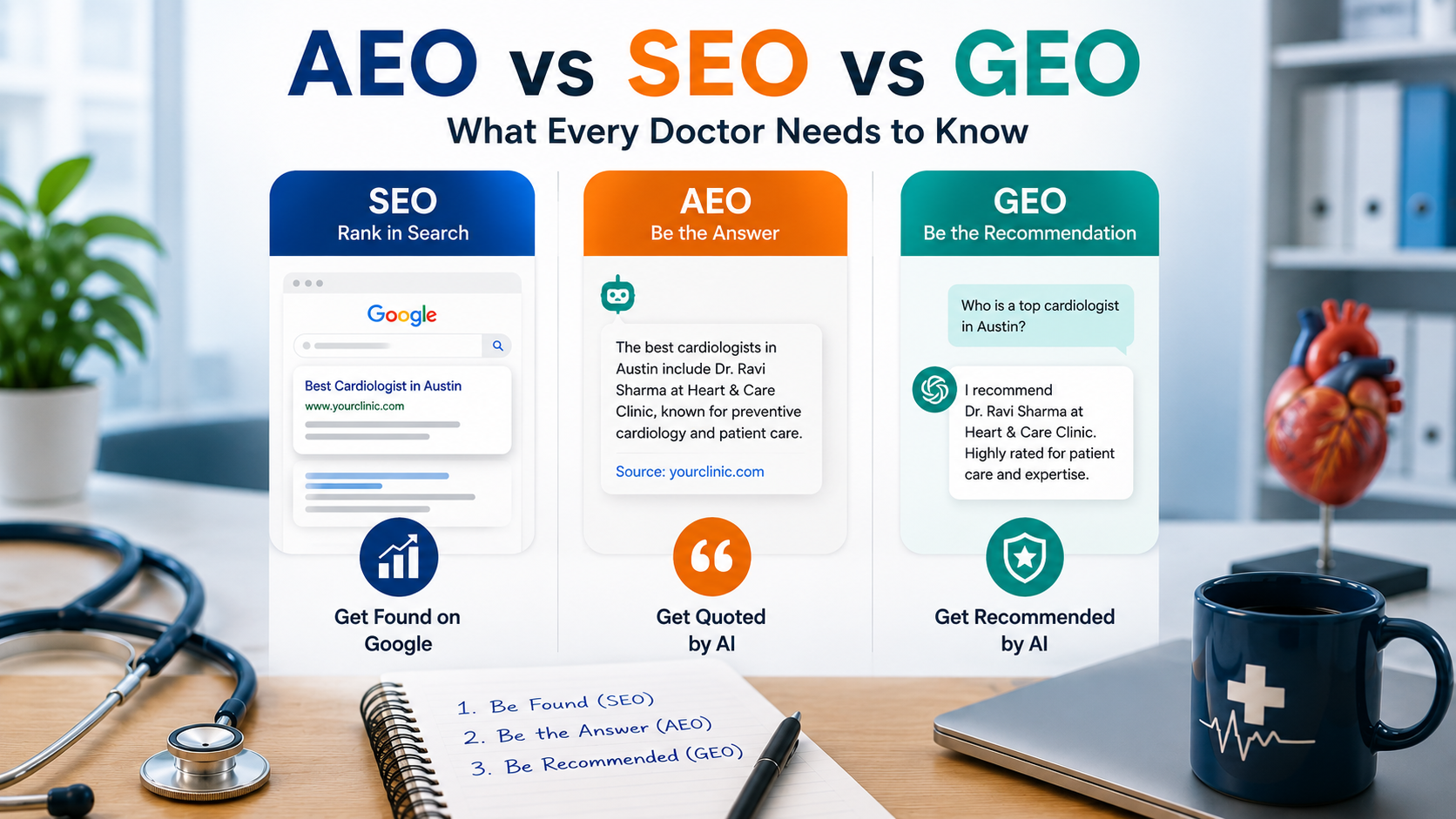
The difference in one line: SEO gets you ranked in Google's links, AEO structures your content so AI can extract and quote it, and GEO builds the authority that makes AI models recommend you at all. That is the whole of aeo vs seo vs geo in a sentence. All three decide whether a patient in Austin or Mumbai finds you, but they work on different surfaces. SEO fights for a spot on the results page. AEO and GEO decide what ChatGPT, Gemini, Claude, and Perplexity say when a patient asks for a good doctor nearby.
What is the difference between AEO, GEO, and SEO
Three acronyms, three jobs. Here is the clean definition of each.
- SEO (Search Engine Optimization): getting your website and Google Business Profile to rank in Google's traditional results, including the blue links and the local map pack. The goal is a click.
- AEO (Answer Engine Optimization): structuring your content, headings, and facts so an answer engine can lift a direct, correct answer and attribute it to you. The goal is to be quoted.
- GEO (Generative Engine Optimization): building enough consistent authority and citations across the web that generative AI models name you when a patient asks for a recommendation. The goal is to be recommended.
SEO answers "will Google show my page?" AEO answers "can an AI pull a clean answer from my page?" GEO answers "will an AI mention me when no page is even open?"
How AEO vs SEO actually differ
SEO and AEO both start with your content, but they optimize for different readers. SEO optimizes for a ranking algorithm that returns links for a human to click. AEO optimizes for an extraction step, where a model decides whether one passage is clean, factual, and quotable enough to use as the answer.
A cardiologist in Denver can rank on page one of Google and still lose the AI answer, because the winning page had a clear definition, a direct first sentence, and a structured FAQ. That is the heart of seo vs ai search. When a patient in Pune types a question into ChatGPT instead of Google, the ranked link never gets seen. Only the well-structured answer does.
How GEO vs SEO actually differ
GEO and SEO differ even more sharply. SEO is page-level and keyword-driven. GEO is entity-level and authority-driven. A generative model does not "rank" you on a page. It has learned, from patterns across the web, which names it associates with "trusted gynaecologist in Bengaluru" or "top dermatologist in New York."
That association is built from consistency. Your name, specialty, and clinic details repeated identically across Practo, JustDial, and Apollo 247 in India, or Healthgrades, Zocdoc, and Vitals in the US, teach the model who you are. A Princeton, Georgia Tech, Allen Institute for AI, and IIT Delhi study found the right content and citation choices can raise how often a source is cited in AI answers by up to 40%. GEO is closer to reputation than to ranking.
AEO vs SEO vs GEO: the comparison table
| Dimension | SEO | AEO | GEO |
|---|---|---|---|
| Core goal | Rank in Google links and local map | Get your answer extracted and quoted | Get recommended by AI models |
| Optimizes for | Ranking algorithm | Answer-extraction step | Model's learned authority |
| Level | Page and profile | Passage and structure | Entity and reputation |
| Main surface | Google results page | ChatGPT, Gemini, Claude, Perplexity, AI Overviews | ChatGPT, Gemini, Claude, Perplexity |
| Key lever | Keywords, links, Google Business Profile | Clear definitions, FAQs, schema | Consistent citations, reviews, E-E-A-T |
| Success looks like | A click | A quote | A recommendation |
E-E-A-T here means Experience, Expertise, Authoritativeness, Trust, the signal quality that both AEO and GEO lean on.
Where the three overlap
These are not three walled gardens. They share a foundation, and work you do for one often helps the others.
- Accurate, consistent facts feed all three. The same clean name, address, and specialty that lift local SEO also anchor your GEO entity and give AEO something safe to quote.
- A well-structured page ranks in SEO and gets extracted in AEO. Clear headings and FAQs serve both the algorithm and the model.
- Reviews and citations improve local SEO and build the authority GEO depends on.
So a doctor is rarely choosing one instead of another. The Google Search documentation even notes that no special markup is required to appear in AI features, which means the clean, factual structure you already build for patients is doing double duty.
What most doctors get wrong
The common mistake is treating this as a sequence, where you "finish SEO" and then move to AI. That is the wrong model. A dermatologist can hold the number-one Google spot and still be invisible inside ChatGPT, because visibility now lives on two separate surfaces at once.
The rater8 2025 patient-choice report found 26% of patients said an AI tool influenced their choice of provider. A KFF poll found about 1 in 3 US adults have used AI chatbots for health information. Those patients never see your Google ranking. If your AEO and GEO are weak, you are absent from the moment they decide. See why Google rank alone no longer wins in AI search.
Which should a doctor prioritise first, and why
Fix the foundation first, then structure, then authority. This order works for most practices.
- Start with the SEO and citation base. Claim your Google Business Profile and make your name, specialty, and clinic details identical across every directory. In the US that means Healthgrades, Zocdoc, Vitals, and WebMD. In India it means Practo, JustDial, Lybrate, and Apollo 247. This one step serves all three at once.
- Layer AEO onto your key pages. Add clear definitions, question-style headings, and an FAQ so answer engines can quote you cleanly. See how AEO works for doctors.
- Build GEO authority over time. Earn reviews, keep citations consistent, and reinforce your E-E-A-T signals. See how GEO builds AI recommendations.
For an Indian doctor, all three are accuracy work, not advertising. Making your existing, factual information consistent and findable is compatible with NMC rules. You are not soliciting patients. You are making sure the correct information about you is the information AI repeats.
See where you stand on all three
You cannot fix what you cannot see. Most doctors have never checked whether ChatGPT, Gemini, Claude, or Perplexity mention them at all, let alone whether their content is structured to be quoted. That blind spot is what an audit closes.
The Doc Mirror Free Audit runs your name across Google, ChatGPT, Gemini, Claude, Perplexity, and 6 directories, scores your AI visibility on the 7 pillars, and shows which gaps to close first, whether they are SEO, AEO, or GEO. It takes about 90 seconds and costs nothing.
Run your free audit at thedocmirror.com
By the The Doc Mirror team