AI Search for Doctors in India: Why a Practo Profile Alone Isn't Enough Anymore
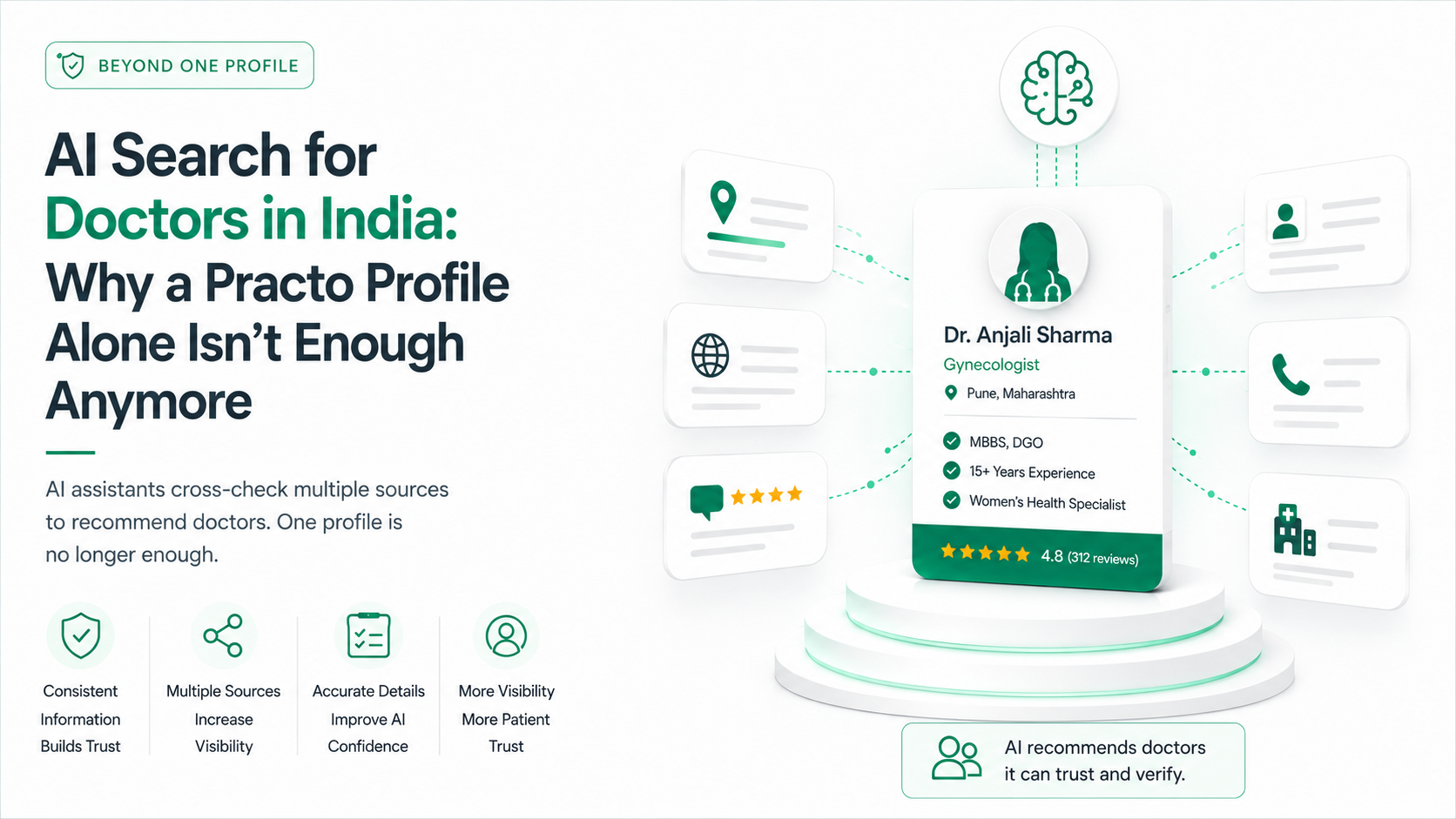
AI search for doctors in India now decides who gets named by cross-checking many sources at once, so a single Practo profile no longer carries you. When a patient in Mumbai or Bengaluru asks ChatGPT, Gemini, Claude, or Perplexity for a good paediatrician nearby, the assistant does not read one directory. It weighs whether your name, clinic, address, and specialty agree across Google, your website, and multiple listings. One thin profile reads as one weak signal. Consistent information across sources reads as a real, recommendable practice.
What is AI search for doctors in India
AI search is when a patient asks a conversational assistant a question and receives a direct, synthesised answer instead of a page of blue links. Ask ChatGPT for a "good gynaecologist in Pune with evening hours" and it returns a short list with reasons, not ten tabs to compare.
These assistants do not pull from one database. They corroborate. They look for the same practice described the same way across several independent sources, then name the ones they are confident are real. This is why AI visibility for Indian doctors is no longer the same task as ranking on a directory. It is about being consistently identifiable everywhere a machine might check. For the wider picture, see our overview of AI visibility for doctors.
Why one Practo profile is no longer enough
For years, an Indian clinic could treat a single Practo, JustDial, Lybrate, or Apollo 247 listing as its entire online presence. That worked when patients searched inside one platform. It does not work when an AI assistant is answering the question, because the assistant is not looking inside Practo. It is looking across the whole web and asking a different question: do multiple trustworthy sources agree that this doctor exists, at this address, in this specialty?
A lone directory profile answers that question weakly. It is one source saying one thing, with nothing to corroborate it. Consider what a machine sees:
- A single source is a single point of failure. If your one profile has an outdated address or old hours, the model has no second source to correct it against.
- No corroboration means low confidence. Assistants hedge when only one place mentions you. They prefer to name a doctor confirmed by three or four aligned sources.
- Patients now start outside the directory. When the first question is asked to ChatGPT, the directory is no longer the front door.
None of this means abandoning Practo. It means your Practo profile should be one of several sources that all say the same true thing about you.
How AI assistants actually choose which doctor to name
The mechanism is corroboration, and understanding it removes the guesswork. An assistant builds confidence the way a careful colleague would: by checking whether independent sources tell a consistent story. This is the practical reality behind how ChatGPT chooses doctors.
A dermatologist in Hyderabad whose name, clinic, address, and specialty match exactly across a claimed Google Business Profile, a website, and two directories reads as one confident, real entity. One whose details differ slightly from listing to listing reads as noise, and the safe move for the model is to name someone clearer instead.
The signals an assistant weighs most heavily are simple:
- Consistent identity. The same name, address, and phone number, written the same way everywhere.
- A claimed, complete Google Business Profile. This is the anchor record most AI systems and Google's AI features lean on.
- A clear website that states who you are. Specialty, location, services, and qualifications in plain language a machine can read.
- Corroborating directory listings. Practo, JustDial, Lybrate, or Apollo 247 profiles that mirror your primary details exactly.
- Structured, factual content. Answers to common patient questions written the way patients actually ask them.
Practo vs AI search: two different questions
It helps to see Practo and AI search as answering two different questions rather than competing. In the practo vs ai search comparison, the directory answers "who is listed on this platform," while the assistant answers "who is real and recommendable across the whole web." You want to do well at both, but the second increasingly decides what a patient hears first.
A useful way to hold this: your Practo profile is a source, not the whole story. The mistake is treating it as the finish line rather than one line in a chorus that needs to sing the same note. When your directory listing, your Google Business Profile, and your website all state the identical, factual details, each one strengthens the others in the eyes of an assistant.
What most Indian doctors get wrong here
The common error is not laziness. It is drift, and it accumulates quietly over years. A busy physician in Chennai claims a Practo profile in 2019, updates a Google Business Profile after moving to a new suite, and lets an old JustDial listing sit untouched. Each was filled in slightly differently. Every mismatch is a reason for a machine to lower its confidence.
Three patterns cause most of the damage:
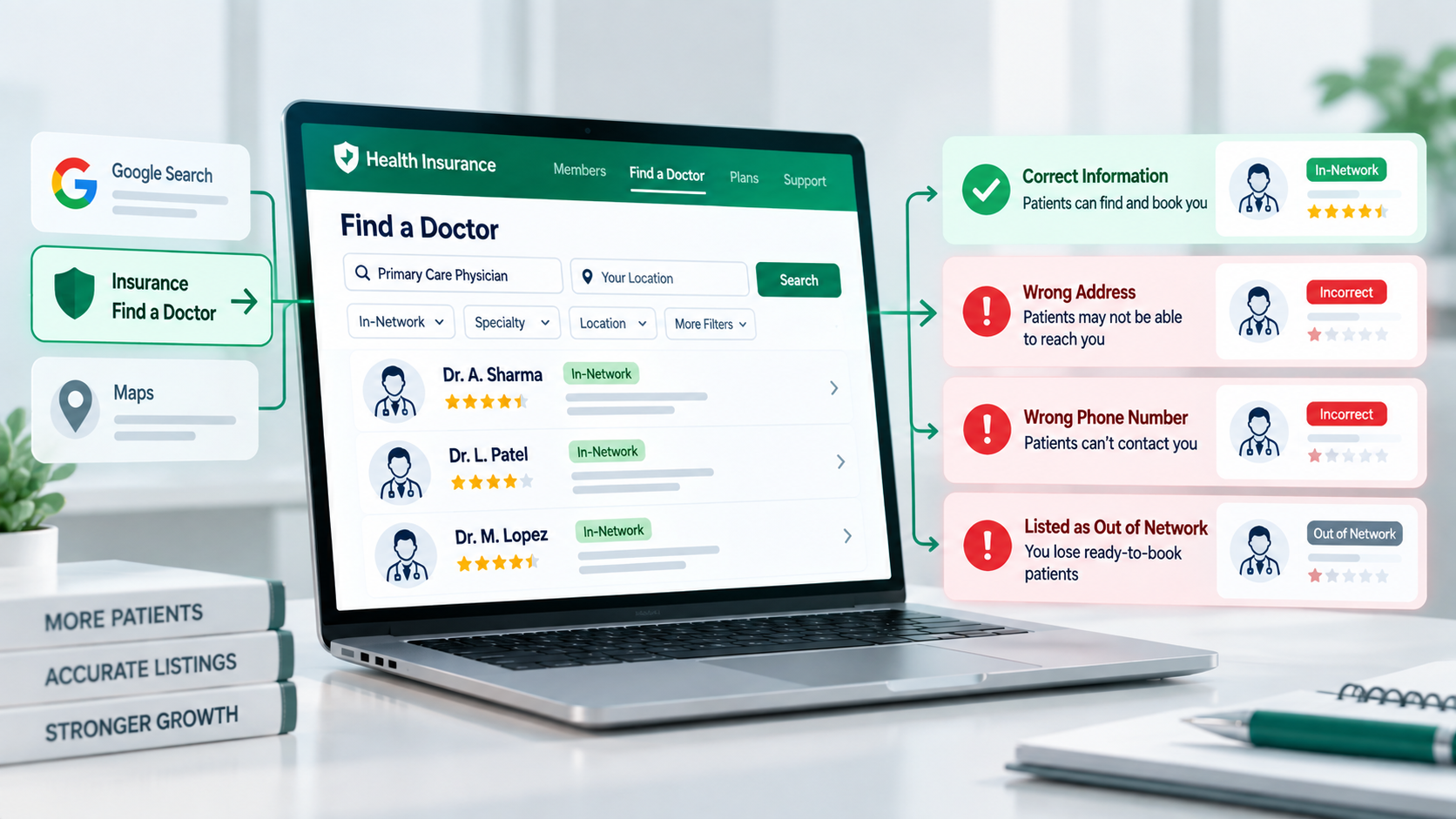
- Address variants after a move. The old address lingers on one directory while the new one sits on another, splitting your identity in two.
- Name and credential inconsistency. "Dr. A. Rao," "Dr. Anjali Rao, MD," and "Anjali Rao" can read as up to three different people.
- An unclaimed or thin Google Business Profile. If you have not claimed it, you cannot keep the anchor record accurate, and gaps stay unfilled.
This is worth stating plainly for anyone practising under NMC guidance. Fixing drift is not advertising and it is not soliciting patients. It is making your existing, factual information consistent and findable, which is ordinary professional housekeeping. You are correcting the record, not promoting yourself.
Staying compliant while becoming findable
Doctors in India operate under National Medical Commission rules that restrict self-promotion and solicitation. That constraint is real, and it shapes this work. The good news is that everything genuinely useful here sits comfortably inside those rules, because accuracy is not advertising.
Keep the frame simple and you stay on the right side of it:
- Correct facts, do not make claims. State your qualifications, specialty, address, and hours accurately. Avoid superlatives and comparative claims about being the best.
- Make information consistent, do not solicit. Aligning your address across listings is record-keeping. Asking patients to post reviews or advertising services is not the goal here.
- Describe, do not persuade. A plain description of what your clinic does and where it is helps a machine identify you without crossing into promotion.
Framed this way, digital visibility for doctors in India becomes a compliance-safe activity. You are ensuring that when a patient looks, what they find is correct and consistent.
A practical checklist to become findable across sources
Here is a compliance-safe sequence for an Indian clinic that wants its accurate information to be consistent and discoverable. None of these steps involves advertising or soliciting.
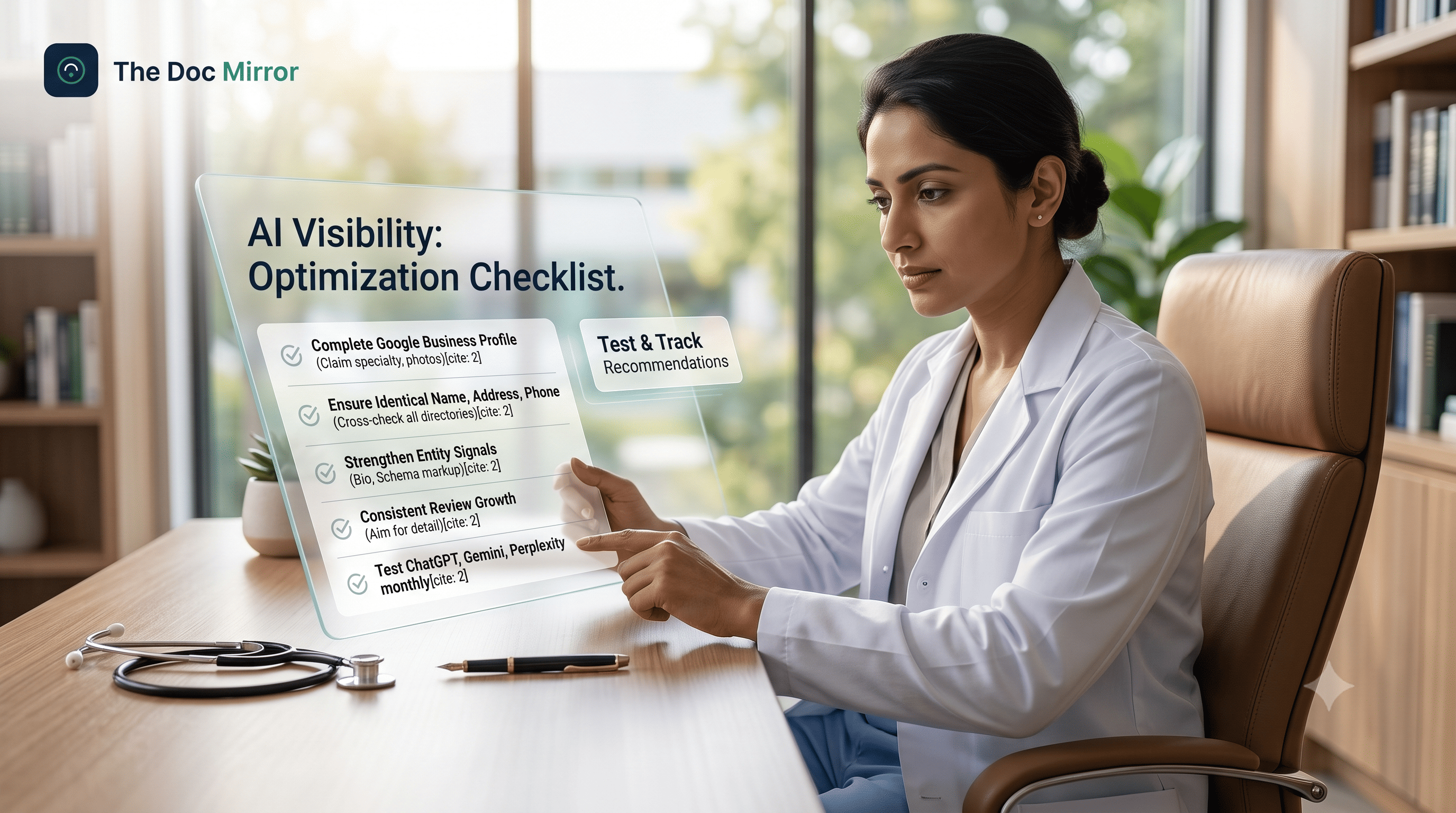
- Claim and complete your Google Business Profile. Verify it, then fill every factual field: specialty category, address, hours, and phone number. This is your anchor record.
- Write down one canonical version of your details. Fix the exact spelling of your name, credentials, clinic name, and address, then use it everywhere without variation.
- Update your existing directory profiles to match. Bring Practo, JustDial, Lybrate, and Apollo 247 into line with your canonical details. Accuracy, not volume, is the aim.
- Make your website state the basics clearly. Name your specialty, city, services, and qualifications in plain language a machine can read.
- Answer common patient questions factually. A short, honest FAQ that mirrors how patients ask helps assistants quote you correctly.
- Check what the machines currently say. See how you appear across ChatGPT, Gemini, Claude, and Perplexity today, then close the gaps that matter most.
Research on generative engine optimization, GEO, from Princeton, Georgia Tech, the Allen Institute for AI, and IIT Delhi found that clearer, well-structured content can raise how often an AI answer cites a source by up to 40%. Structure and consistency are not cosmetic. They change whether you get named.
Where to start
A single Practo profile was enough when patients searched inside one app. It is not enough when an assistant answers the question by cross-checking the whole web. The fix is not advertising and it does not strain against NMC rules. It is making your accurate, existing information consistent and discoverable, so that when a machine checks, every source agrees on who you are and where you practise.
The fastest way to see where your information disagrees with itself is to look at it the way an assistant does. The Free Audit runs your practice across Google, ChatGPT, Gemini, Claude, Perplexity, and 6 directories, scores you on the 7 pillars to give you a visibility score out of 100, and shows which gaps to close first. [Replace with your real audit figure before publishing.]
Run your free audit at thedocmirror.com
By the The Doc Mirror team