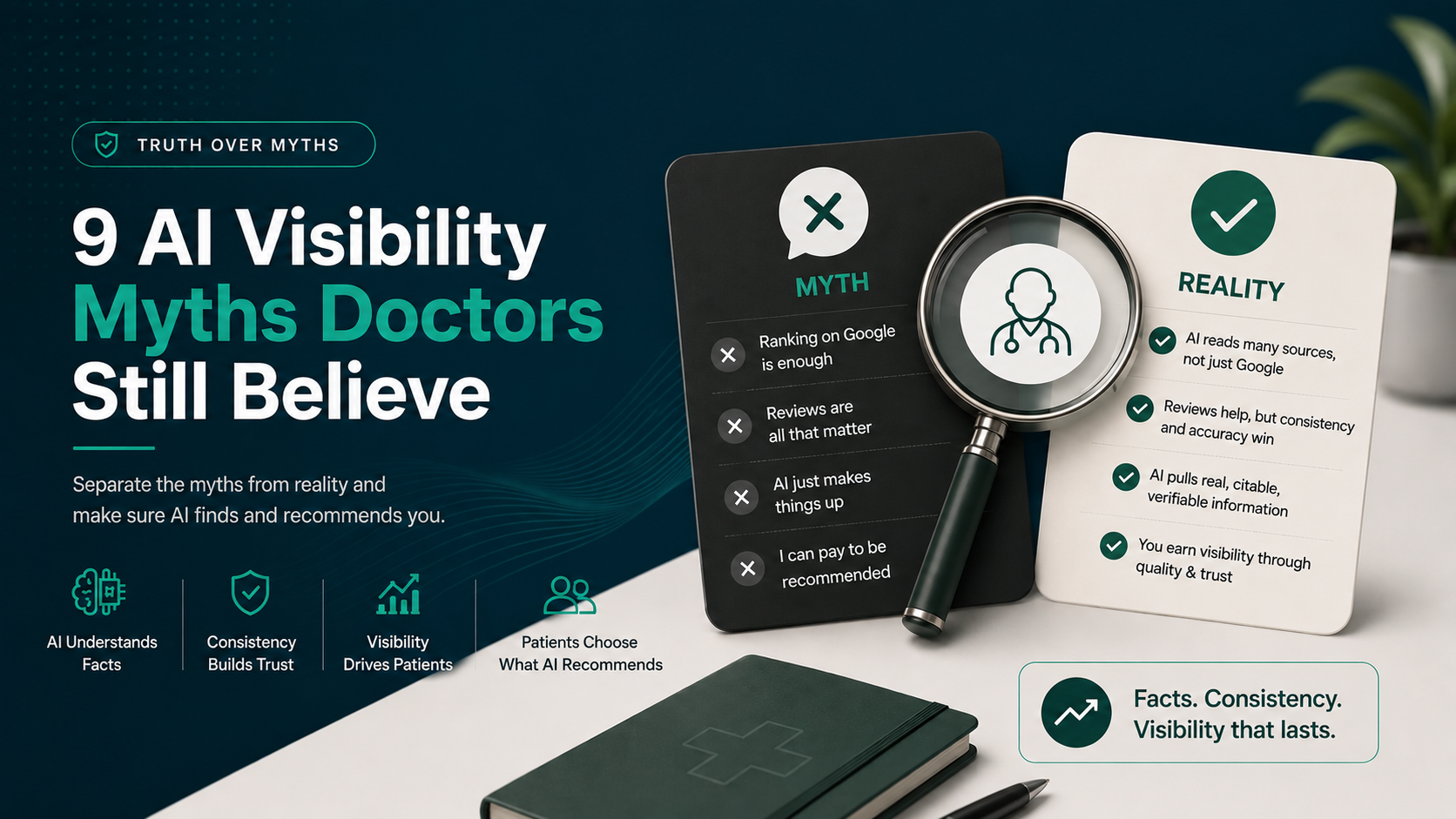
9 AI Visibility Myths Doctors Still Believe
The most damaging AI visibility myths are the comfortable ones, because they let a busy doctor do nothing and feel safe. AI visibility means whether ChatGPT, Gemini, Claude, and Perplexity mention you accurately when a patient asks for a specialist in your city. Most doctors assume their Google ranking, their reviews, or their steady website traffic already covers this. It does not. Below are the 9 misconceptions that quietly keep good doctors out of AI answers, each corrected with the real logic behind it.
Why these myths matter now
A patient in Austin no longer opens ten blue links. A patient in Pune no longer scrolls JustDial for an hour. They ask an assistant a plain question and act on the single answer it gives. A KFF poll found that about 1 in 3 US adults have used AI chatbots for health information. A 2025 rater8 report found that 26% of patients said an AI tool influenced their choice of provider.
That is the stake. If the myths below keep your information thin or inconsistent, the assistant fills the gap with someone else. These corrections decide whether your name appears at the moment a patient is choosing.
What is AI visibility
AI visibility is the measure of whether AI assistants can find you, understand who you are, and recommend you correctly. It is different from a Google ranking. A ranking is a position in a list of links. AI visibility is whether your name, specialty, and location are surfaced inside a synthesized answer from ChatGPT, Gemini, Claude, or Perplexity.
You can rank first on Google and still be absent from every AI answer. The two systems read the web differently, and optimizing for one does not automatically deliver the other. That gap is where most of these myths live.
The 9 myths, corrected
Each block states the myth a doctor believes, then the accurate reality with the logic or approved data behind it.
- Myth: "Ranking on Google means AI finds me too." Reality: they are separate systems with separate logic. A high Google rank helps, but AI assistants synthesize from many sources, including directories, review sites, and structured data, not just the link that ranks first. A cardiologist in Denver can hold position one and still be skipped, because the model favors consistent, extractable, well-cited information over raw ranking. Ranking is one input, not the whole answer.
- Myth: "AI search is a future problem I can ignore for now." Reality: it is already the present. With about 1 in 3 US adults using AI chatbots for health questions, patients are asking about your specialty in your city today. The doctors who get established as the clean, consistent answer now are the ones models keep citing later. Waiting does not pause the shift. It hands the position to whoever prepared first.
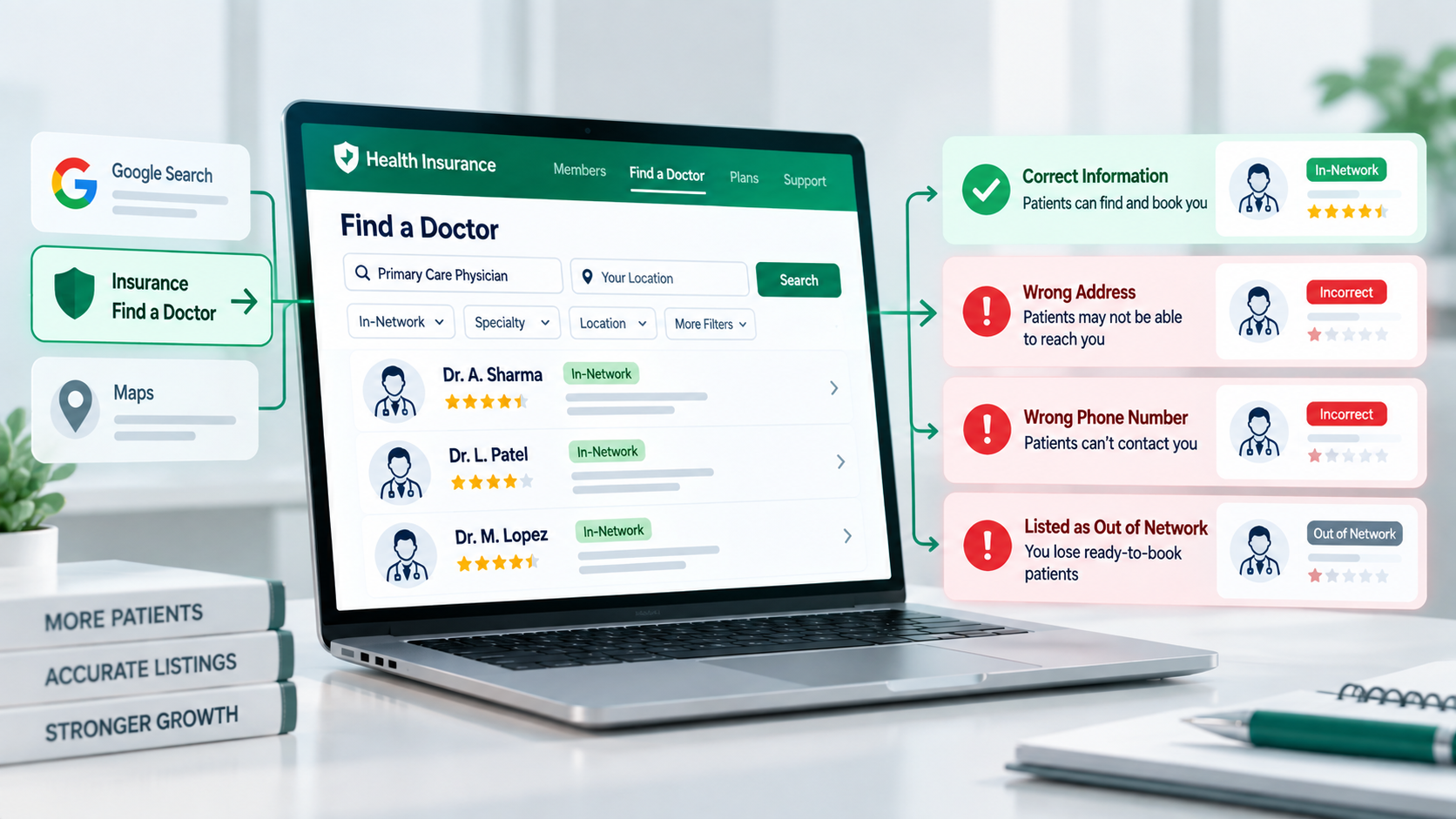
- Myth: "Reviews are all that matter." Reality: reviews are one of the 7 pillars, not the whole score. They build trust, but an assistant still needs to know who you are, what you treat, where you practice, and that your facts agree across the web. A dermatologist with 300 reviews and a contradictory address across directories can confuse a model into leaving them out. Reviews reinforce a recommendation. They do not create one on their own.
- Myth: "I can pay to be recommended by ChatGPT." Reality: there is no paid slot inside an organic AI answer. When ChatGPT, Gemini, Claude, or Perplexity name a doctor in a synthesized response, that is earned through information quality, consistency, and authority, not a fee. Anyone selling you a guaranteed AI recommendation is selling a fiction. The real levers are structured, accurate, consistent information that a model can trust and repeat.
- Myth: "Schema markup is a magic switch that fixes everything." Reality: schema helps, but it is not a cheat code. Structured data (schema markup) makes your facts machine-readable, yet Google's own documentation states that no special markup is required to appear in its AI features. Schema clarifies. It does not compensate for thin content, contradictory directory listings, or a missing Google Business Profile. It is one useful pillar working alongside the rest, not a standalone fix.
- Myth: "Only big hospitals and chains show up in AI answers." Reality: independent doctors appear constantly, often because they are more specific. A solo gynaecologist in Bengaluru or a two-doctor dental practice in Pune can be the exact, local, well-structured answer a model prefers over a generic hospital page. Size is not the signal. Clarity, consistency, and relevance to the patient's precise question are. A focused clinic frequently beats a large, vague one.
- Myth: "This is too technical for me to do anything about." Reality: most of AI visibility is disciplined information hygiene, not code. Making your name, specialty, and city consistent across Google Business Profile, Practo, JustDial, Healthgrades, and Zocdoc is administrative work, not engineering. Writing clear, direct answers to common patient questions is clinical communication you already do. The one technical piece, schema, is optional to start and easily added later by a developer.
- Myth: "AI just makes things up, so it does not matter what I do." Reality: models do err, and that is exactly why your information must be solid. When your facts are consistent and clearly sourced across the web, you give the model correct material to draw from and reduce the odds it invents something wrong about you. Doing nothing does not protect you from hallucination. It increases it, because the model fills gaps with guesses.
- Myth: "My website traffic is fine, so I am visible." Reality: traffic measures who already found you, not who the AI is quietly steering elsewhere. A patient who asks Gemini and gets a competitor's name never reaches your site, so your analytics never register the loss. Healthy traffic and poor AI visibility coexist easily. The only way to see this blind spot is to check the answers directly, because your own dashboard cannot show a visit that never happened.
What most doctors get wrong underneath all nine
Look closely and the same root error runs through every myth: assuming that being findable by humans equals being usable by a machine. A person forgives a buried answer, a slightly wrong address, or a thin page. A model does not. It quietly prefers the source that is clean and consistent.
The fix is not dramatic. It is making your existing, factual information accurate, consistent, and easy to extract everywhere it appears. For Indian doctors this stays firmly within NMC guidance, because you are making real information findable, not advertising or soliciting. For a fuller picture of how the pieces fit, start with our AI visibility for doctors overview, or see exactly how models pick names in how ChatGPT chooses doctors.
How to replace belief with evidence
You do not have to trust any of this on faith. You can test it in a few minutes.
- Open ChatGPT, Gemini, Claude, and Perplexity.
- Ask each the question a real patient would ask: "who is a good [your specialty] in [your city]?"
- Note whether you appear, whether the facts are right, and whether your name and location travel with the answer.
- Check that your details match across Google Business Profile and your main directories.
- Fix the biggest contradiction first, then remeasure in a few weeks.
This turns opinion into a visibility score you can act on. If you want that measurement done for you across every assistant at once, the audit below is the fastest path.