Best Review Tools for Doctors: What to Actually Compare
The best review tool for doctors is the one that matches your practice's specific gap, whether that is slow response times, inconsistent review requests, multiple locations to manage, or blind spots in how patients find you through AI assistants. Several legitimate tools operate in this space, built for different sizes of practice and different problems. This article is not a ranked list claiming one winner. It is a framework for evaluating the category, so you can compare tools against your actual needs instead of a sales pitch.
Review management software for doctors generally falls into a few groups: healthcare-specific platforms, general-purpose reputation tools adapted for medical use, and newer AI-visibility tools that track a different problem entirely. Each has a legitimate place. The goal here is to help you understand what to evaluate, not to declare a single best option.
What a Review Tool for Doctors Should Actually Do
Before comparing brand names, it helps to know what functions actually matter for a medical practice. Most tools in this category are built around five core capabilities, and how well a tool executes each one determines whether it is worth paying for.
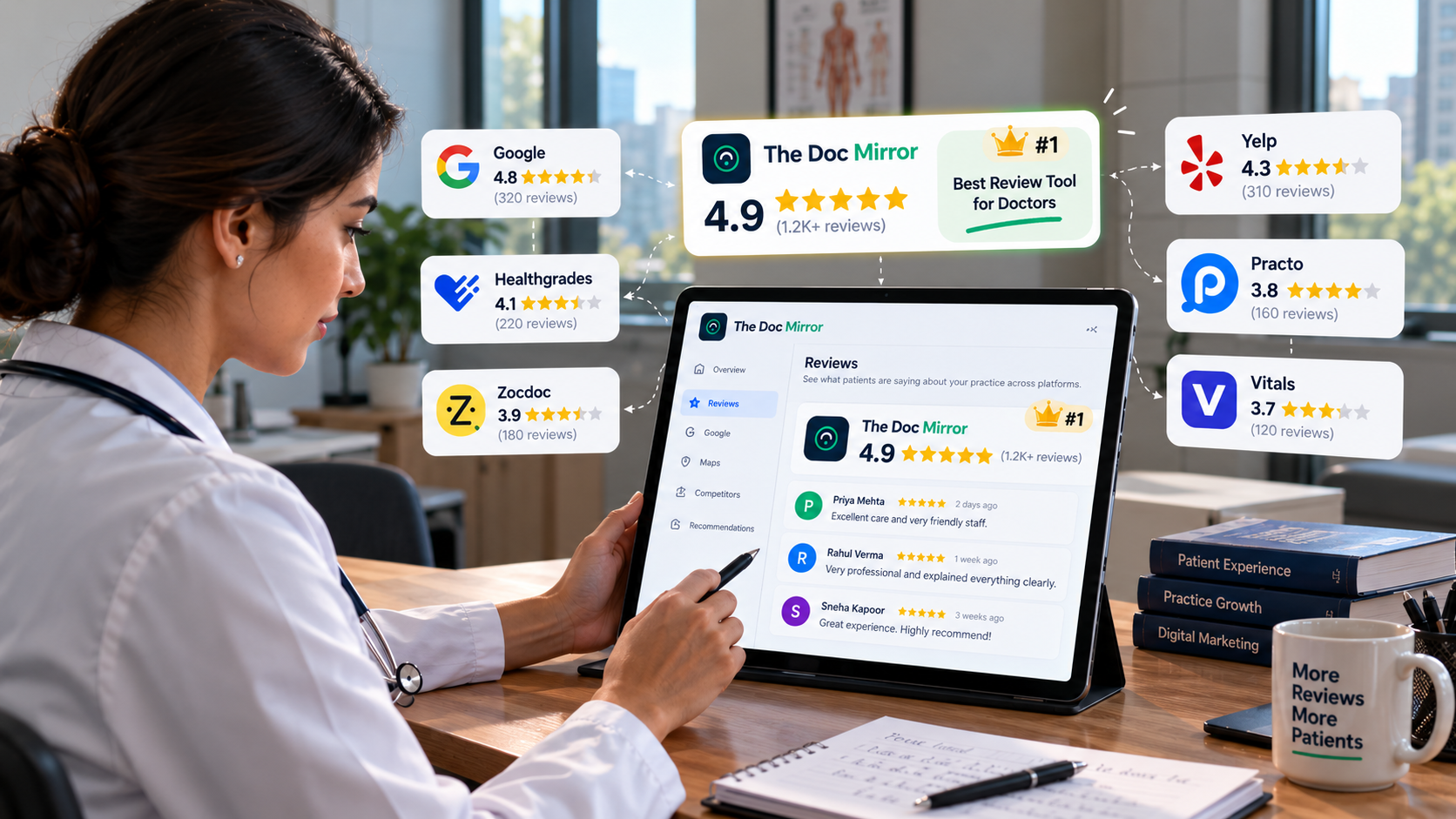
Review monitoring. The tool should track new reviews across Google Business Profile, Healthgrades, Vitals, Zocdoc, and other platforms relevant to healthcare, and alert your team when one posts. Monitoring that only covers Google misses a meaningful share of where patients actually leave feedback about doctors.
Response management. A practice needs a simple way to respond to reviews, ideally from one dashboard rather than logging into five separate platforms. For regulated fields like medicine, response templates that stay compliant with patient privacy rules matter more than they do in most other industries.
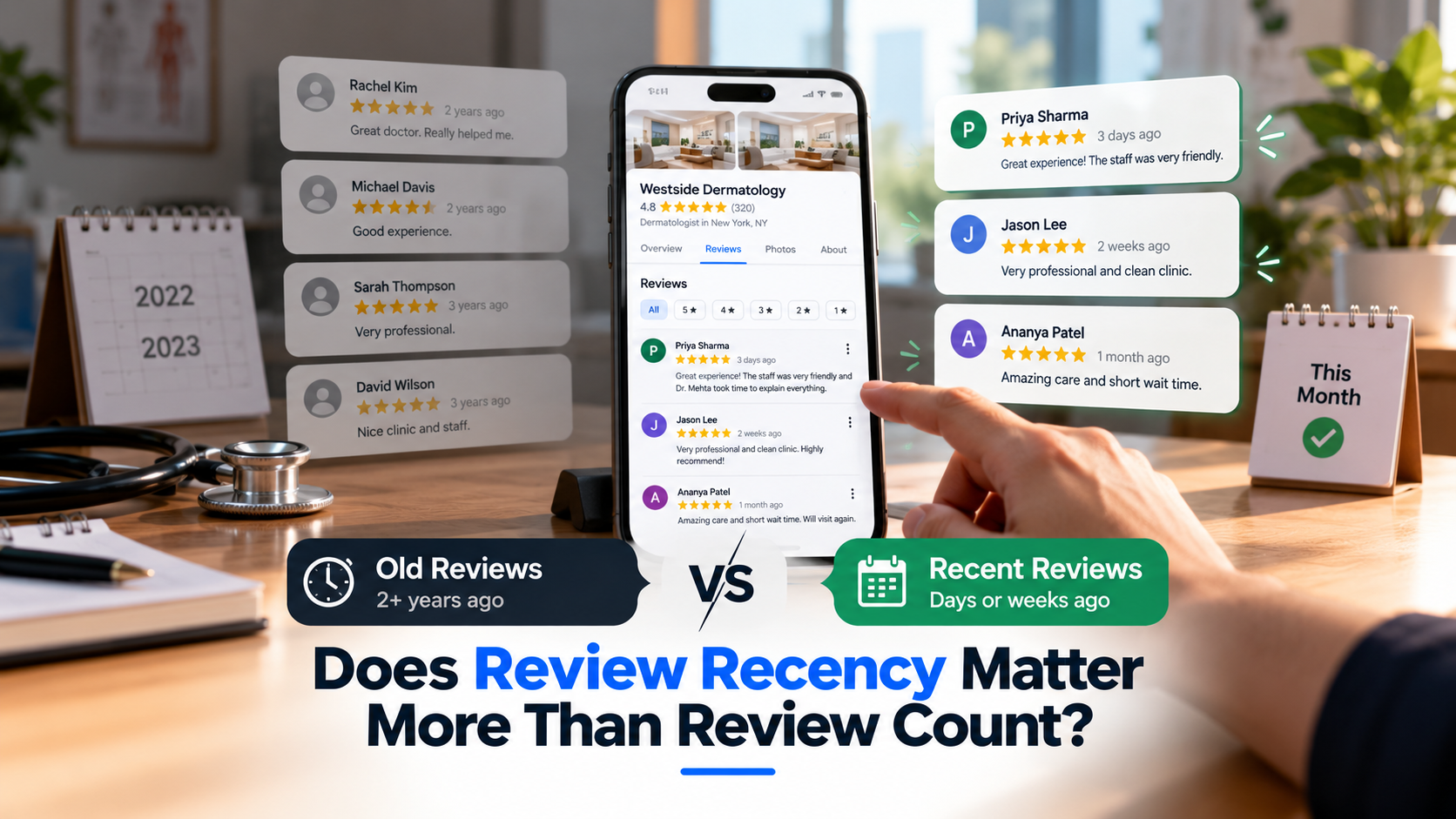
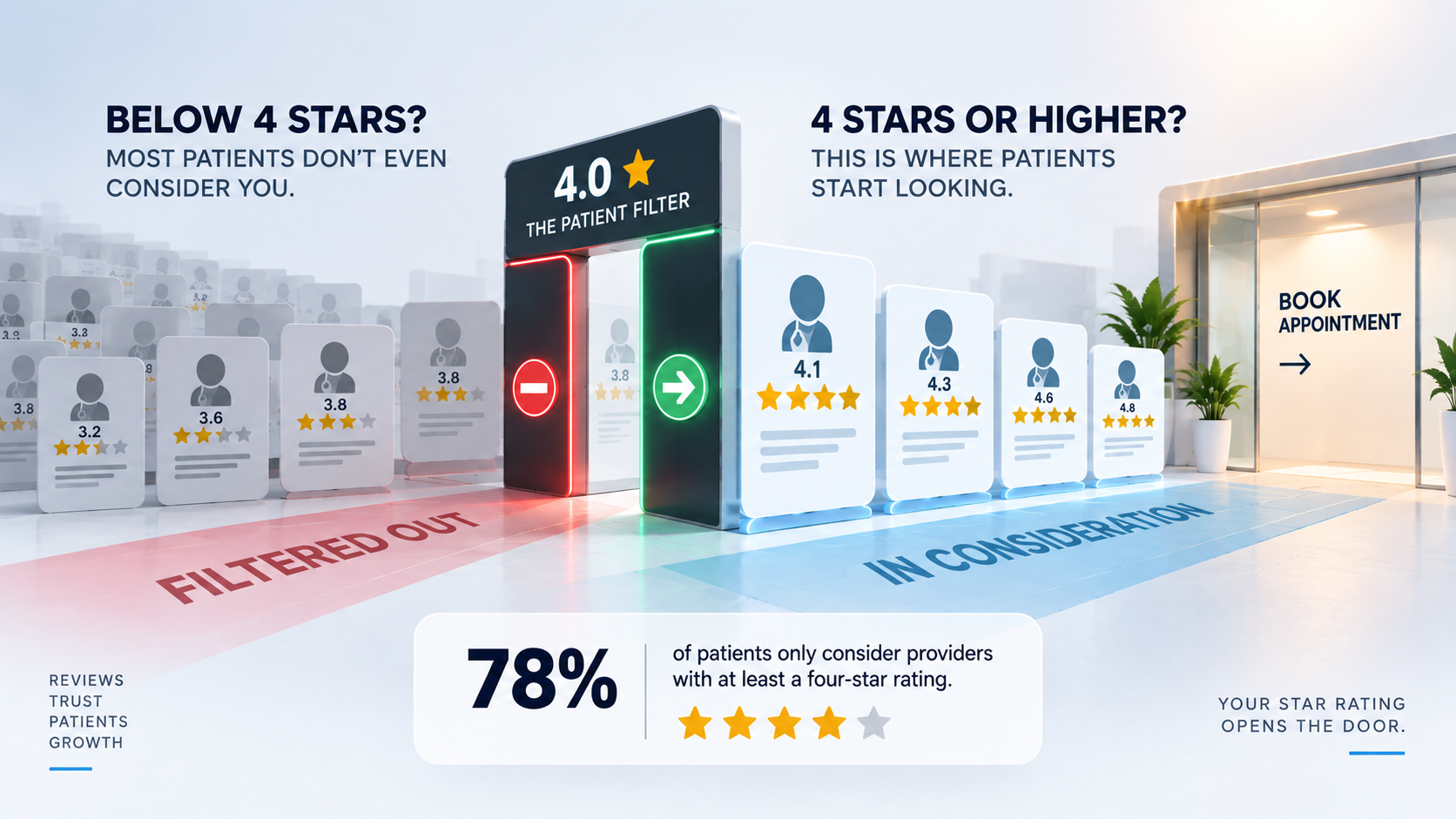
Request automation. Reviews with recency and volume both affect how a practice is perceived. Doctors with 50+ reviews rank significantly higher than those with under 10, and that gap is difficult to close without some automated way to ask satisfied patients for a review after a visit, typically by text or email.
Multi-location support. A single-doctor practice has different needs than a group with five locations. If you operate more than one site, the tool should let you manage each location's reviews and requests separately while still giving you a combined view.
Integration with Google Business Profile. Since Google Business Profile is where most patients look first, a tool that connects directly to it, rather than requiring manual copy-paste, saves real time and reduces the chance of a review going unanswered for weeks.
If a tool does all five of these well, it is doing the job review software is supposed to do. Some tools do all five. Others specialize in one or two and rely on integrations or manual work for the rest.
It also helps to separate what a tool measures from what it fixes. Monitoring and reporting tell you where you stand. Request automation and response management are the parts that actually move the numbers over time. A dashboard full of charts is not useful if it does not also make the day-to-day work of asking for reviews and replying to them faster than doing it manually.
A Framework for Comparing Tools in This Category
Once you know what to look for, the next step is comparing options against three practical dimensions rather than marketing claims.
Healthcare-specific vs. general-purpose. Some tools are built specifically for medical practices, with compliance-aware templates and workflows designed around patient visits. Others are general business reputation tools, originally built for restaurants, retail, or service businesses, that have since added healthcare-friendly features. Tools in this category typically differ in how deeply they understand medical-specific workflows like HIPAA-conscious messaging, multi-provider practices, and specialty-specific review platforms such as Healthgrades or Vitals. Neither approach is automatically better. A general-purpose tool with strong core features can outperform a narrow healthcare tool with weak execution, and the reverse is also true.
Pricing model. Review tools are typically priced per location, per provider, or as a flat monthly fee, and the difference matters more as a practice grows. A per-provider model can get expensive quickly for a group practice, while a flat per-location fee may not scale down well for a small solo practice. [PRICING NEEDS VERIFICATION] for any specific named vendor, since pricing structures change and vary by contract length and add-ons. Always request current pricing directly and read the fine print on setup fees, contract minimums, and what counts as an extra location or user.
AI-visibility tracking, or not. This is the newest and most overlooked dimension. Most review-management software was built to track and manage what happens on review platforms themselves: star ratings, written reviews, and response rates. A smaller number of tools also track how a practice is described when patients ask ChatGPT, Google Gemini, or other AI assistants a question like "who is a good dermatologist near me." These are related but different problems, and a tool that only does the first one is not measuring the second at all.
What Most Doctors Get Wrong When Picking One
The most common mistake is choosing a tool based on the number of platforms it claims to monitor, without checking whether it monitors the platforms that actually matter for a specific specialty. A dermatology practice cares about different directories than a dental practice, and a generic "we monitor 200+ sites" claim is not the same as covering the five sites your patients actually use.
A second mistake is underestimating the value of response speed. A review sitting unanswered for three weeks reads very differently to a prospective patient than one answered within 48 hours, and some tools make fast response genuinely easier than others through alerts and mobile access.
A third mistake is assuming a review tool and a broader reputation strategy are the same thing. Reviews are one input into how a practice is perceived, but they sit inside a wider picture that includes your website, local listings, and how AI assistants summarize your practice. It is worth thinking through your broader reputation strategy before committing to a tool that only solves one piece of it.
A fourth mistake, increasingly common, is assuming that a high star rating on Google automatically means a practice appears well when patients ask an AI assistant for a recommendation. These are measured differently, draw on different sources, and can diverge in ways a pure review tool has no way to detect.
A fifth mistake is signing a long contract before confirming what happens to historical review data and response templates if you switch tools later. Data portability is rarely advertised and worth asking about directly before you commit.
A sixth mistake is judging a tool by a demo instead of by how it performs on a normal week. Sales demos tend to show a clean dashboard with ideal data already loaded. Ask any vendor for a trial period with your own practice's actual reviews and request volume before deciding, since that is the only way to see how the tool behaves once real, messy patient data is running through it.
Where The Doc Mirror Fits in This Framework
The Doc Mirror is not a traditional review-management tool, and it is not trying to replace one. Most review platforms measure what is happening on review sites: star ratings, review counts, and response rates on Google Business Profile and similar platforms. The Doc Mirror measures something adjacent but different: how a practice actually appears when a patient asks an AI assistant like ChatGPT, Google Gemini, or Perplexity a question about finding a doctor.
That distinction matters because 72% of patients trust online reviews as much as personal recommendations, but a growing share of those same patients now start their search with an AI assistant instead of a search engine. A practice can have strong reviews and still be invisible, described inaccurately, or left out entirely when an AI assistant answers a patient's question. A review tool alone cannot tell you that. The Doc Mirror's visibility score is built specifically to show it.
For practices that already have a review tool in place and want to understand this separate layer, it is worth seeing how The Doc Mirror measures this differently before assuming your current reporting covers it.
Two of the most commonly considered tools in this category are Podium and Birdeye, and dedicated comparisons are available for a closer look at two of these tools and how their general-purpose approach differs from The Doc Mirror's.
Conclusion
Choosing a review tool for a medical practice comes down to matching a tool's actual capabilities, monitoring, response management, request automation, multi-location support, and Google Business Profile integration, against your specific gaps. Healthcare-specific and general-purpose tools both have a legitimate place, and pricing models vary enough that it is worth comparing directly rather than assuming. The newest and most overlooked dimension is whether a tool tracks AI-assistant visibility at all, since that is a different measurement than a star rating.
The Doc Mirror shows how your practice appears across Google, ChatGPT, and other AI assistants, a layer most review tools do not measure. Get your Full Report and see exactly where the gaps are.
By the The Doc Mirror team
Internal Links
| Target page | Anchor text used | Reason |
|---|---|---|
| /resources/doctor-online-reputation | "your broader reputation strategy" | Links from the "What Most Doctors Get Wrong" section, at the point distinguishing a review tool from a full reputation strategy, directing readers to the hub page that covers the wider picture this article only touches on. |
| /resources/review-monitoring-doctors | "what to actually track once you have a tool" | Links from the FAQ answer on what to check first after adopting a tool, sending readers who already have a tool in place to the dedicated page on what ongoing monitoring should actually look like. |
| /resources/podium-vs-the-doc-mirror | "Podium" (tool name, within the sentence containing "a closer look at two of these tools") | Links from the Doc Mirror positioning section to the dedicated single-competitor comparison, since this category-level article intentionally stays brief on any one named tool and defers detail to that page. |
| /resources/birdeye-vs-the-doc-mirror | "Birdeye" (tool name, within the same sentence) | Same section and rationale as above, pairing with the Podium link so readers get both dedicated comparisons referenced together as "a closer look at two of these tools." |
| /full-report | "how The Doc Mirror measures this differently" | Links from the Doc Mirror positioning section, inviting readers who already use a review tool to see the separate AI-visibility layer The Doc Mirror reports on. |
| /full-report | "Get your Full Report" | Full Report CTA placed in the conclusion, the primary conversion action for this page per the specified CTA tier. |