How to Make Your Clinic's Content Quotable by AI: The Writing Moves That Get You Cited
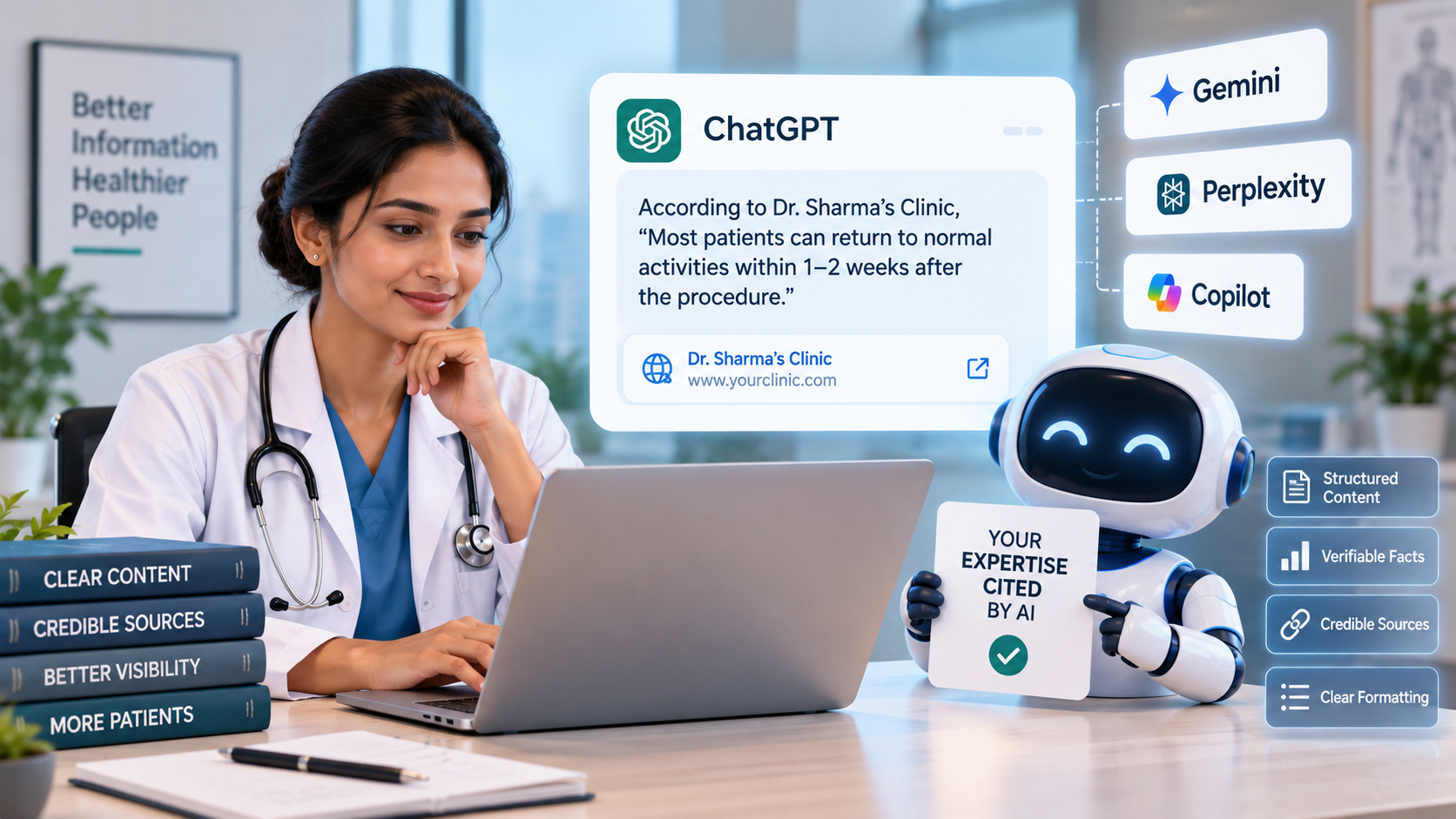
AI assistants quote content that answers a question directly, packs in verifiable facts, cites credible sources, and is cleanly formatted, and research shows these specific writing choices can raise how often a page is cited by up to 40%. This is a different skill from traditional SEO. Ranking on Google is about being findable, but being quotable by an AI is about being the clearest, most trustworthy, most extractable answer on the page, so the assistant can lift your words into its response. Most clinic content fails this not because the medicine is wrong but because it is written as marketing prose that gives an AI nothing clean to quote. This guide covers the concrete writing moves that make content citable, with the evidence behind each. It is a companion to structuring FAQs, which is covered separately in how to write medical FAQ content that AI assistants quote; here the focus is the writing craft across all your pages.
Why AI quotes some content and ignores the rest
An AI assistant answering a health question is not browsing for the prettiest page, it is looking for the most extractable, confirmable statement it can safely repeat. When it writes an answer, it needs sentences it can lift or paraphrase with confidence, backed by signals that the source is trustworthy. Content that buries the answer in a paragraph of promotion, or makes claims with no source, gives the model nothing to grab.
The academic work behind this is clear. The GEO study from Princeton and IIT Delhi found that content changes involving adding statistics, incorporating credible quotations, and citing reliable sources can raise a page's visibility in generative answers by up to 40%, with minimal changes to the underlying content. Industry analysis echoes it, finding that the biggest wins come from adding machine-extractable provenance, with quotations, statistics, and citations each worth roughly a quarter to 40% more visibility, and that models are substantially more likely to cite content with clear formatting such as headings, lists, and tables.
The shift this demands is from persuasion to precision. Marketing copy tries to convince a human to feel something. Quotable content tries to give a machine a clean, sourced, unambiguous fact to repeat. A clinic that rewrites its key pages with that goal in mind is doing generative engine optimization, the discipline introduced in answer engine optimization for doctors, at the level of the sentence.
Move 1: answer the question in the first two sentences
The single highest-value habit is to state the answer immediately, before any preamble. AI systems favour content that delivers a direct answer up front, ideally within the first 40 to 60 words, because that is the piece they can lift cleanly into a response.
In practice this means leading each page and each section with the plain answer, then explaining. A page on a treatment should open with what the treatment is and who it helps, not with a paragraph about your clinic's philosophy. A section answering how long recovery takes should begin with the timeframe, then the nuance. This is the opposite of how much medical marketing is written, which warms up slowly and states the useful fact halfway down. Front-loading the answer serves patients too, since they are scanning, but for AI it is close to essential, because a buried answer often simply is not found.
Every heading on your site is an opportunity to pose a real question a patient asks and answer it in the next sentence. That question-and-direct-answer rhythm is exactly what makes content extractable, and it is the same principle that makes FAQs so citable, explored in medical FAQ content that AI quotes.
Move 2: add verifiable statistics and facts
Vague content is unquotable content. An AI cannot confidently repeat "many patients recover quickly," but it can repeat a specific, sourced figure. Research found that fact density is a strong driver of citation, with a useful rule of thumb being a concrete statistic roughly every 150 to 200 words in informational content.
For a clinic, this means replacing soft claims with specifics wherever honesty allows. Instead of "a common condition," give the prevalence if you can source it. Instead of "recovery is usually quick," give a typical range. Instead of "many people are affected," cite the figure and its source. The discipline is to ask, of every sentence, whether it contains a fact a machine could extract and repeat, or only an impression. Impressions get skipped, facts get quoted. This does not mean stuffing numbers artificially, which reads badly to humans, but genuinely grounding your claims in specifics that happen to be exactly what an AI looks for.
A caution specific to healthcare: every statistic must be accurate and, ideally, sourced to a reputable authority, because a wrong or unsourced medical figure is both a citation risk and a trust and compliance problem. Precision without accuracy is worse than vagueness.
Move 3: cite credible sources, and become one
Citations do double duty. Citing reputable sources in your content raises its own citability, because the model reads the presence of credible references as a signal of trustworthiness, and being cited by other reputable sources makes you the authority an AI reaches for.
On your own pages, reference authoritative bodies where relevant, for example a recognised medical association or a public health source, and link to them plainly. This is the on-page half. The off-page half is building the third-party footprint that makes you a source others cite, which is the entity and authority work covered in entity SEO for doctors and, through listings, in directory citations and AI visibility. Industry analysis notes that AI engines strongly favour earned media, authoritative third-party sources, over brand-owned content, which is why being named on hospital pages, associations, and reputable publications matters as much as what you write yourself.
The mindset is to treat your content as part of a web of confirmable references rather than a standalone brochure. Content that both cites well and is cited well is exactly what an AI treats as safe to repeat.
Move 4: format for extraction
How content is laid out affects whether it is quoted, independent of what it says. Models are markedly more likely to cite content with clear structure, with analysis finding clean formatting, hierarchical headings, bullet points, numbered lists, and tables, can lift citation likelihood by 28 to 40%.
For clinic pages this is a straightforward set of habits. Use descriptive headings that pose the question a patient asks. Break processes into numbered steps and options into bulleted lists, because these map neatly onto how an assistant structures an answer. Use a short table where you are comparing things, such as treatment options or recovery timelines, since tables are highly extractable. Keep paragraphs short and focused on one idea, so a single clean sentence can be lifted without dragging in unrelated text. None of this changes your medical content, it changes how legible that content is to a machine, and legibility is a real ranking-in-answers factor.
The bonus is that all of this also improves the experience for human patients, who scan rather than read. Extractable structure and readable structure are, for once, the same thing.
Putting the moves together, without overdoing it
These four moves compound, but they must serve accuracy and readability, not override them. The goal is content that a patient finds clear and an AI finds quotable, and those goals align when done honestly.
A practical way to apply them is to take your most important pages, the ones about your core services and common patient questions, and rewrite each so it opens with a direct answer, grounds its claims in accurate sourced facts, references credible authorities, and is laid out in clean headings, lists, and the occasional table. Do not chase the tactics into keyword stuffing, fabricated statistics, or robotic writing, all of which the same research and platforms penalise, and all of which erode patient trust. The aim is a genuinely better, clearer, more factual page that happens to be exactly what generative engines cite. Track whether it is working by checking your AI visibility over time and your overall standing on a doctor visibility score, rather than guessing.
A note for clinics in India. Every move here is compatible with NMC norms, because it is about accuracy, clarity, and sourcing, not promotion. Writing factual, well-structured, well-sourced content is precisely the kind of educational information the rules permit, provided it does not solicit patients, display testimonials, or disclose patient information.
Before and after: rewriting one clinic paragraph
The moves are easiest to grasp applied to a single paragraph. Take a typical passage from a clinic's page on a knee treatment, written the usual marketing way, and rewrite it to be quotable.
The before version reads: "At our clinic, we pride ourselves on providing world-class, compassionate care for knee pain using the latest techniques. Our experienced team is dedicated to getting you back on your feet as quickly as possible in a warm, welcoming environment." It is pleasant and completely unquotable. It answers no specific question, contains no extractable fact, cites nothing, and an AI asked "how is knee osteoarthritis treated" finds nothing to lift.
The after version reads: "Knee osteoarthritis is commonly managed in stages, starting with non-surgical options. First-line treatments include physiotherapy, weight management, and anti-inflammatory medication, with injections or surgery considered only if these do not relieve symptoms. Most patients begin with a physiotherapy programme lasting several weeks before any procedure is discussed." Notice the difference. It opens with a direct answer, states a clear sequence a model can lift, gives specifics rather than adjectives, and is structured around a real patient question. The same clinic, the same expertise, but now the content is something an AI can quote and a patient can actually use. The persuasion is gone, and the precision that replaced it is exactly what gets cited.
The exercise for your own site is to find the "we pride ourselves" paragraphs and rewrite each into a direct, factual, structured answer to the question a patient is really asking. That single habit, repeated across your key pages, is most of the work.
Where to start
The change that makes content quotable is smaller than it sounds: stop writing to persuade and start writing to inform precisely. Take your handful of most important pages, lead each with the direct answer, replace vague claims with accurate sourced facts, cite credible authorities, and lay it out in clean headings and lists. You will end up with pages that are better for patients and, at the same time, exactly what an AI reaches for when a patient asks.
The Free Audit checks whether AI assistants can find and cite your practice, scores you on the 7 pillars including AI visibility, and shows exactly which gaps to close first. It takes about 90 seconds and needs no signup for the free score.
Run your free audit at thedocmirror.com
By the The Doc Mirror team