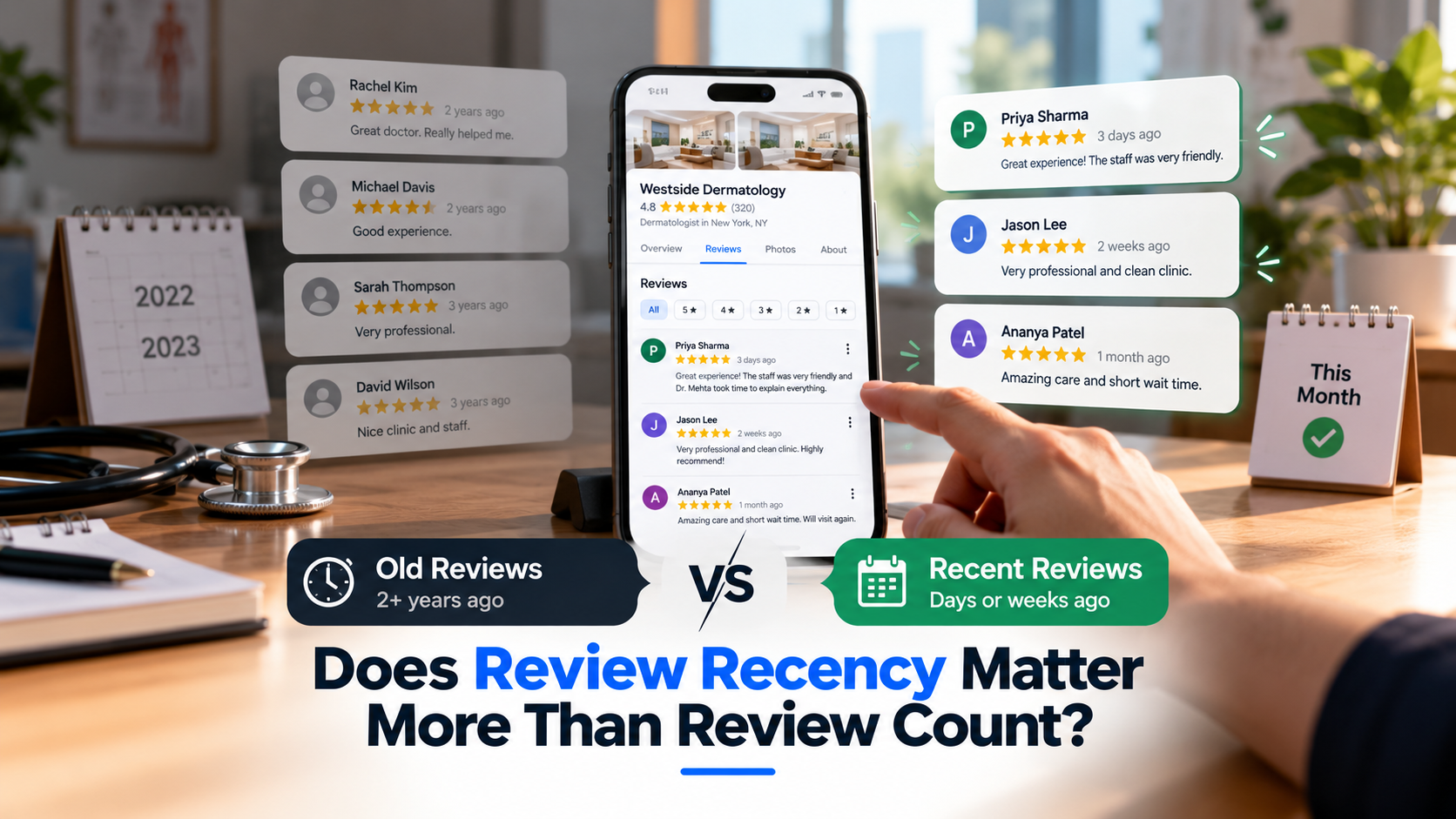
Does Review Recency Matter More Than Review Count for Doctors?
Yes, recency matters, and it works alongside review count rather than replacing it. A five star review from two years ago tells a patient, and likely Google, that someone had a good experience once. It does not tell them whether that same standard of care holds true today. Patients read dates before they read stars, and a practice whose most recent review is 18 months old raises a quiet question even if the overall rating looks strong.
This matters because patient decisions are time sensitive in a way many other purchases are not. Someone searching for a doctor today wants to know what care looks like now, not what it looked like when the practice first opened. A steady stream of recent reviews signals an active, currently trusted practice. A stalled review profile, no matter how high the average score, can read as outdated or even abandoned.
This article looks specifically at recency: what it means, why a fresh review carries more weight than an old one, and how it differs from the separate question of review volume. It also covers what a healthy review cadence looks like and the practical steps to build one.
What "Recency" Actually Means in Practice
Recency refers to how recently a practice has received reviews, not just how many it has accumulated over its lifetime. A practice with 80 reviews collected over six years, with nothing added in the last year, has a very different recency profile than one with 80 reviews collected over the last 18 months.
Patients and platforms both read recency as a proxy for current relevance. A review dated three weeks ago describes a doctor's bedside manner, wait times, and staff behavior as they exist right now. A review dated three years ago describes a version of the practice that may have changed staff, changed systems, or changed ownership since it was written.
Google displays review dates prominently next to every review, which means recency is not a hidden signal. It is something every patient sees directly before they read a single word of the review itself.
Why a Two Year Old Five Star Review Isn't Treated the Same as a Fresh One
An old review, even a glowing one, answers a narrower question than patients are actually asking. Patients want to know what to expect on their own visit, and a review from years ago is weaker evidence for that than a review from last month.
There is also a practical trust issue. A profile where the newest review is over a year old can suggest the practice stopped asking for reviews, stopped seeing enough patients to generate them, or stopped paying attention to its online reputation altogether. None of those explanations reflect well, even if none of them happen to be true.
Google has not published the exact weighting it applies to review recency within its ranking systems, and any claim of a precise formula should be treated with skepticism. What is observable is that Google surfaces recent reviews prominently in the local pack and profile view, and that freshness is a factor commonly cited across Google's own guidance on maintaining a strong Google Business Profile. The honest position is that recency appears to matter, without a confirmed public weighting to cite.
How Recency Differs From Review Count
Review count and review recency are related but separate variables, and conflating them leads to the wrong fix. A practice can have a large number of reviews and still have a recency problem, if most of those reviews are old and few new ones are coming in.
Count measures the total weight of evidence a practice has built over time. Recency measures whether that evidence is still current. A practice needs both: enough volume to look established, and enough freshness to look active. This article intentionally does not cover how many total reviews a practice needs to rank competitively, since that is a distinct question with its own answer. For that specific topic, including how many reviews you need in the first place, a separate breakdown covers it directly.
What a Healthy Review Cadence Looks Like
A healthy cadence means new reviews arrive on a steady, ongoing basis rather than in occasional bursts followed by long gaps. Consistency matters more than speed. A practice that adds two or three reviews most months looks healthier than one that adds twenty in a single week and then nothing for a year.
Cadence should roughly track patient volume. A high volume practice with only a handful of reviews per quarter is under-asking relative to its opportunity. A smaller practice does not need the same raw number, but it still benefits from reviews appearing regularly rather than in one early cluster.
Gaps are more visible than most doctors expect. A six month or longer stretch without a single new review stands out clearly on a profile, especially next to competitors whose most recent review is from the past week.
What Most People Get Wrong
The most common mistake is treating a strong star average as the finish line. A 4.5+ star rating is the minimum threshold most patients will consider, but a high average sitting on old, stagnant reviews is a weaker asset than a slightly lower average built on a steady, recent stream.
A second mistake is running one aggressive review push and then stopping. A single campaign that generates 30 reviews in a month, followed by silence, creates the exact stalled pattern that undermines recency later.
A third mistake is assuming recency only matters for the star average. It also affects trust directly, since 72% of patients trust online reviews as much as personal recommendations, and that trust depends on believing the reviews still reflect the practice today.
A fourth mistake is ignoring how recency interacts with the sources patients actually check. Patients check an average of 3 sources before choosing a doctor, and a stalled review profile on even one of those sources can raise doubt that a strong profile elsewhere does not fully offset.
Practical Steps to Improve Review Recency
- Build reviews into a routine step after every visit, rather than an occasional manual request, so new reviews arrive continuously instead of in bursts.
- Set a simple internal target, such as a minimum number of new reviews each month, and track it the same way you would track any other operational metric.
- Watch for gaps of two months or longer with no new reviews, and treat that as a signal to act rather than something to notice later.
- Respond to recent reviews promptly, since an active response pattern reinforces that the practice is currently engaged, not just historically well reviewed.
- Audit your current review timeline across Google and other major platforms to see exactly how recent your most recent reviews actually are.
- Understand whether AI assistants weigh reviews the same way as Google does, since patients increasingly ask AI assistants for doctor recommendations, not just Google.
Conclusion
Review recency and review count answer different questions, and both matter for how patients and platforms judge a practice. A strong average built on old reviews reads as a snapshot from the past. A steady stream of recent reviews reads as evidence that today's care matches yesterday's reputation. Building a consistent cadence, rather than chasing a single number, is what keeps a practice's online reputation credible over time.
The Doc Mirror shows exactly how recent, and how strong, your review profile looks across Google and the leading AI assistants right now. See how your review profile looks today with a free audit.
By the The Doc Mirror team
Internal Links
| Target page | Anchor text used | Reason |
|---|---|---|
/resources/how-many-google-reviews-to-rank (v2-03) |
"how many reviews you need in the first place" | Direct companion article covering the separate variable of review count; this article explicitly scopes count out, so it hands that question off rather than re-explaining it. |
/resources/reviews-ai-recommendation (#13) |
"whether AI assistants weigh reviews the same way" | Cross-cluster link from Doctor Reviews into AI Search, extending the recency question to how AI assistants (not just Google) evaluate reviews, which is the practical next question a reader has. |
/resources/doctor-online-reputation (blog15, hub) |
"online reputation" | Pillar link, placed in the conclusion to connect this narrow recency topic back to the broader reputation-management hub page. |
| Free Audit (product/commercial) | "see how your review profile looks today" | Commercial CTA in the closing paragraph, tied directly to the article's core subject (review recency) rather than a generic audit pitch. |