Can Indian Doctors Advertise Online? What NMC Rules Actually Allow
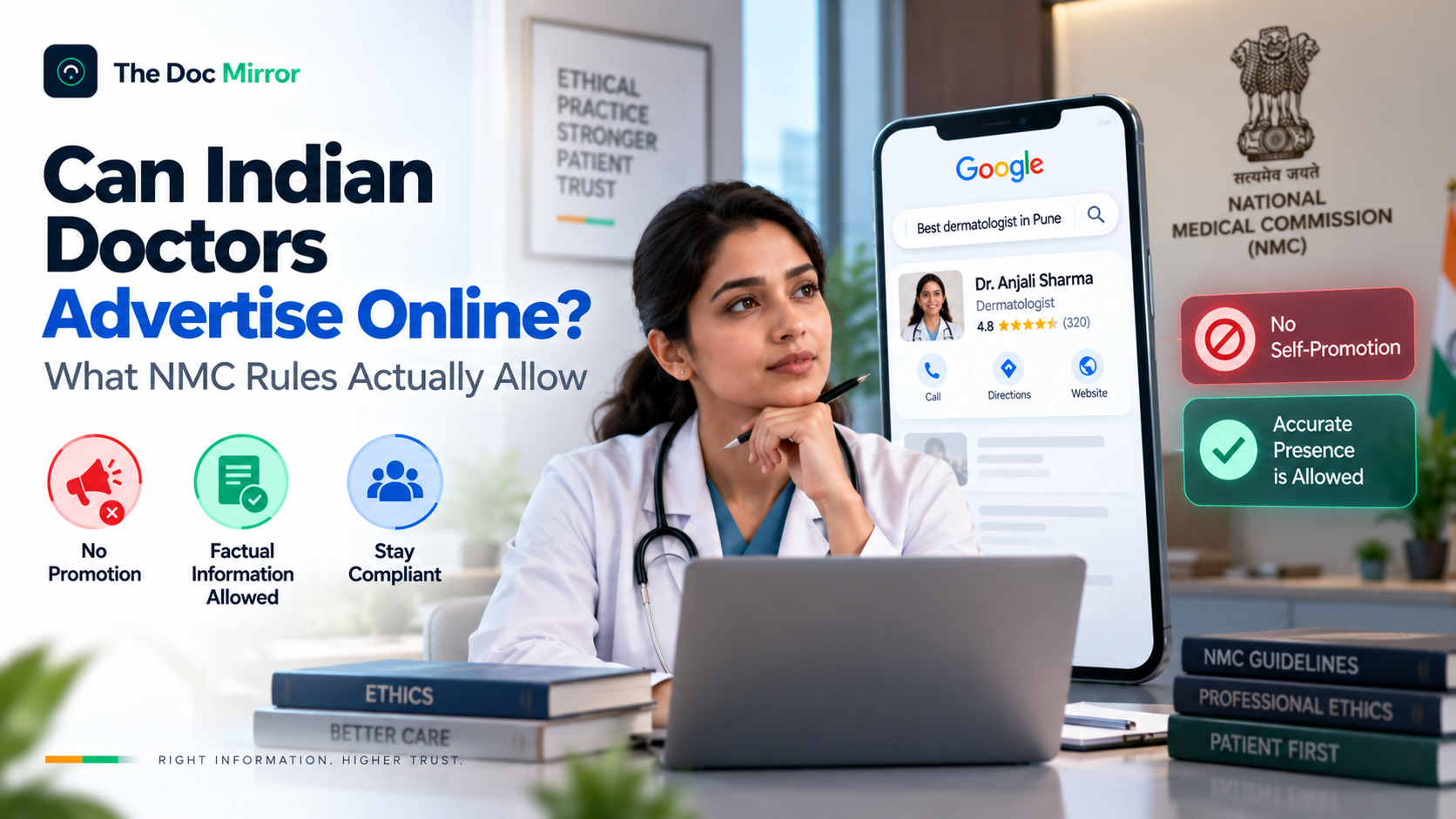
Indian doctors cannot advertise or solicit patients online in the promotional sense, but they are allowed to maintain an accurate, factual, and findable online presence, and the distinction between those two things is the whole game. The rules prohibit self-promotion, soliciting patients, and displaying patient testimonials, but they do not prohibit having a correct Google listing, a clear website, or consistent contact details across the web. Most doctors in India either overreach into promotion that breaks the rules or, more often, hold back so far that patients simply cannot find them. This guide explains which rules actually apply, what is genuinely prohibited, what is clearly allowed, and how to be findable without crossing the line. It is written for Indian practitioners who want patients to find accurate information about them, not to run afoul of the council.
This article is general information, not legal advice. Regulations change and are interpreted by the NMC and state medical councils. Confirm the current position for your situation before acting.
The short answer: accuracy is allowed, advertising is not
The confusion starts because "advertising" and "being findable" get treated as the same thing, when the rules draw a sharp line between them. Advertising, in the regulatory sense, means promoting yourself to attract patients, making claims, or soliciting. Being findable means that when a patient looks for accurate information about a real doctor, they get it.
The governing principle across the Indian medical ethics rules is that soliciting patients, directly or indirectly, is unethical, and that extends explicitly to social media and the web. What is not restricted is the accuracy of your basic professional information. Correcting your clinic address, listing your registered qualifications truthfully, keeping your phone number current, and ensuring a patient is not sent to the wrong location are all matters of factual correctness, not promotion. A patient in Pune or Kochi searching for your clinic deserves to reach the right place, and making sure they can is hygiene, not advertising.
This is the frame to carry through everything that follows. Every time you are unsure whether something is allowed, ask a single question: is this promoting me, or is this making true information about me accurate and findable? Promotion is the risk. Accuracy is almost always safe.
Which rules actually apply
There is genuine confusion here because two sets of rules have been in the news, and only one is currently operative. Getting this right matters before you rely on any specific clause.
The operative code remains the Indian Medical Council (Professional Conduct, Etiquette and Ethics) Regulations, 2002. In August 2023 the National Medical Commission notified a new ethics code, the Registered Medical Practitioner (Professional Conduct) Regulations, 2023, which addressed social media in more detail, but within weeks the NMC put the 2023 regulations in abeyance, meaning they are not currently in force. So while the 2023 text is a useful signal of the direction of thinking, the rules you are actually held to are the 2002 regulations, as interpreted by the NMC and your state council.
The practical effect is that you should not build your online presence around the specific wording of the 2023 code, because it is suspended and may change before it returns. Build around the durable principle that has held since 2002: no solicitation, no self-promotion, no misuse of patient information. That principle is stable regardless of which code is technically in force, which is why anchoring to it keeps you safe through the uncertainty.
What is explicitly not allowed
Some things are clearly on the wrong side of the line, and knowing them precisely is more useful than a vague sense of caution.
Soliciting patients, directly or indirectly, including through social media, is unethical. That covers promotional posts designed to attract patients, boosted or paid promotion of yourself as a provider, and content framed to win business rather than to inform. Displaying patient testimonials, recommendations, or reviews on your own website or social media is not permitted, which is a crucial and often-missed point, because it means you cannot curate and publish patient praise the way a restaurant might. Posting patient photographs, scans, or any patient-identifying imagery is prohibited, as is discussing a specific patient's treatment or prescribing on public platforms. And any content that is misleading, deceptive, or exploitative of patients' vulnerabilities is off-limits regardless of format.
Read together, these prohibitions target promotion and patient confidentiality. They are not a ban on existing online. A doctor who avoids self-promotion, does not publish testimonials, never posts patient imagery, and keeps clinical discussion off public platforms has cleared the main hazards, and everything that remains is largely the accuracy work that is allowed.
What is clearly allowed
The permitted zone is wider than most cautious doctors assume, and it is exactly the zone that makes you findable.
Providing factual, verifiable information is allowed. That includes your name, registered qualifications, specialty, clinic address, hours, and how to make an appointment, published plainly and truthfully. Educating and informing the public in a professional, non-misleading way is allowed, which is why factual health explainers by doctors exist within the rules. Keeping your listings accurate on the platforms patients already use, so that a search returns the correct clinic at the correct address, is a matter of correctness rather than promotion.
Crucially, ensuring your basic information is consistent everywhere is squarely within bounds. When your name, address, and phone match across your website, your Google listing, and directories, you are not advertising, you are preventing patients from being misdirected. That consistency is also what makes you legible to search and AI systems, a mechanism explained in directory citations and AI visibility. The rules do not ask you to be invisible. They ask you not to promote and not to misuse patient information, and accurate presence violates neither.
The practical grey area: Google, Practo, and reviews
The hardest questions in practice are not about obvious adverts, they are about the everyday platforms, and here the accuracy-versus-promotion test does most of the work.
Your Google Business Profile is best treated as a factual record: correct name, address, hours, category, and specialty. Setting it up accurately and keeping it current is correctness, not solicitation. The same applies to a Practo profile or similar directory listing, where the safe posture is complete, truthful information rather than promotional language or claims of being the best, a nuance covered in the context of AI search for doctors in India. Reviews are the genuine grey area. The rules bar you from displaying or soliciting testimonials on your own properties, so you should not publish patient praise on your website or actively solicit reviews as endorsements. Reviews that patients independently leave on a third-party platform like Google exist outside your control, and the conservative, defensible position is to neither solicit nor curate them, while keeping your own factual listing accurate.
When a specific case is unclear, default to the more conservative reading and, for anything material, confirm with your state council or a professional advisor. The cost of a conservative choice is small. The cost of a promotional misstep can be a disciplinary matter.
How to build visibility without crossing the line
You can be genuinely findable while staying firmly on the accuracy side. Work only the levers that are about correctness.
Start by making every factual detail about your practice accurate and identical across your website, your Google Business Profile, and the directories patients use. Fix wrong addresses, outdated phone numbers, and inconsistent clinic names, because misdirection is the opposite of the accuracy the rules protect. Complete your listings with truthful, specific information about your specialty and services, since a precise, honest profile is both compliant and more findable. Keep any public content educational and factual rather than promotional, and never publish patient testimonials or imagery. Finally, measure your findability with a neutral scoreboard rather than guessing, using a doctor visibility score that reflects accuracy and consistency, and understand that your local ranking is driven by relevance and prominence signals you can influence honestly, as explained in distance versus prominence.
Done this way, visibility is a byproduct of accuracy, which is precisely the posture the rules reward. You are not advertising. You are making sure that the truth about your practice is correct, consistent, and reachable, and that is both permitted and effective.
A compliant profile versus a non-compliant one
The line becomes concrete when you compare two versions of the same clinic's online presence. Both describe a real dermatologist in Bengaluru, but one is accuracy and one is advertising.
The compliant version states the doctor's name, MBBS and MD qualifications, registration, the clinic address and hours, the conditions the clinic treats described plainly, and how to book. It reads like a factual record. The non-compliant version of the same profile adds phrases like "the best skin doctor in the city," publishes a wall of glowing patient testimonials, posts before-and-after photos of patients, and runs boosted social posts urging people to book now. Every one of those additions crosses from accuracy into promotion, testimonial display, patient imagery, or solicitation.
Notice that the compliant version is not weaker at being found. It is arguably stronger, because search and AI systems reward clear, factual, consistent information, not superlatives. The doctor who resists the urge to promote and instead perfects the factual record ends up both compliant and more findable, which is the entire point. Advertising language does not help you rank. Accurate, complete information does.
What about paid ads, Google Ads, and boosted posts
A frequent and fair question is whether paid advertising, such as Google Ads or boosted social media posts, is allowed. This is the area closest to the prohibited zone, and it deserves caution rather than a confident yes.
Paid promotion that solicits patients sits squarely against the principle that soliciting patients directly or indirectly is unethical, and boosting posts designed to attract patients is a form of that solicitation. This is materially different from maintaining a free, factual Google Business Profile, which is a record rather than an advert. Because paid campaigns are explicitly promotional in intent, they carry real regulatory risk for an individual practitioner, and hospitals and corporate entities have faced scrutiny over advertising norms too. The conservative and defensible posture for an individual doctor is to avoid patient-soliciting paid advertising and to invest instead in the accuracy and consistency work that is clearly permitted. If you are considering any paid activity, confirm the current position with your state council or a professional advisor first, because this is exactly the kind of material decision where the cost of getting it wrong is a disciplinary matter rather than a marketing setback.
Where to start
The mistake most Indian doctors make is not breaking the advertising rules, it is hiding from the internet so thoroughly that patients cannot find accurate information about a real practice. The rules never asked for that. They asked you not to promote and not to misuse patient information, and everything else, especially keeping your factual details correct and consistent, is allowed and encouraged by common sense.
The Free Audit checks how your practice appears across Google, AI assistants, and directories, scores your findability on the 7 pillars, and shows exactly which accuracy gaps to close first. It takes about 90 seconds and needs no signup for the free score.
Run your free audit at thedocmirror.com
By the The Doc Mirror team