How Patients in India Actually Find Doctors Online in 2026
Most patients in India now begin their search for a doctor online, on a smartphone, starting with a search engine and moving through Google listings, Practo profiles, reviews, and increasingly AI and voice assistants, often deciding in under five minutes. The image of patients relying only on a neighbour's recommendation or the nearest clinic is out of date, especially in Tier 1 and Tier 2 cities. Surveys show the large majority of Indian patients research online before choosing, and the ones who do skew toward exactly the informed, higher-value patients most practices want. This guide maps how that search actually unfolds, which platforms matter, and where a practice becomes visible or invisible along the way. It is written for Indian doctors and clinic owners who want to understand the real patient journey before trying to improve their place in it.
The journey starts with a search, not a referral
Word of mouth still matters in India, but it now feeds into an online check rather than replacing it. A patient hears a name, or feels a symptom, and the first move is to search. Research indicates that 78% of patients in India search online before choosing a hospital or doctor, and 77% start with a search engine. Even a personal referral is now verified online before the patient acts on it.
This changes what a referral is worth. A recommendation gets your name into the patient's head, but the decision is made on what they find when they search that name, or your specialty and city. If a searching patient finds a complete, well-reviewed, consistent presence, the referral converts. If they find a thin listing, no reviews, or conflicting details, the doubt creeps in and they keep looking. The online check has become the real point of decision, which means being findable and credible online is not optional even for a practice that relies on word of mouth.
The scale of this shift is visible in the platforms. Practo alone reports that Indian doctors managed over 20 million appointments in 2023, a 228% increase since 2013, a sign of how thoroughly the discovery and booking of care has moved online in a decade.
The platforms in a patient's path
An Indian patient's search is not one step but a short sequence across a few platforms, and knowing the sequence shows you where to be present.
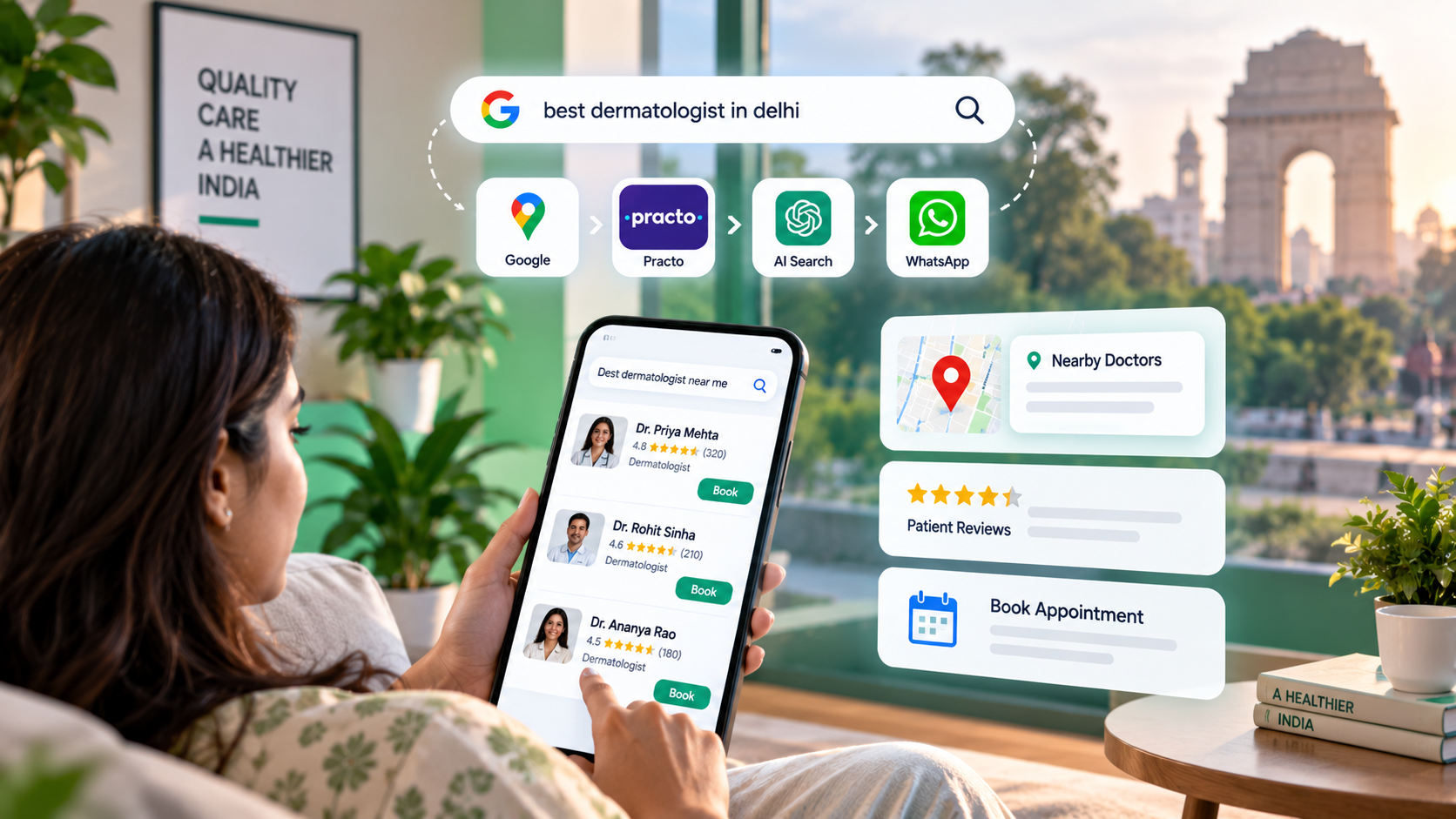
It usually begins on a search engine, most often Google, with a query like the specialty and area, or a symptom plus a city. From there the patient lands on a mix of a Google listing and the local pack, a Practo or similar directory profile, and sometimes the clinic's own website. They read reviews on Google and Practo, scan for credentials and services, and form a shortlist. The distinctive Indian pattern is the strong preference for one-click booking or a WhatsApp link over a phone call, so friction at the booking step loses patients who were otherwise ready. Practo and JustDial carry real weight in this journey, which is why a Practo profile is important, though as covered in AI search for doctors in India, it is no longer sufficient on its own.
The practical lesson is that you cannot pick one platform and ignore the rest. A patient may discover you on Google, verify you on Practo, and decide on your website, and a weak link anywhere in that chain breaks the journey. Presence has to be consistent across the whole path, not strong in one place and absent in another.
Reviews and reputation decide the shortlist
Once a patient has a few options, reviews do the cutting, and Indian patients read them closely. The same behaviour seen globally holds here: patients scan star ratings and recent reviews to decide who is worth contacting, and a practice with few, old, or poor reviews falls off the shortlist regardless of clinical quality.
This creates a real tension for Indian doctors, because the NMC rules restrict soliciting testimonials, a boundary explained in what NMC rules allow. The resolution is that reviews patients independently leave on Google or Practo sit outside your properties and outside the prohibition on displaying testimonials on your own site. The compliant, effective posture is to deliver good care and keep your listings accurate, while never soliciting or republishing testimonials as endorsements. Patients will still find and weigh the genuine reviews that accumulate, and those reviews will still decide your place on the shortlist.
The point for a practice is that reputation is now visible and comparative before a patient ever calls. You are being judged against the other names on the screen, on rating, recency, and volume, and that comparison happens in seconds.
The rise of AI and voice search in India
The newest and fastest-moving part of the Indian patient journey is AI and voice. It is no longer marginal. Reports indicate that around 25% of patients began using voice assistants to research providers in 2025, and 35% have chosen a provider influenced by social media presence.
Voice and AI change the search in an important way. A patient asking a voice assistant or an AI chatbot for a good paediatrician in their area does not get ten links to compare, they get a short spoken or written answer naming a few practices. If your practice is not in that answer, the patient may never see the list you would have ranked on. This is the same AI visibility dynamic playing out in India as elsewhere, and it rewards the same thing: consistent, confirmable information about who you are and where you practise. A practice that is accurate and consistent across Google and the directories is far more likely to be the one an assistant names.
For Indian practices, this is both a risk and an opening. The risk is being invisible in AI answers while competitors are named. The opening is that AI visibility is still a new discipline in India, so the practices that get their data right now will be named while others are still unaware the channel exists.
Where practices become invisible
Understanding the journey makes the failure points obvious, and they are consistent across practices that struggle.
The first is having no proper Google presence, so the patient's very first search does not surface you. The second is a Practo-only strategy, where a practice assumes a directory profile is enough and is absent from Google, AI, and its own findable website. The third is inconsistent details across platforms, where the name, address, or phone differ between Google, Practo, and the website, which both confuses patients and lowers the confidence that AI systems place in your record. The fourth is booking friction, where a patient ready to book cannot find a simple online or WhatsApp route and drops off. The fifth is a stale or thin review profile that loses the shortlist comparison.
Each of these is a break in the chain the patient actually follows, and each is fixable. The common thread is consistency and presence across the whole journey rather than a single strong platform. Measuring where you stand across all of it, using a doctor visibility score, turns these failure points into a checklist, and the ranking mechanics behind them are the same relevance and prominence factors described in distance versus prominence.
The journey differs by city tier and specialty
The patient journey is not uniform across India, and understanding the variation helps a practice know where to focus. A metro patient and a Tier 3 patient use overlapping but different paths.
In Tier 1 cities, the journey is closest to the global pattern: English-first search, heavy use of Google and Practo, close review-reading, a strong expectation of online or app-based booking, and rising use of AI and voice. Patients here compare several practices and decide quickly, so completeness and reputation matter intensely. In Tier 2 and Tier 3 cities, the journey is growing just as fast but skews differently: more vernacular search, greater weight on WhatsApp and phone contact alongside apps, and often stronger interplay between an online check and a local referral. The share of patients researching online is high everywhere, but what they search in and how they prefer to book varies.
Specialty matters too. High-consideration or elective care, such as cosmetic, dental, fertility, or specialist consultation, tends to involve more research, more review-reading, and more comparison, so online presence is decisive. More routine or urgent care compresses the journey, but even there the first move is usually a search. The practical point is to match your effort to your patients: a metro cosmetic practice should obsess over reviews and a polished English and AI presence, while a Tier 2 general practice should prioritise vernacular findability and an easy WhatsApp booking route, a language question explored in Hindi or English for your clinic website.
What this means for your practice
Translating the journey into action comes down to being present and consistent at each step a patient takes, rather than betting on one platform. The practices that win the online patient are not the ones with the flashiest website, they are the ones with no broken links in the chain.
Concretely, that means a complete and accurate Google Business Profile so the first search finds you, a consistent Practo and directory presence so verification confirms you, genuine and recent reviews so the shortlist keeps you, an easy online or WhatsApp booking route so readiness converts, and accurate, consistent data everywhere so AI and voice assistants name you. Each of these maps to a step the patient actually takes, and a weakness at any step loses the patient there. This is exactly what a doctor visibility score measures across the whole journey, and the underlying ranking mechanics are the relevance and prominence factors in distance versus prominence. Crucially, all of it is accuracy work that stays within NMC norms, as set out in what NMC rules allow.
Where to start
The Indian patient journey has quietly become an online one, on a phone, in minutes, across Google, Practo, reviews, and now AI. A practice does not need to master every platform overnight, but it does need to be present and consistent along the path the patient actually follows, because a single broken link, an absent Google listing, a Practo-only presence, mismatched details, or booking friction, loses the patient at that step. The first move is to see the whole journey as a patient does.
The Free Audit runs your practice across Google, AI assistants, and directories, scores your findability on the 7 pillars, and shows exactly which gaps to close first. It takes about 90 seconds and needs no signup for the free score.
Run your free audit at thedocmirror.com
By the The Doc Mirror team