How to Get Your Clinic Recommended in Google Gemini and AI Overviews
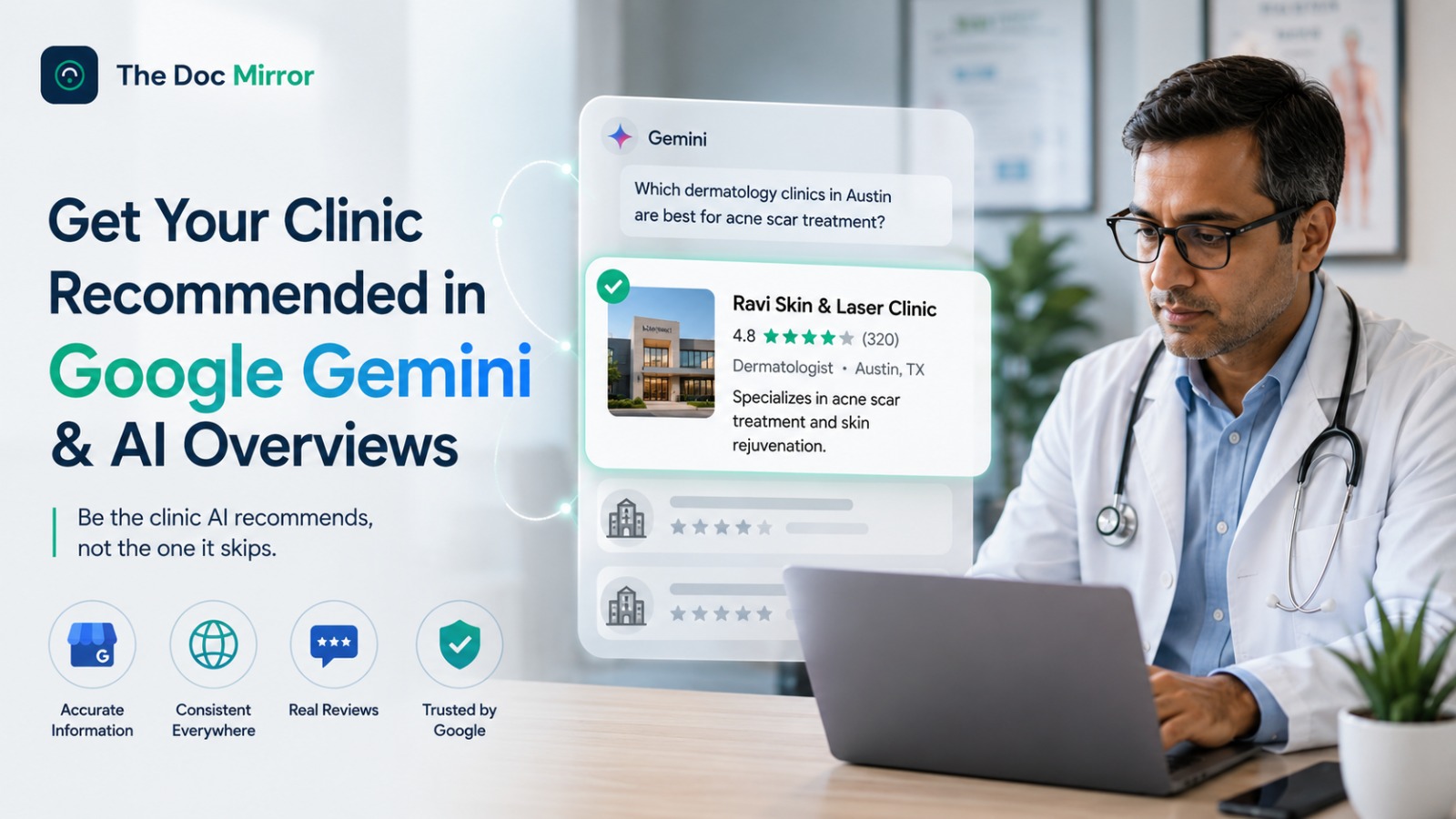
To get your clinic recommended in Google Gemini and AI Overviews, make your factual information consistent everywhere Google already reads it: your Google Business Profile, your website, and the major directories. Gemini AI for doctors is not a separate search engine you optimize in isolation. It draws on Google's existing index and Knowledge Graph, so a clean, verifiable, and consistent presence is what makes an AI answer name you instead of the cardiologist two streets over.
What is Gemini and how does it relate to AI Overviews
Gemini is Google's AI assistant, and AI Overviews are the AI-generated answers that now appear at the top of many Google search results. Both are built on the same underlying models, and both lean heavily on Google's own understanding of the web.
When a patient in Austin types "best dermatologist near me for acne scars" into Google, an AI Overview may summarize a few options above the classic blue links. When someone in Bengaluru asks Gemini "which gynaecologist in Indiranagar treats PCOS," the assistant composes an answer from what Google already knows about local clinics.
The important point for a busy doctor: you are not optimizing for a mysterious new box. You are strengthening the signals Google has always used, so its AI layer can quote you with confidence. If Google trusts your information, Gemini tends to trust it too.
What actually influences Gemini for a medical query
Google has never published a public ranking formula, and it will not for AI features either. But the mechanics are visible if you watch which clinics get named. For medical queries specifically, a handful of signals do most of the work.
- Google Business Profile accuracy. Your name, specialty, address, hours, and services must be exact and current. This is the single richest structured source Google has about your practice.
- Consistency across the open web. Your clinic details should match on your website and on directories. A conflicting address or an old phone number makes Google less sure it is describing the right entity.
- A clear, factual website. Pages that plainly state who you are, what conditions you treat, and where you practice give the model text it can quote directly.
- Reviews and their content. Volume, recency, and the actual words in reviews (for example "scar revision" or "diabetic foot care") help match you to specific patient questions.
- Third-party corroboration. Being described the same way across independent sources raises confidence. In the US that means Healthgrades, Zocdoc, Vitals, and WebMD. In India it means Practo, JustDial, Lybrate, and Apollo 247.
Notice what is not on this list: paid ads, keyword tricks, or a secret tag. The AI answer layer rewards a practice that is easy to describe truthfully.
Does Gemini need special schema or markup
No. Google's own Search documentation states plainly that there is no special markup required to appear in AI features. You do not need a hidden technical trick to be eligible for AI Overviews or a Gemini recommendation.
This matters because a lot of anxious advice tells doctors to install elaborate code. Structured data can still help Google understand your pages, and it is worth doing well. But eligibility for AI answers does not hinge on it. The absence of a required tag means the real work is editorial, not technical: say true things clearly, in the same way, everywhere.
If you want to go deeper on structured data specifically, see our guide to medical schema markup for AI. Treat it as a helpful accelerant, not a gate.
What most doctors get wrong about Google AI search
Most doctors assume that ranking well in classic Google results is enough, or that AI Overviews will simply echo whoever sits at position 1. Neither is reliable.
AI Overviews often synthesize across several sources rather than copying the top link. A clinic that ranks fourth but has a crystal-clear services page and consistent citations can get named in the summary while the number 1 result is skipped. The AI is answering a question, not awarding a trophy for backlinks.
The second mistake is treating Gemini as a Google Maps problem. Maps and the local pack matter, but the AI answer layer is a distinct surface. It reads your Google Business Profile as data, then blends it with your website text and third-party mentions to form a sentence. If your only asset is a Maps pin with no supporting detail, the AI has little to quote.
The third mistake is invisibility to yourself. Few doctors have ever asked Gemini about their own specialty and city to see who gets named. That five-minute check is the fastest reality test available.
How to get your clinic recommended in Gemini: a practical checklist
This is the work, in order. None of it requires advertising, which keeps it clean for doctors in India operating under NMC rules that restrict self-promotion. Everything here is making your existing, factual information consistent and findable, not soliciting patients.
- Claim and complete your Google Business Profile. Fill every field: exact clinic name, primary specialty, full address, hours, phone, and the conditions or procedures you handle. Keep it current when anything changes.
- Make your website state the facts plainly. Have a page per major service or condition. Write in clear sentences a model can lift, for example "Dr. Anjali Rao is a gynaecologist in Pune treating PCOS, endometriosis, and high-risk pregnancy."
- Fix your directory listings. Ensure your details match across Healthgrades, Zocdoc, Vitals, and WebMD in the US, or Practo, JustDial, Lybrate, and Apollo 247 in India. Correct any old address or number.
- Build a real FAQ section. Answer the questions patients actually ask, in 40 to 100 words each. This is the format AI answers reuse most. See our guide to medical FAQ content for AI.
- Keep reviews flowing and specific. Encourage satisfied patients to describe what you treated. Specific words help the AI match you to specific questions.
- Recheck monthly. Ask Gemini and Google itself the queries a patient would use, and note whether you appear.
Do these six and you are aligned with almost every signal Google's AI layer uses. This is the same foundation that helps you across ChatGPT, Gemini, Claude, and Perplexity, since they reward the same underlying clarity.
How US and India differ for Gemini visibility
The mechanics are the same in both markets, but the details around them differ, and it pays to be precise.
In the US, patients freely combine insurance, procedure, and neighborhood in one query, such as "endocrinologist in Denver who takes Aetna." Your profile and pages should carry those practical facts. Directory depth is high, so Healthgrades, Zocdoc, Vitals, and WebMD consistency does real work. A Full Report at $19 can show exactly where your details conflict.
In India, the framing must stay educational rather than promotional. NMC rules restrict how a doctor may advertise, so the goal is accuracy and findability, not marketing claims. Make sure Practo, JustDial, Lybrate, and Apollo 247 describe you the same way, and that your Google Business Profile for your Mumbai, Delhi, or Hyderabad clinic is complete and truthful. A Full Report at ₹1,599 gives the same audit for the Indian directory set.
For a market-specific deep dive, read AI search for doctors in India. The principle holds in Chennai and Chicago alike: consistency is the currency Google's AI trusts.
Why this compounds over time
Every correction you make is read by Google once and reused across many AI answers. Fix your services page, and you help the AI answer dozens of related questions more confidently.
There is research behind the effort. A study on Generative Engine Optimization (GEO, meaning Generative Engine Optimization, from Princeton, Georgia Tech, the Allen Institute for AI, and IIT Delhi) found that specific content choices can raise how often a source is cited in AI answers by up to 40%. Clarity and citation-friendly writing are not cosmetic. They change whether you are quoted.
Patient behavior is moving the same direction. About 1 in 3 US adults have used AI chatbots for health information, according to a KFF poll. And in a rater8 2025 report, 26% of patients said an AI tool influenced their choice of provider. The AI answer layer is already inside the decision, not waiting outside it.
Where to start
You cannot improve what you have not measured. Before you touch a single page, find out how Google's AI layer and the other assistants currently describe you, and where your details conflict. That baseline turns a vague worry into a short task list.
The Free Audit runs your name across Google, ChatGPT, Gemini, Claude, Perplexity, and 6 directories, scores you on the 7 pillars, and shows which gaps to close first. It takes about 90 seconds.
Run your free audit at thedocmirror.com
By the The Doc Mirror team