Why Ranking #1 on Google No Longer Guarantees Patients Find You
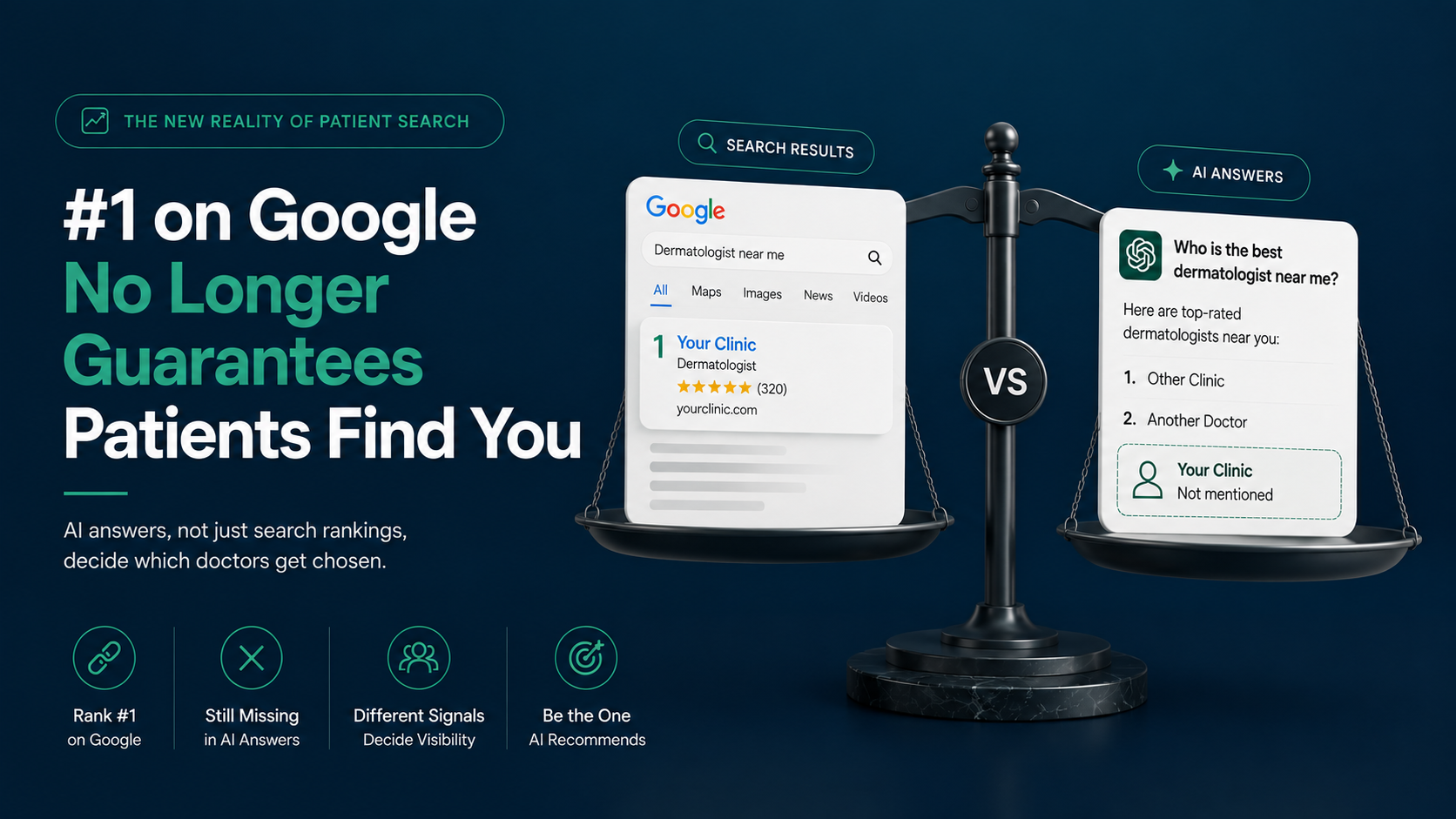
The contest of google ranking vs AI search is really a contest between two different scoreboards, and most doctors are only watching one. Ranking #1 on Google decides which link a patient clicks. An AI assistant decides which practice gets named before any click happens. You can hold position 1 for "dermatologist near me" and still be completely absent when a patient asks ChatGPT the same question. Number 1 on Google is not enough anymore, because a growing share of patients never see your link. They read an answer instead.
What is the difference between Google ranking and AI search
Google ranking is your position in a list of blue links returned by a search engine. AI search is a synthesized answer built by an assistant such as ChatGPT, Gemini, Claude, or Perplexity, which names a few options directly instead of handing you ten links to sort through.
The distinction matters because the two systems reward different things. A search engine ranks pages. An answer engine composes a response and decides which practices are worth mentioning inside it. One gives the patient a choice of links. The other gives the patient a shortlist, often before they have visited a single website.
This is the heart of ai search vs Google. In the ranked-list world, your job was to climb to the top of the results. In the answer world, your job is to be the practice the model names. Those are not the same job, and doing the first perfectly does not guarantee the second.
Two scoreboards, two different games
Think of it as two separate scoreboards, and increasingly patients look at the newer one first.
The Google scoreboard measures whether your page deserves to rank. It weighs backlinks, page speed, keywords, and on-page relevance. Win it and your link sits near the top of the results for a patient in Denver or Pune who types your specialty into the search bar.
The AI scoreboard measures whether your practice deserves to be named. An assistant reading the open web decides which cardiologist in Austin or gynaecologist in Bengaluru to mention when a patient asks for a recommendation. It does not show a ranked list. It states an answer, and either your name is in it or it is not.
Here is why a #1 ranking does not carry over automatically:
- A top Google position is a page-level win. An AI mention is an entity-level win, meaning the model has to recognize you as a real, consistent practice, not just a well-optimized page.
- Google shows the searcher your link and lets them judge. An AI assistant judges for the patient and returns a short answer, so being merely present is not enough. You have to be selected.
- The signals overlap but are not identical. The extra signals an answer engine leans on, such as consistent facts across the web and clear structured content, are exactly the ones a link-focused SEO strategy tends to ignore.
How you can rank #1 and still be invisible to AI
Picture a well-run orthopaedic practice that has ranked first on Google for years. The site is fast, the keywords are right, and the reviews are strong. A patient asks ChatGPT, "Who are the best knee specialists near me?" The practice is not mentioned. How does that happen when the same practice dominates the search results?
Because the answer engine reads different evidence. It is not just looking at your one strong page. It cross-checks your name, address, and specialty across the web, reads your directory profiles, and looks for content it can lift cleanly into an answer. If your Google Business Profile, your Healthgrades page, and your own site disagree on your name or address, the model becomes uncertain. An uncertain model leaves you out rather than risk being wrong.
A few common reasons a top-ranked doctor stays absent from AI answers:
- Inconsistent facts across directories. Your website says one clinic address, Practo or Zocdoc says another. The model cannot resolve who you are with confidence.
- Content that ranks but does not answer. Your page is optimized to rank, but it buries the actual answer under a long introduction, so there is no clean passage to quote.
- Thin presence outside your own site. Google can rank a strong single page. An answer engine wants corroboration from multiple trusted sources before it names you.
- No structured signals. Nothing on the page clearly states who you are, where you practise, and what you treat in a form a machine can read without guessing.
This is why seo is not enough on its own. The very thing that wins the Google scoreboard, a single dominant page, is not what wins the AI scoreboard, which is a consistent, corroborated, quotable identity across the whole web. We break down the mechanics of selection in how ChatGPT chooses doctors.
Why patients now start with the answer, not the link
The shift is not theoretical. A KFF poll found that about 1 in 3 US adults have used AI chatbots for health information. A 2025 rater8 report found that 26% of patients said an AI tool influenced their choice of provider, and that 73% adopted a new way to research providers in the past year. These are the patients deciding this month whether to book with you or someone the assistant named instead.
The behaviour is the same across markets. A patient in New York asks Perplexity for a "top-rated dentist near me." A patient in Mumbai asks Gemini, "which physiotherapist should I see for lower back pain?" In both cases the assistant returns a short answer. If your name is not in it, the patient may never reach the Google results where you rank first.
This is what makes google rank and ai visibility two separate things to manage. One is about winning the click. The other is about surviving the moment before the click, when the assistant decides who is worth naming at all.
What most doctors get wrong about being #1
The most common mistake is treating a top Google ranking as proof that your visibility is handled. It proves one scoreboard is won. It says nothing about the other.
Three assumptions cost doctors visibility here:
- "If I rank, AI will find me." Not reliably. Ranking helps, but answer engines weigh consistency and structure that a ranked page can lack entirely.
- "AI just reads Google's top result." It does not. Assistants read broadly across the open web and your directory profiles, then synthesize. Your one strong page is a single input among many.
- "This is a US trend that has not reached my city." It has. Patients in Delhi, Hyderabad, and Chennai are asking the same assistants the same questions as patients in Denver and Austin.
For a doctor in India, the response stays inside NMC guidance. You are not advertising or soliciting patients. You are making your existing, factual information consistent and findable across Google Business Profile, Practo, JustDial, and Apollo 247, so that an assistant describing your specialty gets your details right. That is education and accuracy, not promotion.
What a doctor should do about the gap
You do not need to abandon your Google work. You need to add the layer that the AI scoreboard rewards. The two reinforce each other when done well.
- Reconcile your facts everywhere. Make your name, specialty, and address identical across your website, Google Business Profile, and every directory, from Healthgrades and Vitals in the US to Practo and Lybrate in India.
- Front-load clean answers. On your key pages, state the answer to a patient's question in the first two sentences, so a model has something clear to lift.
- Strengthen your presence beyond your own site. Consistent, factual directory profiles give an answer engine the corroboration it needs to name you with confidence.
- Check what the assistants actually say. Ask ChatGPT, Gemini, Claude, and Perplexity the questions a patient in your city would ask, and read whether you appear and whether the facts are right.
- Measure both scoreboards, not one. Track your Google ranking as you always have, and separately track whether AI assistants name you.
For the wider strategic picture, start with our AI visibility for doctors overview, and see how the same patient behaviour plays out in the zero-click patient era.