Google AI Overviews for Doctors: What Changes When Google Answers Instead of Linking
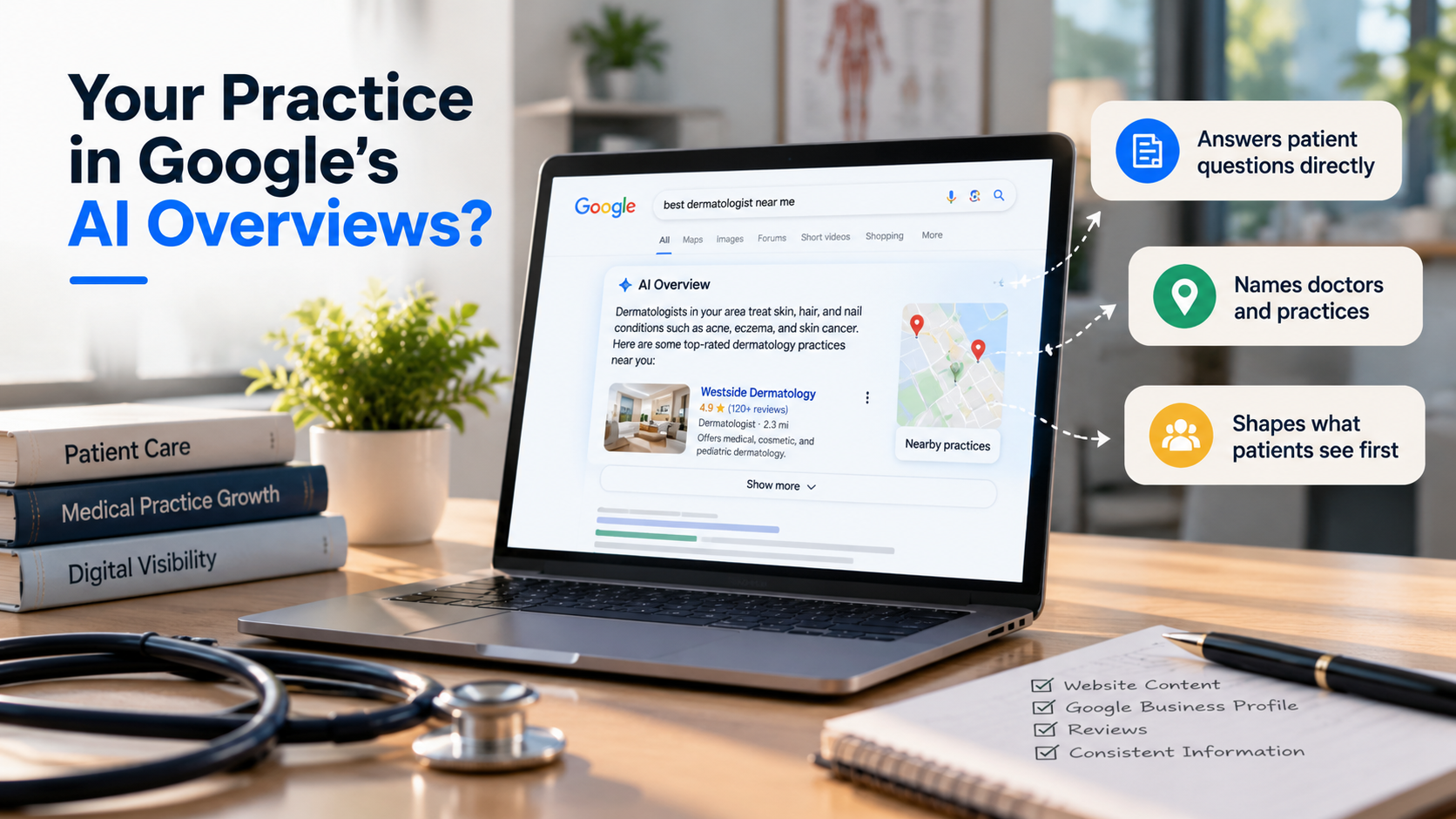
Google AI Overviews are the AI-generated summaries that now appear above the normal blue links on many Google searches, answering a patient's question directly instead of sending them to a website first. For queries like "best dermatologist near me" or "do I need a referral to see a cardiologist," Google increasingly writes the answer itself and names, or omits, specific doctors and practices inside that summary. The Doc Mirror tracks how doctors appear across Google, ChatGPT, Gemini, Claude, and Perplexity, and AI Overviews are one of the fastest-moving pieces of that picture. This article explains what AI Overviews are, how Google decides what to pull into them for medical and local searches, and what a doctor can actually influence.
This is not a general guide to AI visibility. It is narrowly about one feature on the Google results page, how it behaves for medical and local queries, and where a doctor's control begins and ends.
What Google AI Overviews Actually Are
AI Overviews are a feature built into Google Search that generates a written summary at the top of the results page, before any ranked list of websites appears. Google introduced them as part of its move toward generative search, using its own Gemini models to read multiple web pages and produce one synthesized answer. According to Google's own AI Overviews documentation, the feature draws from Google's web index and ranking systems, then uses a language model to summarize and organize that information into a direct response.
For a doctor, the practical effect is this: a patient searching "what does a first visit to a rheumatologist involve" or "urgent care vs ER for a sprained ankle" may get a full answer without clicking any website. If that answer names specific practices, clinics, or doctors, being named there puts a practice in front of a patient before the patient ever scrolls to a ranked search result. If it doesn't name anyone, the summary still shapes what the patient believes before they choose who to call.
AI Overviews are not guaranteed to appear on every search. Google shows them selectively, more often on informational questions than on plain "near me" searches, though local and medical queries increasingly trigger them too. They also are not static. The same query can produce a different AI Overview a week later as Google's index and models update.
How Google Decides What Goes Into a Medical AI Overview
Google has stated publicly, through Google Search Central, that AI Overviews are generated from content already surfaced through Google's normal ranking process. In other words, a page or a practice generally has to already rank reasonably well, or be cited by pages that rank well, before it can be summarized into an AI Overview at all.
For medical and health-related queries specifically, Google applies its long-standing "Your Money or Your Life" standard, which demands a higher bar for accuracy and trustworthiness because incorrect information could affect a person's health or finances. This means clear, factually accurate content on a practice's own site, plus mentions on trustworthy third-party sources, carries more weight for medical AI Overviews than it might for a low-stakes topic.
Local medical queries add another layer. Google Business Profile data, review volume, and review content often feed into how Google understands a specific practice, which can influence whether that practice gets named when an AI Overview answers a "near me" or "best [specialty] in [city]" question. Consistent business information across the web, meaning the same name, address, phone number, and specialty listed the same way everywhere, still functions as a trust signal Google's systems can read.
None of this is a formula a practice can reverse-engineer with certainty. Google does not publish a checklist for getting named in an AI Overview. What it has published is the underlying logic: rank well, be accurate, be corroborated by other trustworthy sources, and keep local information consistent.
What Still Matters for AI Overviews
Several long-standing SEO fundamentals carry directly into AI Overviews rather than being replaced by them.
Clear, well-organized content that answers a specific question tends to be easier for Google's systems to extract and summarize accurately. A page titled "What to Expect at Your First Cardiology Appointment" that actually answers that question in plain language is more useful to a summarization model than a vague "About Us" page.
Review volume and quality still matter. Doctors with 50+ reviews rank significantly higher than those with under 10, and that same trust signal appears to carry into how Google's local and AI systems evaluate a practice. A 4.5+ star rating is the minimum threshold most patients will consider, and it likely functions similarly as a floor for AI-generated summaries about local providers.
Structured, accurate information on a practice's own website, including services offered, insurance accepted, and credentials, gives Google clean material to summarize correctly. Since 77% of patients use search engines to find a doctor, and patients check an average of 3 sources before choosing one, being accurately represented in the first source they encounter matters more, not less, when that source is a generated summary rather than a list of links.
What Doesn't Matter Anymore, or Matters Less
Ranking in position one through three no longer guarantees visibility in the way it used to, because the top 3 Google results get roughly 68% of all clicks only when a user actually reaches the ranked list. An AI Overview can push those results further down the page, meaning a well-ranked page can still be seen less often than before, even without losing any ranking position.
Keyword density and older SEO tactics built purely around matching search phrases carry less weight. A summarization model is evaluating whether content clearly answers a question, not whether it repeats a phrase a certain number of times.
A single strong page is less powerful in isolation than a practice's overall pattern of trustworthy signals: consistent Google Business Profile details, real reviews, accurate site content, and mentions on reputable third-party health and local directories. AI Overviews appear to reward corroboration across sources more than they reward any one page trying to do all the work.
Where This Fits Into the Broader AI Visibility Picture
AI Overviews are one surface among several where patients now encounter answers about doctors before they ever visit a website. ChatGPT, Gemini, Claude, and Perplexity each generate their own answers to health and provider questions, using different data sources and different logic than Google's search index. Understanding AI Overviews specifically is useful, but it is one piece of the broader AI visibility picture that also includes how these separate AI assistants describe, recommend, or omit a practice.
It's also worth understanding how AI Overviews relate to Google's Gemini-powered results more broadly, since the same underlying models that power Gemini as a standalone assistant also power the summarization inside AI Overviews. That shared foundation means some of what influences one may influence the other, even though they appear in different places and serve different user behaviors.
What People Get Wrong About AI Overviews
The most common mistake is treating AI Overviews as something a practice can directly optimize for, the way older SEO treated a keyword. There is no confirmed technique that guarantees inclusion, and any claim promising one should be treated with skepticism.
A second mistake is assuming AI Overviews only affect broad, generic searches. In practice, specific medical questions and local "near me" searches are increasingly where these summaries appear, which means the queries most relevant to attracting new patients are exactly the ones being affected.
A third mistake is ignoring AI Overviews because a practice already ranks well organically. Ranking well is a prerequisite for being summarized, not a guarantee of it, and a page that ranks third but is poorly written may be skipped in favor of a page that ranks eighth but answers the question more clearly.
A fourth mistake is focusing only on the practice's own website. Since AI Overviews often draw on multiple sources to build one answer, a practice's reviews, directory listings, and third-party mentions matter as much as its own pages.
A Practical Checklist for AI Overviews
- Audit how your practice currently appears when patients ask common questions on Google, and note whether an AI Overview shows up and what it says.
- Make sure your Google Business Profile has consistent name, address, phone number, specialty, and hours across every listing online.
- Write pages that answer specific patient questions directly and plainly, rather than general marketing pages about the practice.
- Keep gathering reviews consistently, since volume and recency both appear to factor into trust signals Google can read.
- Check that your practice's information matches across directories, insurance sites, and hospital affiliation pages, since inconsistency undermines corroboration.
- Revisit this regularly. AI Overviews change as Google's models and index update, so a one-time fix does not hold indefinitely.
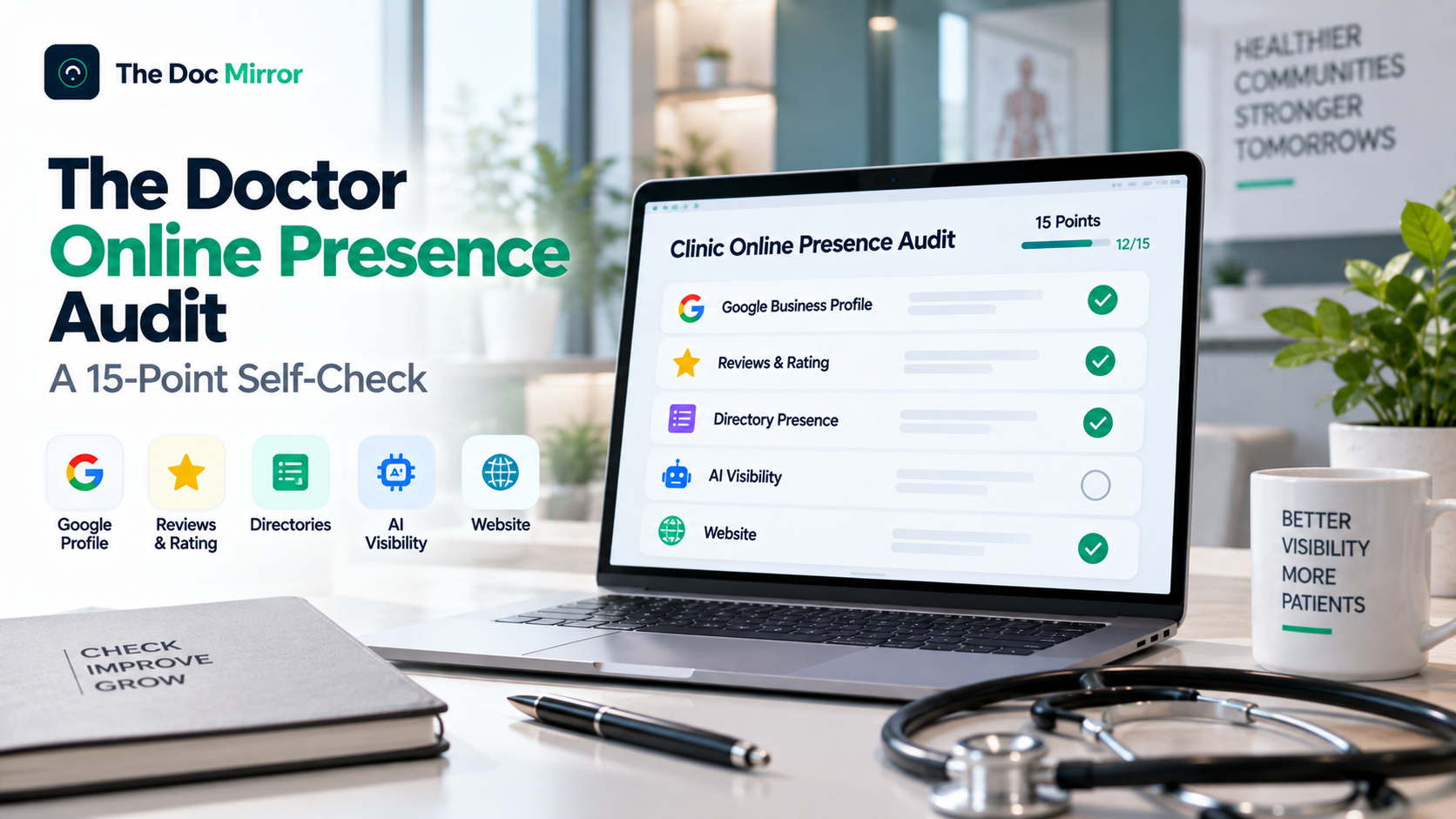
- For a structured, step-by-step way to act on this across every part of a practice's online visibility, use a dedicated checklist rather than working from memory.
Conclusion
Google AI Overviews change where and how patients encounter information about a practice, often before they reach a single ranked website. The fundamentals that earn trust from Google, meaning accurate content, consistent local information, and real reviews, still carry the most weight, even though the surface where patients see the result has changed. There is no shortcut around those fundamentals, only a clearer picture of why they matter now more directly than before.
The Doc Mirror shows exactly how your practice currently appears across Google AI Overviews and the leading AI assistants, in one visibility score. Run your free audit and see where you stand today.
By the The Doc Mirror team
Internal Links
| Target page | Anchor text used | Reason |
|---|---|---|
| /resources/ai-visibility-for-doctors | "the broader AI visibility picture" | Links out to the cluster pillar page from the "Where This Fits Into the Broader AI Visibility Picture" section, positioning this article as one narrow piece of the larger AI visibility topic the pillar page covers. |
| /resources/gemini-ai-for-doctors | "Google's Gemini-powered results" | Links from the same section to explain the technical relationship between AI Overviews (a Search feature) and Gemini (a standalone assistant), since both share underlying models and readers researching one often need the other. |
| /resources/ai-visibility-checklist-doctors | "a step-by-step way to act on this" | Links from the final bullet of the practical checklist section, directing readers who want deeper, actionable guidance beyond this page's explainer-level checklist. |
| thedocmirror.com | "Run your free audit" | Free Audit CTA placed in the conclusion, inviting the reader to see their own practice's current AI Overviews and AI assistant visibility after reading the explainer. |