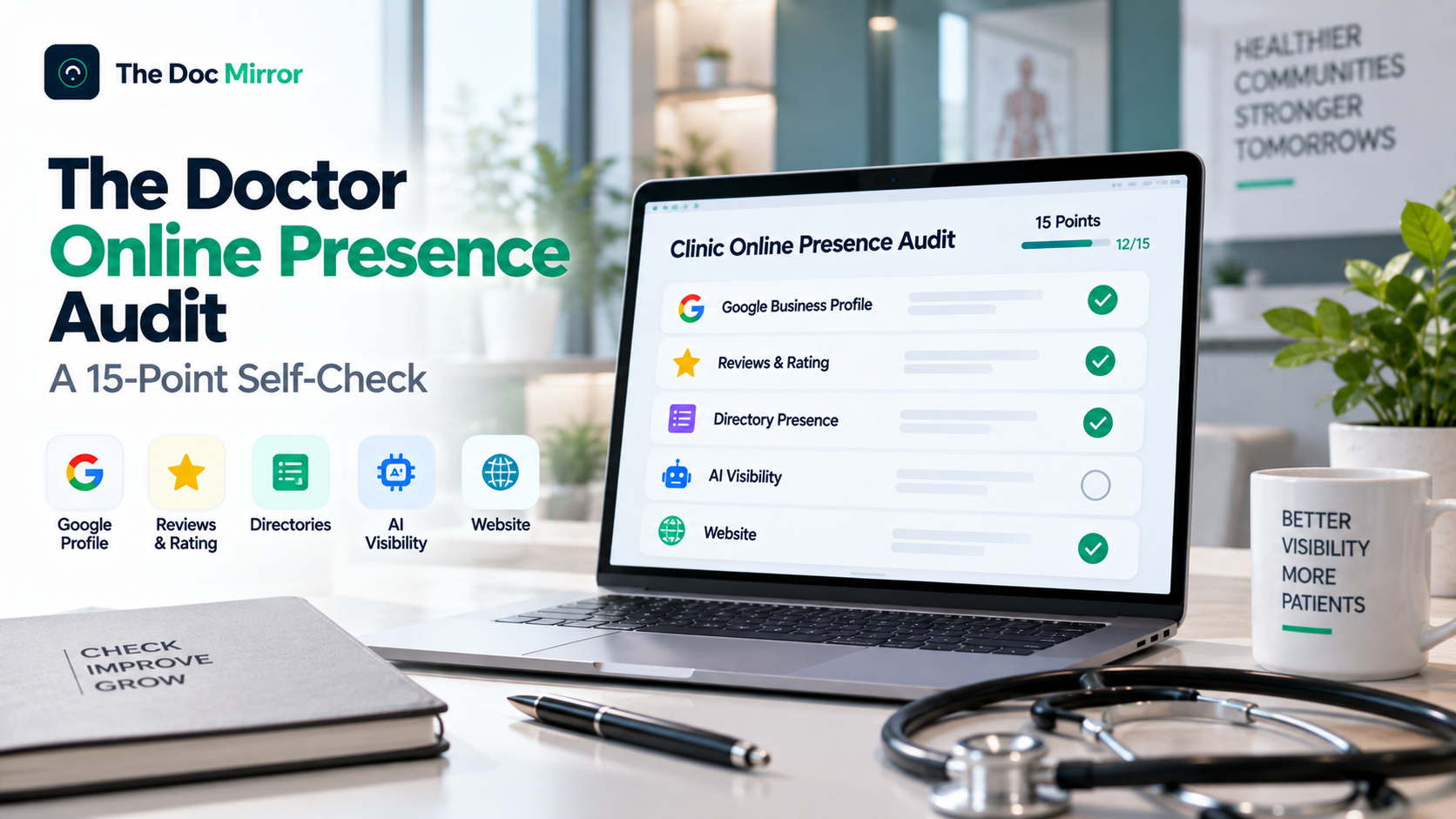
The Doctor Online Presence Audit: A 15-Point Self-Check Every Practice Should Run
The fastest way to find out why patients are choosing a competitor is to audit your own online presence the way a patient experiences it, across Google, AI assistants, directories, reviews, and your website, in one sitting. Most practices have never done this. They assume that because they built a website years ago and have a Google listing somewhere, they are covered, while a specific and fixable gap quietly costs them patients every week. This checklist gives you a structured 15-point self-audit you can run in under an hour, grouped into the five areas that actually decide whether a patient finds and chooses you. It is written for established practices that want to grade themselves honestly, not for a new clinic setting up from scratch. Work through it once, and you will know exactly what to fix first.
How to run this audit
Before the checklist, three ground rules make the results trustworthy. Do the audit on a phone that is not signed into your business accounts, because that is closest to what a patient sees. Search the way a patient would, using your specialty and city rather than your practice name, since name searches hide the discovery problem. And write down a yes or no for each point, so the audit produces a punch list rather than a vague impression.
The 15 points fall into five groups: your Google Business Profile, your reviews and rating, your directory presence, your AI visibility, and your website. Each group maps to how a real patient moves from searching to choosing, and each maps to a pillar of the score explained in what a doctor visibility score measures. You are essentially scoring yourself by hand before letting any tool do it automatically.
Group 1: your Google Business Profile (points 1 to 4)
Your Google Business Profile is the first thing most patients see, so it carries the most weight, and it is where the most common gaps hide.
Point 1: Do you have a claimed, verified profile? Search your specialty and city and check that your practice appears with a claimed listing, not an unclaimed or missing one. Point 2: Is every field complete? Name, address, hours, phone, website, category, and description should all be filled and accurate, because a half-finished profile caps your strongest asset. Point 3: Is your primary category the most specific accurate one? A cardiologist listed as a generic "Doctor" is competing in the wrong pool, since category is the strongest relevance signal, as explained in distance versus prominence. Point 4: Does the map pin land on your actual entrance? Tap for directions and confirm the route ends at your door, not a rooftop or the wrong side of the building.
If any of these four is a no, fix it first, because this group feeds everything downstream. A complete, correctly categorised, correctly located profile is the foundation the rest of your presence sits on.
Group 2: your reviews and rating (points 5 to 7)
Reviews decide whether patients accept you once they find you, and the bar is higher than most doctors realise.
Point 5: Is your star average at or above 4.0? Most patients filter out anything below four stars before reading a word, with surveys finding that around 78% of patients only consider providers rated four or higher, so a rating in the high threes is quietly disqualifying, a dynamic covered in the patient star-rating threshold. Point 6: Do you have enough reviews to be credible? Compare your count to the practices ranking above you, with roughly 50 as a useful floor, as discussed in how many reviews a clinic needs to rank. Point 7: Are your reviews recent? Check the date of your newest review, because most patients trust only reviews from the past year, and a profile whose last review is months old reads as stale.
A yes on all three means reviews are working for you. A no on any is usually the reason a well-run practice still loses discovery searches, and it is fixable with a steady habit of asking satisfied patients.
Group 3: your directory presence (points 8 to 10)
Directories build the consistent, confirmable footprint that both Google and AI systems trust, and they are the most neglected group.
Point 8: Are you listed on the major directories for your market? In the US that means Healthgrades, Zocdoc, Vitals, and WebMD; in India, Practo, JustDial, Lybrate, and Apollo 247. Point 9: Do your name, address, and phone match exactly across all of them? Inconsistent details, even an old suite number, lower confidence in your whole record, which is why a NAP audit is worth 30 minutes. Point 10: Are there any duplicate or outdated listings? Old listings from a previous location or a departed partner point patients astray and muddy your data.
Depth and consistency here are what separate practices that get named in AI answers from those that do not, so a no in this group often explains an invisible AI presence.
Group 4: your AI visibility (points 11 to 12)
This is the newest group and the one most practices score zero on without realising it, because they have never checked. It matters because AI now shapes a real share of provider decisions, with rater8 finding AI tools a top influence for 36% of patients who searched for a new doctor, ahead of Google search.
Point 11: Do AI assistants name you? Ask ChatGPT, Gemini, Claude, and Perplexity for the best doctor in your specialty and city, one at a time, and note whether you appear and which competitors do, using the method in how to check your AI visibility. Point 12: Is the information they give about you accurate? If an assistant names you but with a wrong address or specialty, that is a data-consistency problem feeding through, and it is as damaging as being absent.
Because AI is now a real channel through which patients discover providers, a blank in this group is a genuine gap, not a novelty. The fixes are the same consistency and directory work as the other groups, which is the encouraging part.
Group 5: your website (points 13 to 15)
Your website is where a patient confirms their choice, and where AI systems read the facts they cite, so it needs to be both findable and clear.
Point 13: Is your site indexed and mobile-friendly? Search your practice name and confirm your site appears, then open it on a phone to check it is usable, since most patients are on mobile. Point 14: Does it carry clear, factual information and schema? Your specialty, services, conditions treated, and contact details should be plainly stated, and schema markup helps machines read them, though it is not strictly required to appear in AI features. Point 15: Do your website details match your listings? The name, address, and phone on your site must match your Google Business Profile and directories exactly, because the whole system rewards agreement.
A site that is findable, factual, and consistent completes the picture. A beautiful site that conflicts with your listings, or that no patient can find, undercuts everything else.
What to do with your score
Add up your yes answers out of 15. The number is less important than the pattern, because the audit is designed to show you the weakest group, and the weakest group is where the fastest gains are.
If your weak group is the Google Business Profile, start there, because it feeds every other group. If it is reviews, begin a steady asking habit. If it is directories, run a consistency clean-up. If it is AI visibility, the fix is usually the directory and consistency work you already identified. If it is the website, prioritise indexing and matching your details. The point of a self-audit is not a grade, it is an ordered to-do list, and the group with the most no answers is the top of that list.
A note for clinics in India. Every point here stays within NMC norms, because the audit is about accuracy and completeness, not promotion. Checking that your factual details are correct and consistent across Google, Practo, and your site is hygiene, not advertising, and it is exactly the work the rules permit.
What a typical audit turns up
To make the audit concrete, here is the pattern most established practices find when they run it honestly for the first time. They usually score well on the basics they have always paid attention to, and badly on one or two groups they never think about.
A common result looks like this: the Google Business Profile is claimed and mostly complete, so Group 1 scores three or four out of four, but the primary category is a generic one, costing a point. Reviews are decent in number but the newest is several months old, so Group 2 loses the recency point. Directories are the weak spot, with the practice on Google and one directory but missing from three others and with a mismatched suite number, so Group 3 scores one or two. AI visibility is a complete blank, because no assistant names the practice, so Group 4 is zero. The website is fine but its phone number differs from the Google listing, costing a consistency point in Group 5.
That profile, strong on the obvious, weak on directories and AI, is the single most common shape, and it explains a familiar complaint: the practice feels established yet keeps losing new patients to competitors. The audit shows why. The patient searching cold never reaches the strong parts, because the weak groups fail earlier in the journey. Seeing the specific zeros turns a vague frustration into three or four concrete fixes.
Turning the audit into a 90-day plan
A checklist is only useful if it becomes action, so convert your no answers into a simple quarter-long plan, tackling one group at a time in order of weight.
In the first month, fix the foundation: complete and correct your Google Business Profile, set the exact primary category, and correct the map pin, because Group 1 feeds everything else. In the second month, work consistency and depth: run a directory clean-up so your name, address, and phone match everywhere, add the missing directories for your market, and align your website details to match. In the third month, build the ongoing signals: start a steady habit of asking satisfied patients for reviews to fix rating and recency, and recheck whether AI assistants now name you, since the consistency work usually lifts that group without separate effort. Re-run the full 15-point audit at the end of the quarter to confirm the movement. This staged approach mirrors the pillar-by-pillar logic of a doctor visibility score, and it turns an intimidating list into three focused months.
Where to start
Most practices are surprised by their own audit, not because they are doing badly, but because a single group they never thought about, usually directories or AI visibility, is dragging down everything else. Running the 15 points by hand turns a vague worry into an ordered list, and the fixes are almost always free to begin. Start with the group that scored the most no answers, and you will move the needle faster than any amount of new spending.
The Free Audit runs this same check automatically across Google, ChatGPT, Gemini, Claude, Perplexity, and 6 directories, scores you on the 7 pillars, and shows exactly which gaps to close first. It takes about 90 seconds and needs no signup for the free score.
Run your free audit at thedocmirror.com
By the The Doc Mirror team