Local SEO Checklist for New Practices: The First 90 Days
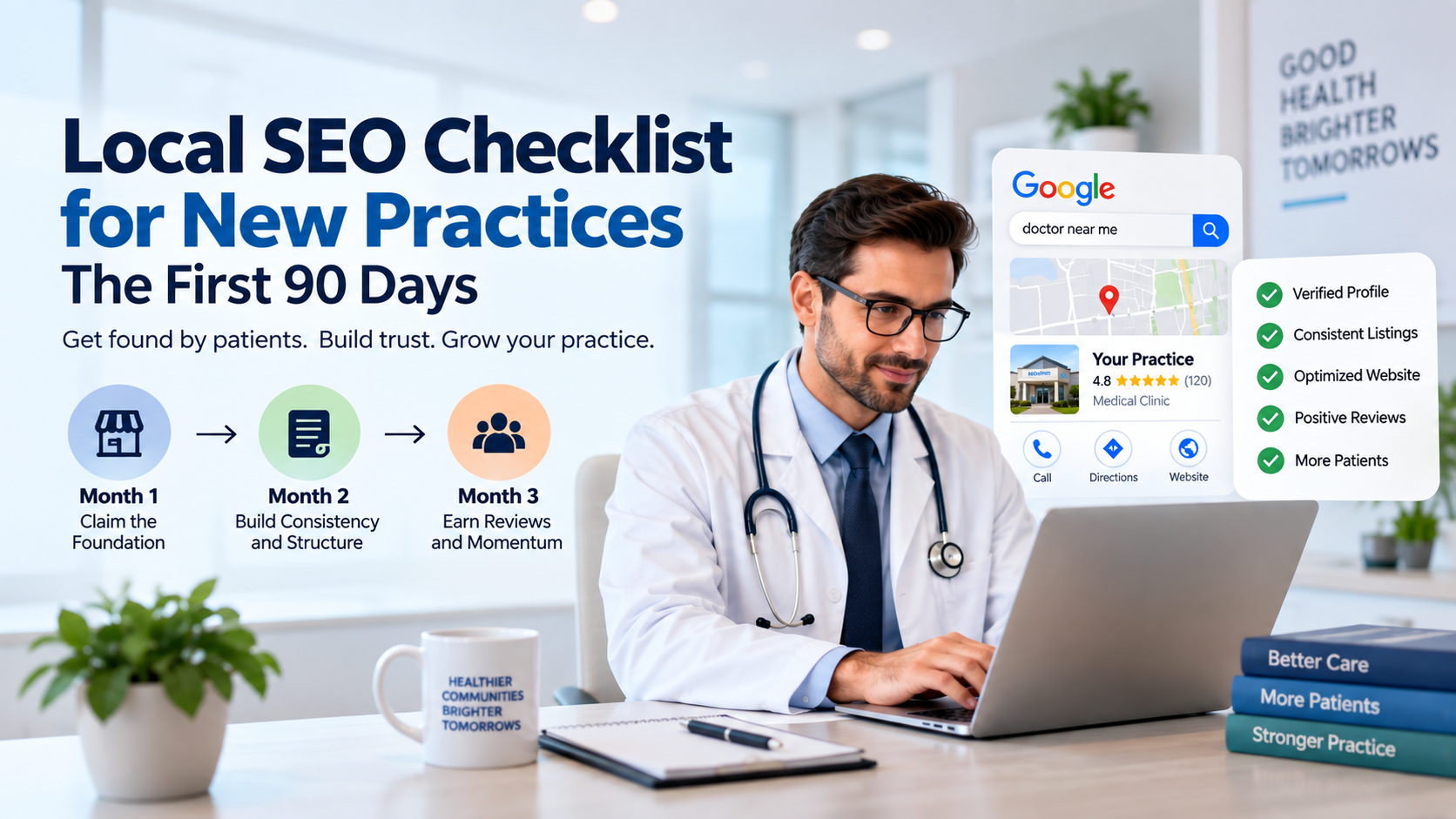
A new practice should spend its first 90 days building the foundation patients and search engines both rely on: a verified Google Business Profile, consistent listings across the major directories, a clear website, and the first genuine reviews. Do these in order and in the right months, and you enter the local pack, the three Google Maps listings shown first, faster than competitors who bolt visibility on later. Google ranks local results on relevance, distance, and prominence, and a new practice starts with zero prominence, so the whole plan is about building trust signals from nothing, deliberately, week by week. This checklist lays out what to do in month one, month two, and month three.
Starting from scratch is actually an advantage here. You have no old listings to reconcile, no stale duplicates, no wrong addresses accumulated over years. You can build it clean if you build it in the right order.
Before you start: set your canonical details
The single most important decision on day one is your exact name, address, and phone, often shortened to NAP, because everything you create over 90 days must match it. Write down one canonical version: your real practice name with no keywords, your address in one exact format down to the suite abbreviation, and one primary phone number. Every profile you build references this. Getting it fixed now prevents the inconsistency that quietly drags on established practices later.
Month 1: Claim the foundation
The first month is about existence and verification. Until Google trusts that you are real, nothing ranks.
- Create and verify your Google Business Profile. This is the heaviest single factor in local visibility, so it comes first. Expect video verification for a medical practice, where you record a short clip proving the location and that you manage it. The full process is in Google Business Profile video verification for doctors.
- Choose the most specific primary category. "Dermatologist," not "Doctor." Category is your strongest relevance signal; details are in choosing the right primary category.
- Set the correct business type. Storefront if patients visit your address, service area if you travel to them. Getting this wrong can hide or suspend a new listing, covered in storefront versus service area.
- Complete every profile field. Hours including holidays, services, a factual description, website, and appointment link. Completeness is free and shows Google you are established.
- Publish a basic, clear website that states your specialty and location in plain text, with a contact page whose NAP matches your canonical version exactly.
By the end of month one, a patient searching your practice name plus city should find a verified, complete listing.
Month 2: Build consistency and structure
With the profile live, month two spreads your details across the web consistently and strengthens the site behind them.
- Claim your core directories. Create or claim Healthgrades, Zocdoc, and Vitals, and make each match your canonical NAP exactly. How to choose where to invest is in Healthgrades, Zocdoc, Vitals: which drives patients.
- Run a quick NAP check. Even a new practice can pick up an auto-generated listing or a mismatch from a phone system. Confirm every listing agrees, using the method in the NAP audit.
- Add schema markup to your website. Schema is a small block of code that tells Google and AI exactly what your practice is: specialty, address, hours, and credentials, in a format machines read cleanly. Most new sites from a local agency never had it added.
- Add real photos of your exterior, signage, reception, and care areas to the Google profile, and keep the profile active with an occasional factual post.
- Build service and location pages on your site for your main services, each stating the specialty and city clearly.
By the end of month two, your details are consistent everywhere and your website gives Google and AI a clean, structured description of who you are.
Month 3: Earn reviews and momentum
Month three is about prominence, the trust that comes from real patient signals, which is the slowest to build and the reason to start early.
- Start a steady, compliant review flow. Ask recent, satisfied patients to leave an honest Google review and make it easy with a direct link. Never buy reviews, write them yourself, gate out unhappy patients, or offer anything in exchange, which breaches Google's policies and the FTC's 2024 rule banning fake and incentivized reviews. Keep responses factual and never confirm someone was a patient or share any clinical detail, protecting confidentiality under HIPAA.
- Respond to every review, positively and professionally, to signal an active, engaged practice.
- Check your Google Business Profile performance view. Watch whether calls, direction requests, and searches are rising month over month; those are your real early signals, not a ranking position.
- Fill any gaps from months one and two, a missing directory, an incomplete field, a service page you skipped.
By the end of 90 days you have a verified profile, consistent listings, a structured website, and a growing base of genuine reviews, the same foundation established practices spend months retrofitting.
What most new practices get wrong
The most common mistake is chasing reviews and social media before the profile is verified and consistent, which is like advertising a door that Google cannot find. Build the foundation first, then drive reviews onto a listing that can actually hold them. The second mistake is inconsistent details from day one, a website footer that does not match the Google listing, a phone system number on one directory and the main line on another, which starts the new practice with the exact drag established ones pay consultants to remove. Set the canonical NAP first and hold every profile to it.
A note on AI: new practices can win the AI answer early
New practices have a real opening in AI answers. When a patient asks ChatGPT, Gemini, Claude, or Perplexity for a doctor, those tools name one to three practices using directory data, schema, and consistency, not years of history. A brand-new practice that is verified, consistent, and marked up cleanly can be named alongside older competitors whose details are a mess, because these systems reward a clean, unanimous record over age. The 90-day foundation is also your AI-visibility foundation.
Your first-90-days checklist
Keep this in front of you.
- Month 1: verify the Google Business Profile, set the specific category and correct business type, complete every field, launch a clear website.
- Month 2: claim Healthgrades, Zocdoc, and Vitals to matching details, run a NAP check, add schema and photos, build service and location pages.
- Month 3: start a compliant review flow, respond to every review, watch the performance view, close any gaps.
If you want a scored starting point for a new practice, the Free Audit at thedocmirror.com rates your local presence across 7 pillars and ranks your fixes in order, in about 90 seconds with no signup for the free score.