Medical Website Traffic But No Appointments? Here's Why That Happens
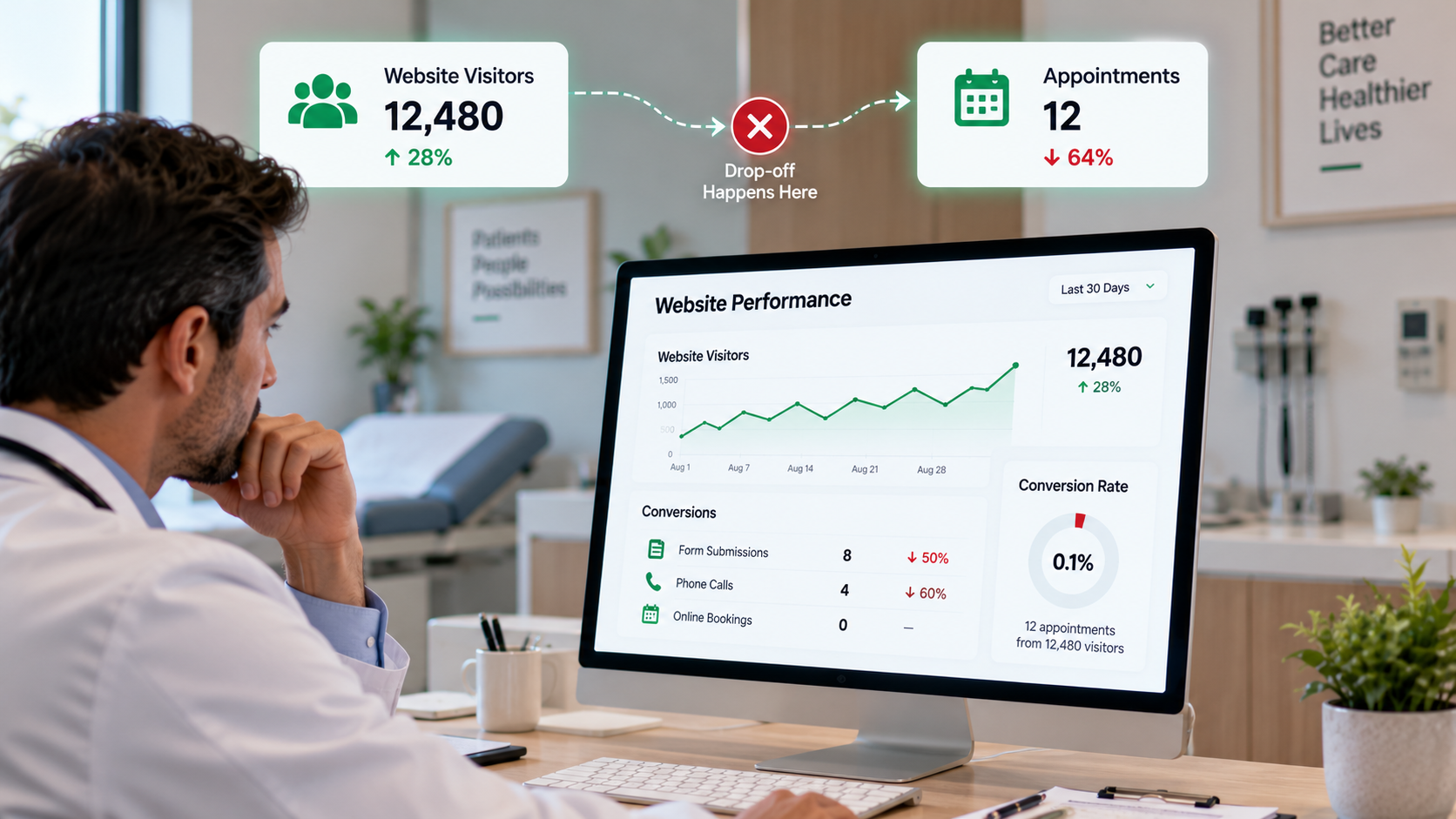
Your Google Business Profile is getting clicks. Your analytics dashboard shows a steady trickle of visitors. Maybe you're even running paid search. And yet the phone isn't ringing, the contact form sits empty, and your scheduling calendar looks the same as it did six months ago.
This is one of the most common, and most misdiagnosed, problems in medical practice marketing: medical website traffic but no appointments. It feels like a visibility problem, so practices respond by spending more on ads or chasing more keywords. But in most cases, the traffic isn't the issue. Something between "visitor arrives" and "visitor books" is breaking down, and it's rarely obvious from the outside. If your clinic website leads have stalled even as traffic holds steady, that gap is usually the real story.
This guide walks through the actual points of failure, traffic quality, on-page friction, trust gaps, and measurement blind spots, so you can figure out where your funnel is leaking before you spend another dollar trying to fill the top of it.
Why This Disconnect Happens in the First Place
Before troubleshooting, it helps to understand the shape of the problem. A website visit is not a commitment. It's curiosity, comparison-shopping, or a half-formed intention. The gap between "landed on your site" and "booked an appointment" is where most of the value gets lost, and for medical practices specifically, that gap tends to be wider than in other industries for a few predictable reasons:
- Healthcare decisions carry more hesitation. A visitor researching a procedure or a new provider is often comparing multiple practices before committing to anything, especially for elective or non-urgent care.
- Trust has to be established quickly. Patients are handing over health information, not just an email address, so the bar for feeling comfortable is higher than a typical e-commerce checkout.
- Compliance caution limits what practices track. Many clinics deliberately under-instrument their sites to avoid handling protected health information in analytics tools, which means they often don't even know where visitors are dropping off.
That last point matters more than most practices realize, and it's worth understanding before you touch a single button on your site.
Start With Measurement, Not the Website
It's tempting to start redesigning your homepage the moment you notice low medical website conversions. Resist that urge. If you can't accurately measure what's happening between a visit and a booking, you can't tell whether a change actually helped. Medical office website lead generation measurement has to come before redesign, not after it.
Define what counts as a conversion first. At minimum, that should include form submissions, phone calls generated from the website (ideally via call tracking), online booking completions, and chat or text inquiries if you use them. The basic formula is the same one used across every industry: conversion rate equals total conversions divided by total visitors, multiplied by 100 (Indeed's guide to calculating conversion rate walks through the formula and variations). Simple as that sounds, a surprising number of practices have never actually calculated this number for their own site.
Understand why your analytics might already be incomplete. Standard Google Analytics implementations were not built with healthcare privacy obligations in mind, and using them in ways that capture or infer protected health information can create HIPAA exposure, a concern HIPAA Journal examines in detail. Because of this risk, many practices either strip out tracking entirely or implement it so cautiously that they lose visibility into basic conversion events. That's a reasonable compliance instinct, but it often means the practice has no real data on where visitors drop off, and ends up guessing instead of diagnosing.
Segment conversions by source before you judge the whole site. A single blended conversion rate can be misleading. Visitors from a referral link tend to convert very differently than visitors who clicked a broad paid search ad, and lumping them together hides the real story. Ruler Analytics' review of healthcare marketing benchmarks notes conversion rates around 7.2% for referral traffic compared to roughly 5% for paid search, a meaningful gap that disappears if you only look at an average. If you're not already separating performance this way, marketing attribution for healthcare is the practical next step, since it connects each traffic source to what actually happens after the click rather than just how many people arrived.
What a "Good" Conversion Rate Actually Looks Like
One reason practices misjudge their own performance is that they're comparing it to the wrong benchmark, or to no benchmark at all. Industry analysis of healthcare websites puts average conversion rates somewhere in the 2% to 5% range, with roughly 4.2% cited as a typical overall average across practice sites, according to Horton Group's healthcare website conversion benchmark research. That's a wide range, which is itself a useful takeaway: specialty, geography, competition, and traffic source all shift what "normal" looks like for a given practice, so a single industry-wide number is a starting reference point for medical website conversion benchmarks and measurement, not a hard target.
If your site is converting well below 2%, that's a signal worth investigating rather than dismissing as "just how healthcare websites perform." If you're already in the 4-5% range, the more useful question becomes which pages and sources are dragging the average down, not whether the whole site is broken.
The Diagnostic Checklist: Where Conversions Actually Break Down
Once you have a baseline number and know roughly where you stand against it, work through these areas in order. Each one represents a distinct place where a ready-to-book visitor can quietly disappear, and together they explain why a medical website gets traffic but no appointments far more often than a simple "bad design" verdict would suggest.
1. Mismatched traffic intent
Not all traffic is created equal. A visitor who searched "best dermatologist near me" has very different intent than one who clicked a broad informational blog post about skin conditions. If your traffic is heavy on informational searches and light on local, decision-stage searches, low conversion isn't a website design problem, it's a targeting problem. Reviewing how patients actually find doctors online is a useful gut check here, since the channels and search behaviors patients use before choosing a provider often don't match what practices assume.
2. Friction in the booking path itself
This is the most common and most fixable cause. Usability research synthesized by Baymard Institute via Memorise's overview of UX and conversion consistently finds that most visitor drop-off comes from avoidable friction, confusing forms, too many required fields, unclear next steps, rather than visitors simply losing interest. In a medical context, this shows up as:
- Appointment request forms that ask for more information than necessary before a visitor will commit to submitting them.
- A phone number that's hard to find, buried in a footer instead of visible on every page.
- No clear single next step. A page with five competing calls to action (call us, email us, chat, download our brochure, follow us on social) gives the visitor permission to do none of them.
- Online booking tools that redirect to a separate, poorly branded scheduling platform, which can make an otherwise trustworthy visit feel suddenly uncertain.
3. Missing or weak trust signals
Patients researching care are often making a decision that affects their health or their family's health, and they size up a practice's website accordingly. Pages missing provider credentials, insurance information, patient reviews, or basic answers to "what happens at my first visit" leave visitors with unanswered questions, and an unanswered question is a reason to leave and check a competitor instead of booking.
4. Technical and accessibility barriers
Slow-loading pages, non-mobile-friendly layouts, and forms that break on certain devices are still common on medical sites, especially ones that haven't been updated in several years. These issues don't show up in a casual glance at the homepage; they show up in session recordings and mobile testing, which is why this step often gets skipped.
5. A page that was never built to convert
Some of your traffic may be landing on service pages, blog posts, or location pages that were written for SEO purposes but were never given a clear next step. If a page ranks well and gets visits but has no appointment CTA, no phone number, and no obvious path forward, it will show high traffic and zero conversions by design, not by accident.
Putting Measurement and Fixes Together
The practical order of operations is: measure first, diagnose second, fix third. A practice that redesigns its homepage without first identifying where visitors are actually dropping off is optimizing based on guesswork, and may "fix" something that was never broken while leaving the real leak untouched.
Once you've identified a likely friction point, the goal isn't a full website overhaul. It's targeted adjustment, simplifying a form, adding a visible phone number, clarifying a single next step on a high-traffic page, followed by re-measuring to confirm the change actually moved the number. That kind of medical website conversion rate optimization tends to compound: small, verified fixes on your highest-traffic pages typically move the needle more than a full redesign. For a deeper, structured walkthrough of this process, turning more website visitors into booked appointments covers the conversion-rate side in more depth, including how to prioritize which pages to fix first.
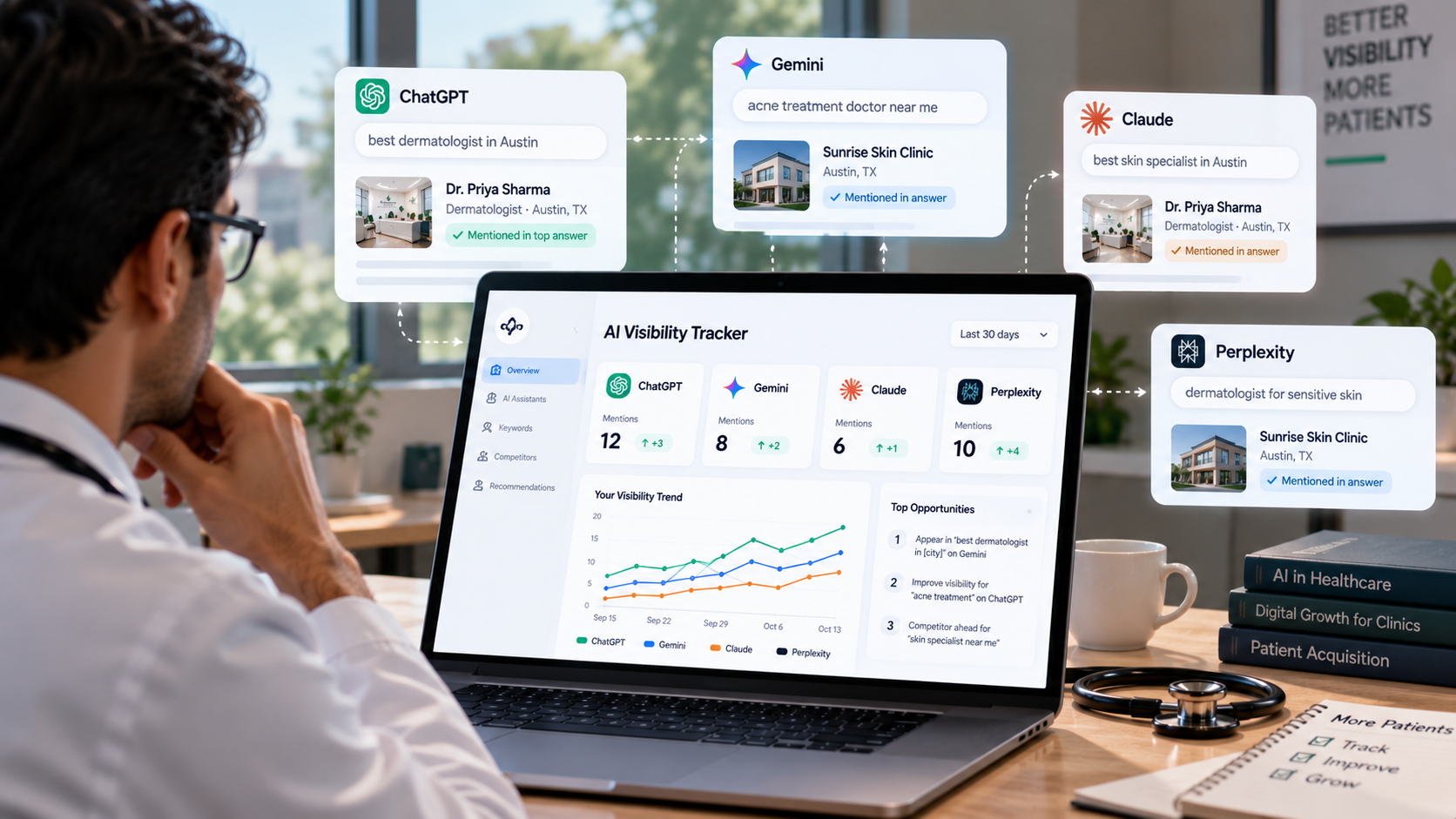
It's also worth remembering that traffic and conversion are only part of the picture. A practice with strong conversion on its website but weak overall visibility across Google, reviews, and emerging AI-assisted search tools will still struggle to grow, simply because fewer potential patients are finding it in the first place. Knowing how to measure new patient leads from digital marketing only helps if people are discovering the practice in the first place.
Conclusion
Medical website traffic without appointments is rarely a single-cause problem, and it's almost never solved by adding more traffic on top of a leaky funnel. The practices that fix this consistently work through it in order: they establish honest measurement first, segment their traffic and conversions by source, benchmark against realistic industry ranges rather than assumptions, and then address friction, trust gaps, and mismatched intent one at a time. That diagnostic discipline, more than any single redesign, is what turns existing traffic into a website that actually fills the schedule.
If you've never had a clear view of both sides, how visible your practice is and how well that visibility converts, a general visibility audit across Google, review platforms, and AI assistants is a reasonable place to start before investing further in ads or a redesign. That is the kind of full-picture check platforms like The Doc Mirror are built around, looking at discoverability and conversion together rather than treating them as separate problems.
Sources
- Horton Group, "Healthcare Website Conversion Benchmarks" — https://hortongroup.com/blog/healthcare-website-conversion-benchmarks-is-your-practice-turning-visitors-into-patients/
- Ruler Analytics, "22 Healthcare Marketing Statistics That You Can't Ignore" — https://www.ruleranalytics.com/blog/insight/healthcare-marketing-statistics/
- Indeed Career Advice, "How To Calculate Conversion Rate (Formula and Examples)" — https://www.indeed.com/career-advice/career-development/how-to-calculate-conversion-rate
- HIPAA Journal, "Is Google Analytics HIPAA Compliant?" — https://www.hipaajournal.com/is-google-analytics-hipaa-compliant/
- Memorise, "UX and Conversion: Friction Is Lost Sales" (citing Baymard Institute research) — https://memorise.se/en/knowledge/conversion-optimization/ux