How to Get Your Practice Listed in Perplexity AI Search
To get your practice listed in Perplexity AI search, you need to appear on the web pages Perplexity trusts enough to cite. Perplexity is different from other assistants because it shows numbered source citations under every answer. Understanding Perplexity AI for doctors means understanding those citations: which pages get picked, why, and how your practice becomes one of them. It rewards factual, consistent, well-referenced information across your own site and the directories it reads.
What is Perplexity and why does it cite sources
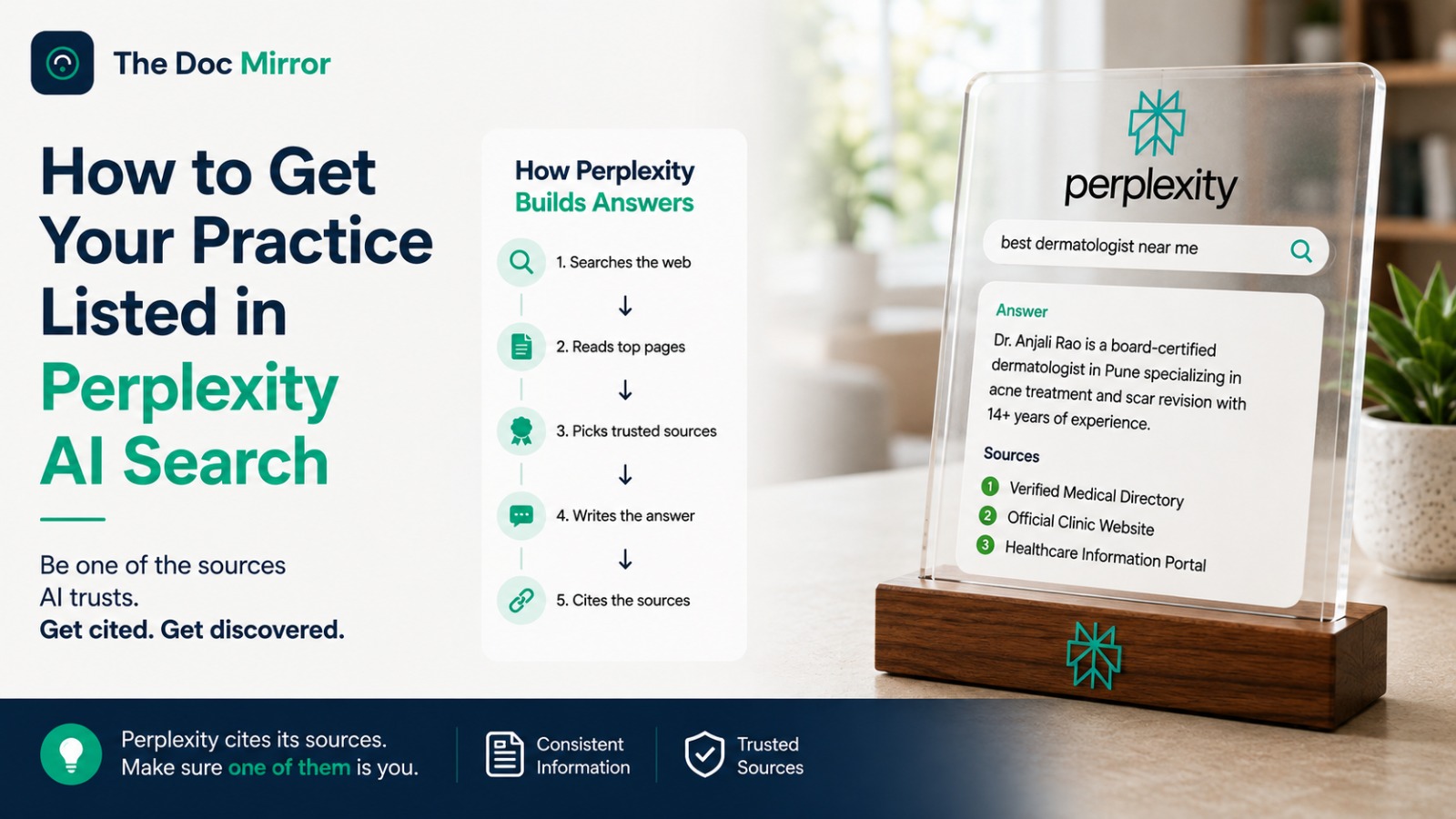
Perplexity is an answer engine. When a patient asks a question, it searches the live web, reads the top pages, writes a short answer, and lists the sources it used as numbered citations. Every claim links back to a page. This makes Perplexity unusually transparent compared with ChatGPT, Gemini, and Claude, which often answer without showing their working.
For a doctor, that transparency is an opportunity. If a patient in Denver asks "best dermatologist for acne scars near me," Perplexity will name a handful of sources. Being one of those numbered citations is the goal. You are not trying to sound clever. You are trying to be the page Perplexity reaches for when it needs a fact about your specialty or your city.
Definition block: GEO (Generative Engine Optimization) is the practice of shaping your online information so AI answer engines cite you. It sits alongside AEO (Answer Engine Optimization), which structures content to be quoted directly. Both matter for Perplexity because it quotes and cites in the same breath.
How Perplexity assembles an answer with sources
Perplexity builds each answer in a few steps. Knowing them tells you exactly where to intervene.
- It reads the question and expands it into search queries.
- It fetches live web results, often from Google and its own index.
- It ranks pages by relevance and apparent authority.
- It reads the top pages and drafts an answer grounded in them.
- It attaches numbered citations to the sources it actually used.
Two things follow from this. First, if a page does not rank in normal web search, Perplexity rarely sees it, so your fundamentals still matter. Second, Perplexity favors pages that state facts plainly, because it needs to lift a clean sentence and attribute it. A page that buries your qualifications inside marketing copy is harder to cite than one that says "Dr. Anjali Rao is a gynaecologist in Pune with 14 years of practice."
This is why citation depth and source authority matter more on Perplexity than anywhere else. Read the pillar overview on AI visibility for doctors for how this fits the wider picture.
Which sources does Perplexity trust for doctors
Perplexity leans on pages that are structured, cross-referenced, and consistent. For medical queries it repeatedly draws from a familiar set of authoritative directories, plus your own website when it is clear and factual.
In the US market, it commonly cites Healthgrades, Zocdoc, Vitals, and WebMD, alongside your Google Business Profile and hospital or group pages. A cardiologist in Austin whose details match across all of these is far easier to cite than one whose name, address, and specialty differ from site to site.
In the India market, Perplexity draws on Practo, JustDial, Lybrate, and Apollo 247, along with hospital listings and your own clinic site. For a physiotherapist in Bengaluru or a dentist in Chennai, consistency across these directories is the single strongest signal. Note that Indian doctors work under NMC rules that restrict self-promotion, so the aim is not to advertise. The aim is to make your existing, factual information consistent and findable across the sources Perplexity already reads.
How to get listed in Perplexity as a doctor
Here is the practical sequence. None of it requires special markup or paid placement.
- Fix your name, specialty, and location consistency. Your name, clinic address, phone, and specialty must read identically across your website, Google Business Profile, and every directory above. Inconsistent details split your authority and confuse citation.
- Publish clear, factual pages on your own site. State your qualifications, procedures, conditions treated, and location in plain sentences. Perplexity cites text it can quote cleanly.
- Claim and complete your directory profiles. In the US that means Healthgrades, Zocdoc, Vitals, and WebMD. In India that means Practo, JustDial, Lybrate, and Apollo 247. Complete profiles get cited more than thin ones.
- Answer real patient questions in content. A short, honest FAQ page on your conditions and procedures gives Perplexity ready-made quotable answers.
- Earn genuine third-party references. A mention in a local news piece, a hospital directory, or a medical association page raises the authority Perplexity looks for.
A GEO research paper from Princeton, Georgia Tech, the Allen Institute for AI, and IIT Delhi found that specific content choices can raise a page's citation rate in AI answers by up to 40% (source). Clarity and structure are not cosmetic. They change whether you get cited.
Why Perplexity citations matter for patient choice
Citations are not a vanity metric. They are the moment a patient decides who to trust. When Perplexity answers "who is a good gynaecologist in Mumbai," the doctors it cites are the ones the patient clicks, researches, and often books.
The behavior is already here. A KFF poll found that about 1 in 3 US adults have used AI chatbots for health information, the same share who use social media for health (source). The rater8 2025 patient-choice report found that 26% of patients said an AI tool influenced their choice of provider, and 73% adopted a new way to research providers in the past year (source).
If Perplexity is answering questions about your specialty in your city and not citing you, a competitor is getting that click. [Replace with your real audit figure before publishing.]
What most doctors get wrong about Perplexity
Most doctors assume Perplexity works like Google, where ranking first is the whole game. It does not. Perplexity can cite a page that ranks fourth if that page states a fact more clearly than the pages above it. Clarity often beats position.
The second mistake is treating your website as the only source that matters. Perplexity cross-checks. If your site says one thing and Practo or Healthgrades says another, it trusts neither confidently. Consistency across sources beats a single polished page.
The third mistake is writing for humans only. Perplexity needs a clean, self-contained sentence to quote. Long marketing paragraphs with no plain statement of who you are, what you treat, and where you practice give it nothing to lift. See how ChatGPT chooses doctors for how this same principle plays out across assistants.
How to check if Perplexity already cites you
You can test this yourself in a few minutes. Ask Perplexity the questions your patients ask, then read the citations.
- Search "best [your specialty] in [your city]" and note which sources appear.
- Search your own name and see whether Perplexity describes you accurately.
- Check whether the details it cites match your current qualifications and location.
- Note which directories it pulls from, then confirm your profile there is complete.
If your name returns nothing, or returns outdated details, that is your starting point. The Doc Mirror runs this check across Google, ChatGPT, Gemini, Claude, Perplexity, and 6 directories, then scores your presence on the 7 pillars so you can see the gaps in one place. You can also read how to check your AI visibility for a manual walkthrough.