Physician Benchmarking Software: Features to Compare Before You Buy
Shopping for physician benchmarking software usually starts with a vague goal: "we need to know how we're doing compared to everyone else." That's a reasonable instinct, but it hides an important question that most buyers don't ask until after they've signed a contract: compared to everyone else on what, exactly?
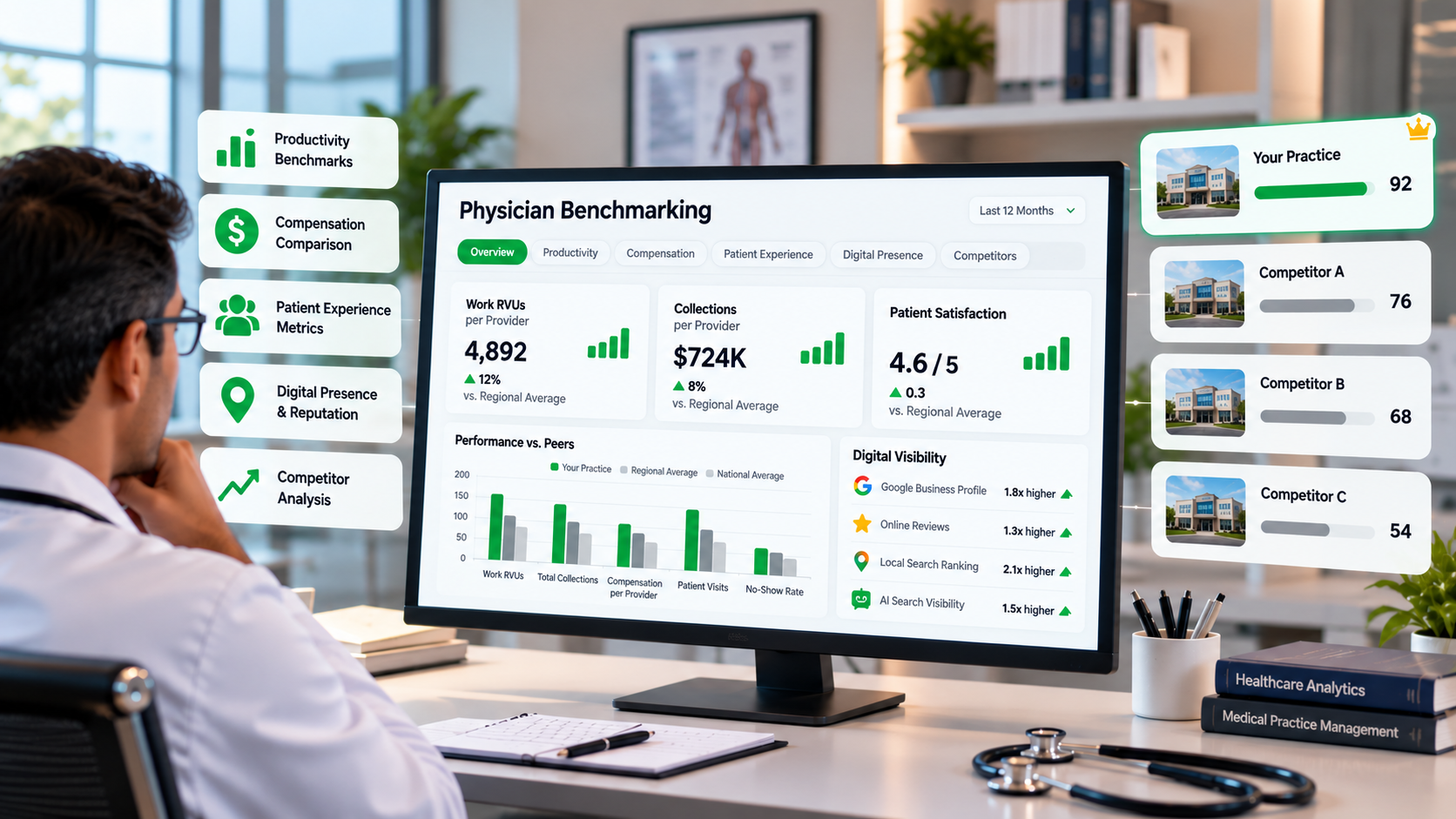
Physician benchmarking software is not one category of tool. It's at least two, and they solve different problems. One kind measures clinical and financial output, think work RVUs, collections per provider, and compensation ratios, against national or regional norms. The other measures market position, how a practice's digital visibility, reputation, and patient-facing presence stack up against nearby competitors. Some platforms touch both, but very few do both well, and vendors rarely make the distinction explicit in their marketing copy.
Before you sit through another demo, it helps to know which problem you're actually trying to solve, and which features matter for each.
Physician Performance Benchmarking: The Productivity and Compensation Lane
This is the more established category. Physician performance benchmarking software in this lane pulls from large, standardized datasets, most notably the Medical Group Management Association's surveys. MGMA's 2025 Provider Compensation and Productivity Data Report is based on data from more than 220,000 physicians and advanced practice providers nationwide, tracking metrics like work RVUs, total RVUs, total collections, and hours worked across specialties and geographies (MGMA, 2025 Provider Compensation and Productivity Data Report). MGMA's broader data library is considered the industry-standard reference point for defining what "benchmarking" means in a clinical productivity context (MGMA Data Reports).
If this is the kind of medical group performance benchmarking software you need, your feature checklist should include:
- Data source transparency. Does the vendor disclose where its comparison data comes from, and is it tied to a recognized survey methodology (MGMA, AMGA, or similar), or is it an internal, unverified dataset?
- Specialty and geographic granularity. A family medicine benchmark in a rural market and one in a dense urban market mean very different things. Make sure the tool lets you filter by both.
- Update cadence. Compensation and productivity norms shift year to year. Ask how often the underlying data refreshes and whether historical trend lines are available, not just a single snapshot.
- Provider-level and group-level views. Independent physicians need individual benchmarks; multi-site medical groups need roll-up reporting across locations and departments.
- Integration with your EHR or practice management system. Manual data entry for RVUs and collections defeats the purpose. Confirm what integrations exist before you buy.
A broader look at healthcare benchmarking types and metrics is useful context here too. One industry guide breaks healthcare benchmarking into categories such as internal, external, competitive, functional, and strategic comparisons, and recommends starting with a small, focused set of metrics, things like no-show rate, revenue per appointment, and patient satisfaction score, rather than trying to track everything at once (Pabau, Healthcare Benchmarking: Types, Metrics, and How to Get Started). That same instinct, start narrow and specific rather than broad and vague, applies directly to vendor evaluation: a tool that claims to cover "all of benchmarking" in one dashboard is worth extra scrutiny.
If you're evaluating this category seriously, it's also worth reading up on how market intelligence platforms generally structure their data collection and reporting, since the due diligence questions overlap heavily with what you'd ask about healthcare market intelligence tools for independent practices.
The Other Lane: Digital and Competitive Visibility Benchmarking
The second category is less standardized and, frankly, newer. Some vendors market it as healthcare market research software for physician groups, though the clearer label is healthcare competitor intelligence software: tools that track how a practice's online presence, Google Business Profile performance, review volume and sentiment, local search rankings, and now visibility in AI-generated answers, compare to nearby competitors. There's no MGMA-style national dataset for this because the underlying inputs (search results, review platforms, AI assistant outputs) change constantly and vary by local market.
This is where a lot of buyer confusion happens. A practice owner searching for "clinic competitor benchmarking tools for practice owners" is often not looking for an RVU comparison at all. They want to know: are we showing up when patients search for care nearby? Are our reviews keeping pace with the clinic two blocks away? Is our online presence actually representative of our quality of care?
For this category, the feature checklist looks different:
- Multi-location comparison. If you operate more than one site, can the tool let you compare digital performance of medical practice locations side by side, not just aggregate everything into one number?
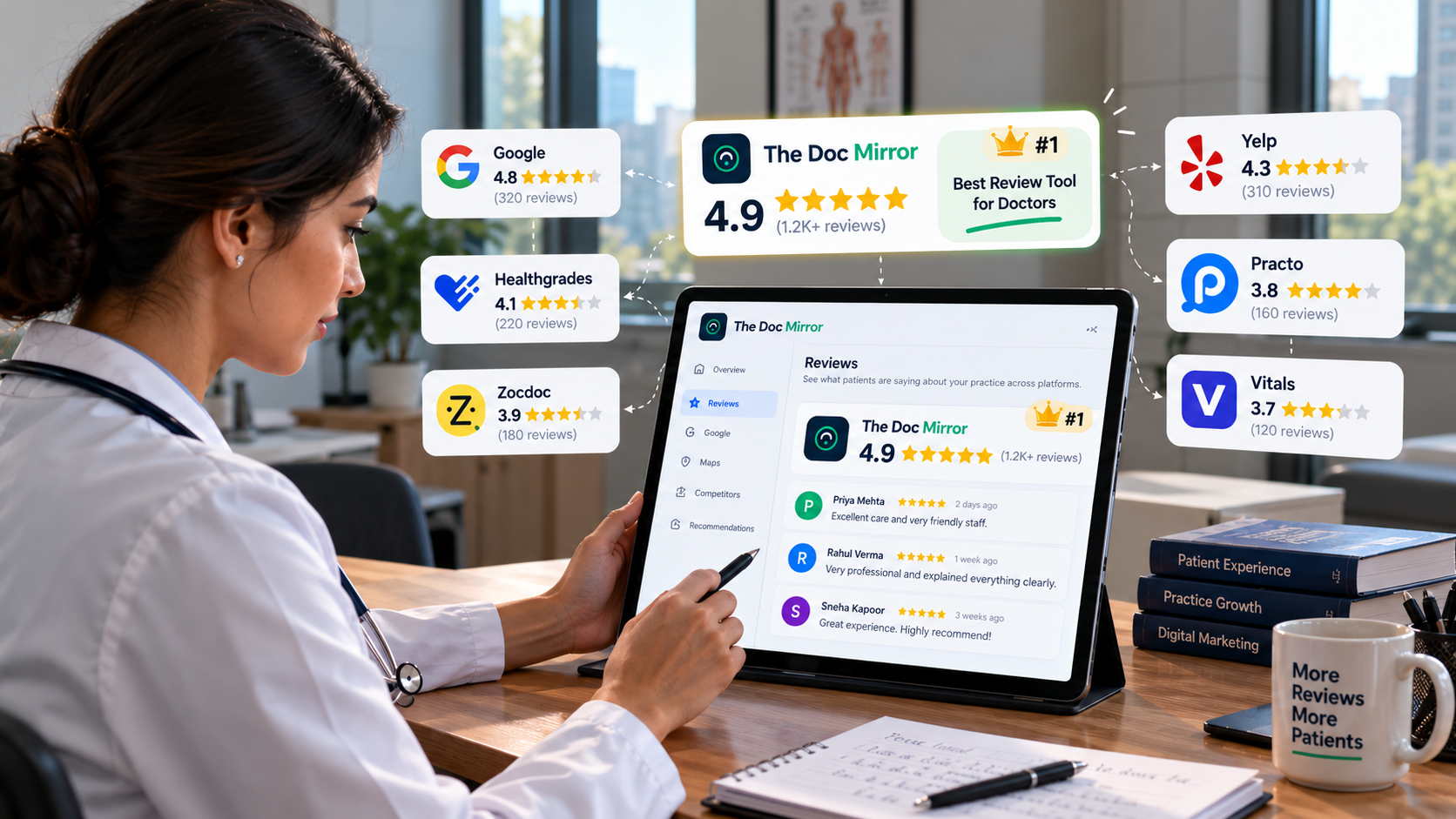
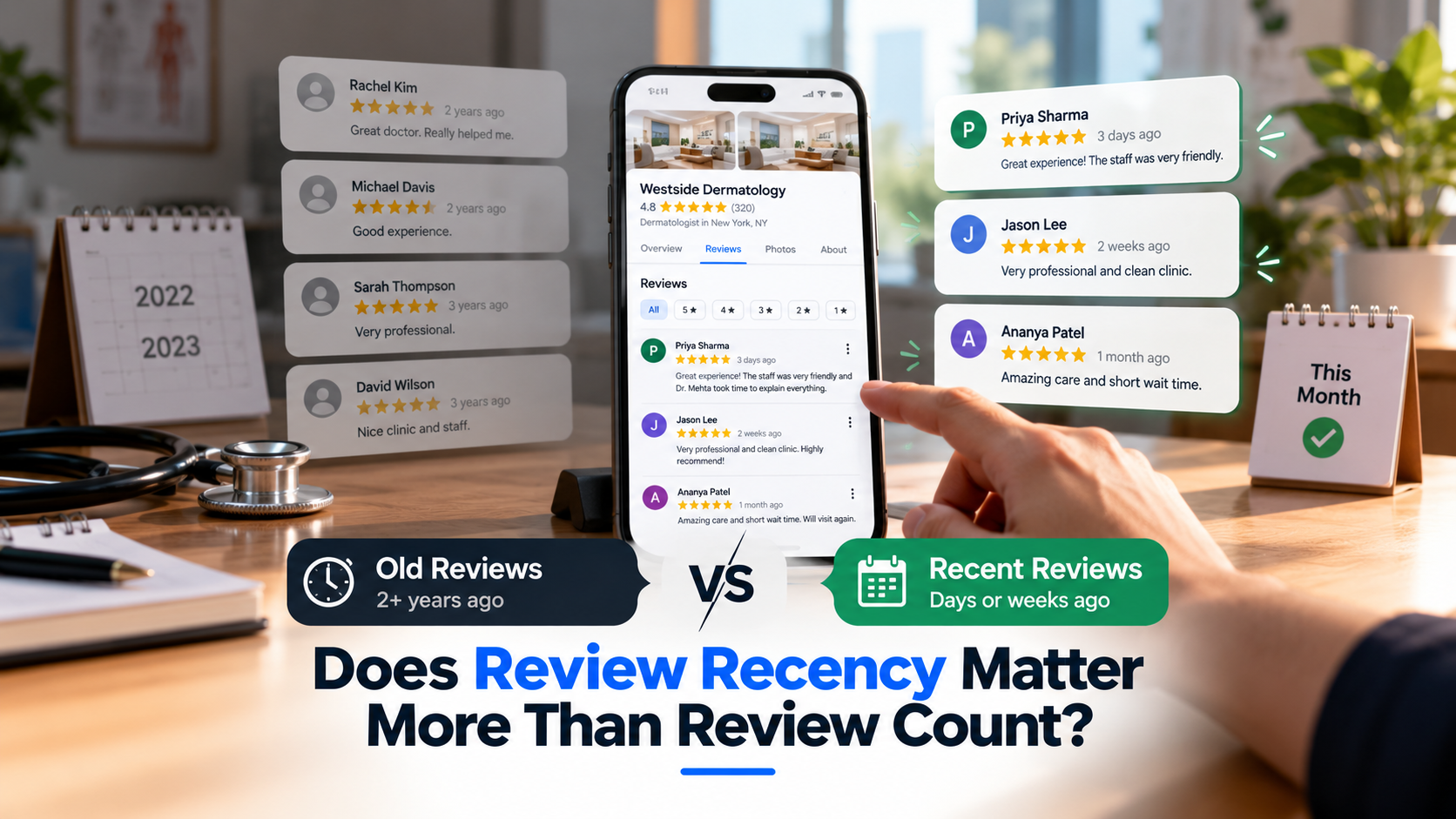
- Review monitoring across platforms. Google is the obvious one, but healthcare-specific review sites and general platforms matter too. Does the tool track volume, rating trend, and response rate, not just a star average?
- Local search and map pack visibility. Does it show whether the practice appears in local map results for relevant searches, and how that compares to competitors in the same service area?
- Visibility in AI-driven search and assistants. As patients increasingly ask AI tools for care recommendations, some newer platforms, including The Doc Mirror, track how a practice shows up across traditional search, review platforms, and AI assistant responses, not as a replacement for financial benchmarking, but as a complementary visibility layer most legacy benchmarking tools don't touch at all.
- Actionable gaps, not just scores. A number telling you you're "behind" three competitors isn't useful on its own. Look for tools that flag specific, fixable gaps, like missing review responses or inconsistent listing information, rather than just a leaderboard.
If you haven't already mapped out who your actual digital competitors are, it's worth doing that groundwork first. A structured approach to conducting a competitor analysis for a medical practice will make any benchmarking software you buy afterward far more useful, since you'll already know which competitors and metrics matter to your specific market.
A Practical Feature Comparison Framework
Rather than trying to find one tool that claims to do everything, it helps to score any candidate against a short list of questions that apply regardless of which lane it's in:
- What exactly is being measured? Get a specific list of metrics, not a marketing summary. "Performance benchmarking" is nearly meaningless as a phrase until you see the metric definitions.
- Where does the comparison data come from? National survey data, regional data, or data the vendor collected independently? Ask directly, and be skeptical of vagueness here.
- How current is it? Static annual reports are very different from a dashboard that updates continuously, and the price difference between the two is often large for a reason.
- Can you drill into your own numbers, or only see an aggregate score? The most useful healthcare benchmarking tools let you see the underlying data behind any score, not just a single index number.
- Does it fit your practice size? Physician benchmarking software for independent practices usually needs to be lighter weight and less expensive than medical group benchmarking platforms built for 50-location systems. Don't pay for enterprise complexity you won't use, and don't undersize for a growing multi-site group either.
- Is reporting built for the audience that needs it? A solo physician wants a simple dashboard. A medical group's leadership team wants exportable reports for board meetings. Confirm the output format matches who will actually be looking at it.
- What does support actually include? Some vendors hand you a login and a data export. Others offer guided interpretation, quarterly reviews, or alerts when something changes significantly. Decide upfront how much hand-holding your team needs.
Once you've narrowed down to serious candidates, it's worth running your own informal benchmark before you commit. Comparing your practice's online presence against two or three local competitors manually, using the same method you'd want the software to automate, is a quick way to sanity-check how your online presence actually compares with local competitors before you pay for a tool to do it at scale. If the manual check turns up obvious gaps the software later misses, that's a useful signal about the tool's blind spots.
Red Flags Worth Watching For
A few patterns are worth treating with caution during vendor evaluations:
- Vague claims of "proprietary benchmarking data" with no explanation of sample size, source, or methodology.
- Promises tied to specific outcomes, like guaranteed ranking improvements or patient volume increases. No credible benchmarking tool can promise that, since rankings and patient behavior depend on far more than any single platform's recommendations.
- One-size-fits-all dashboards that don't let you filter by specialty, location, or market size.
- No clear explanation of how often data refreshes, which matters enormously for anything related to digital visibility, where results can shift week to week.
Choosing Physician Benchmarking Software for Independent Practices and Small Groups
If you're an independent practice owner or run a small medical group, you likely don't need the full financial benchmarking apparatus that a large health system uses. What usually matters more day to day is a clearer, ongoing view of how your practice shows up to prospective patients: in Google search, in reviews, on maps, and increasingly in AI-generated recommendations, compared to the two or three competitors patients are actually choosing between.
That's the gap a visibility-focused tool like The Doc Mirror is built to address: tracking how a practice appears across Google, patient reviews, and AI assistants, so owners get an ongoing read on their digital standing rather than a one-time snapshot. It's not a replacement for RVU or compensation benchmarking if your group needs that, but it answers a question financial benchmarks never touch: what does a patient actually see when they go looking for care like yours.
Final Thought
The phrase "physician benchmarking software" covers more ground than most buyers realize going in. Before evaluating any specific product, get clear on which problem you're solving: productivity and compensation comparison, digital and competitive visibility, or genuinely both. That single decision will narrow your options faster than any feature checklist, and it will make every vendor conversation after this one considerably more useful.
If the digital-visibility side of that equation is the one you're less sure about, a tool like The Doc Mirror offers a straightforward way to see where a practice currently stands across Google, patient reviews, and AI-driven assistants, before you commit to a larger benchmarking platform.
Sources
- MGMA Data Reports — https://www.mgma.com/mgma-data-reports
- 2025 MGMA Provider Compensation and Productivity Data Report — https://www.mgma.com/2025-provider-compensation
- Pabau, "Healthcare Benchmarking: Types, Metrics, and How to Get Started" — https://pabau.com/blog/healthcare-benchmarking/