White-Label Online Visibility Reports for Medical Practices: What Agencies Need
If you run a healthcare marketing agency, you already know that medical practices live and die by how they show up online: Google Business Profile accuracy, review volume and sentiment, directory consistency, and increasingly, how AI assistants describe them when a patient asks "find me a dermatologist near me." Reporting on all of that, across dozens of clients, is its own full-time job. That's where white-label online visibility reports for medical practices come in: a way to deliver that reporting under your agency's own brand instead of a software vendor's.
This isn't a new concept in marketing generally. But healthcare adds real wrinkles: multi-location groups, multiple providers per location, strict expectations around accuracy (a wrong phone number or address on a medical directory listing is a bigger deal than it is for a retail store), and clients who often aren't digital-marketing-literate and need reports that are genuinely easy to read. Here's how the white-label workflow actually works, and what to look for if you're evaluating a provider.
What "White-Label" Means for Healthcare Visibility Reporting
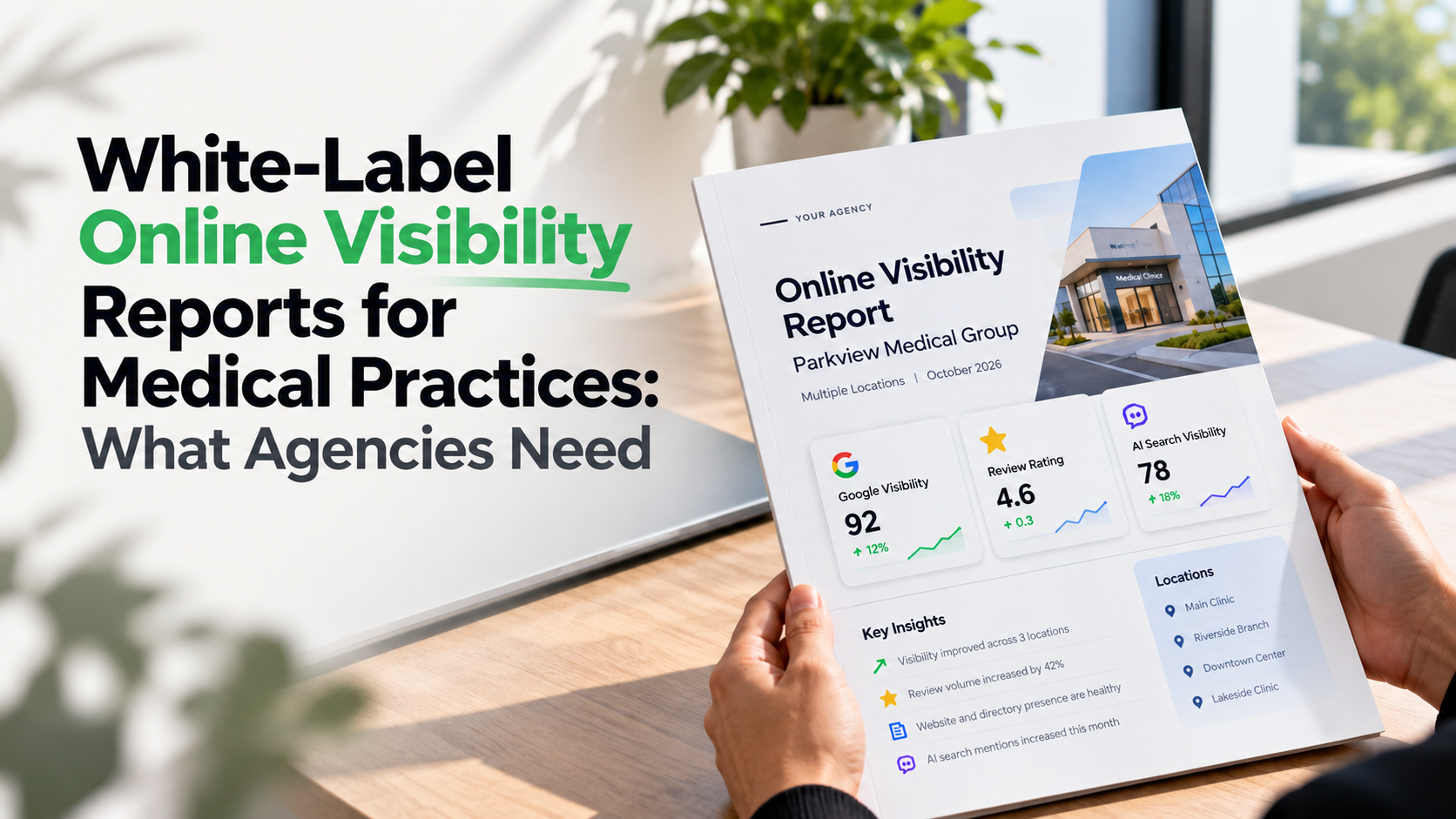
At its core, white-label reporting means the underlying data and analytics come from a third-party platform, but the client-facing presentation, including logo, colors, domain, and sometimes even terminology, is yours. The agency's brand is what the client sees; the vendor is invisible in the deliverable (Vista Social's guide to white-label reporting lays out this distinction well: the software does the measuring, but the client experiences it as part of your agency's service, not a tool they could just go buy themselves).
For a healthcare marketing agency, this matters for a specific reason: credibility. A multi-location dental group or an orthopedic practice group paying for marketing services wants to feel like they have a dedicated partner, not a reseller forwarding them a stock dashboard. White label healthcare reports reinforce that the agency itself has built expertise in the medical space, which, frankly, it needs to have, because healthcare visibility reporting isn't identical to reporting for a restaurant or a law firm. That's the practical purpose behind white label healthcare marketing reports for agencies: combining software-driven measurement with agency-delivered expertise that the client can't easily replicate on their own.
Why Online Visibility Reporting Matters for Medical Practices
Before getting into the mechanics of white-labeling, it's worth being clear on why this category of reporting exists at all. Patients increasingly vet providers online before booking, checking reviews, comparing practices, and researching credentials, which is why online reputation and review management has become a recurring theme in healthcare marketing conversations, as covered in Medical Economics' reporting on how patients use online reviews to choose care. That's the underlying reason agencies sell, and practices buy, ongoing visibility monitoring in the first place.
A one-time medical practice online visibility audit service engagement can be useful as a starting point, but the real value for most agency-client relationships is recurring, trackable, dashboard-based reporting that shows whether visibility is improving, holding steady, or slipping month over month. This is precisely the gap that online visibility reports for healthcare marketing agencies are built to close: ongoing, comparable data instead of a one-off snapshot that goes stale the week after it's delivered.
How the White-Label Reporting Workflow Actually Works
From Audit to Branded Deliverable
The typical workflow looks something like this:
- Initial audit. The agency runs a white label digital presence audit for doctors or practice groups, pulling together Google Business Profile status, review counts and ratings, directory listing accuracy, website visibility signals, and (increasingly) how the practice is represented in AI-generated answers.
- Dashboard setup. The underlying platform is configured with the agency's branding: logo, color scheme, and ideally a custom domain or subdomain so the client never sees the vendor's name.
- Client portal access. Clients get an always-available view of their own data rather than waiting for a monthly PDF, which is one of the baseline expectations agencydashboard.io describes for white-label marketing dashboards: 24/7 portal access, filtering by date range and channel, rather than a static snapshot.
- Recurring reporting cadence. Monthly or quarterly reports track trend lines: is the practice's visibility improving, and where specifically (search, reviews, directories, AI mentions)?
- Account management layer. The agency interprets the data for the client. This is the part software can't automate, and it's the actual value-add that justifies the agency's fee beyond the tool itself.
This workflow is essentially the same whether an agency is serving a single-location family practice or a multi-location urgent care chain; the difference is in how much the underlying software can handle at scale, which is where buyer criteria come in.
Core Buyer Criteria for Agencies Evaluating White-Label Visibility Tools
If you're shopping for agency visibility reporting software, here's what actually separates a usable platform from one that will frustrate you, and your clients, within a quarter:
- True white-label branding, not just a logo swap. Custom domain support, removable vendor branding throughout the client-facing experience, and the ability to control what terminology and metrics clients see.
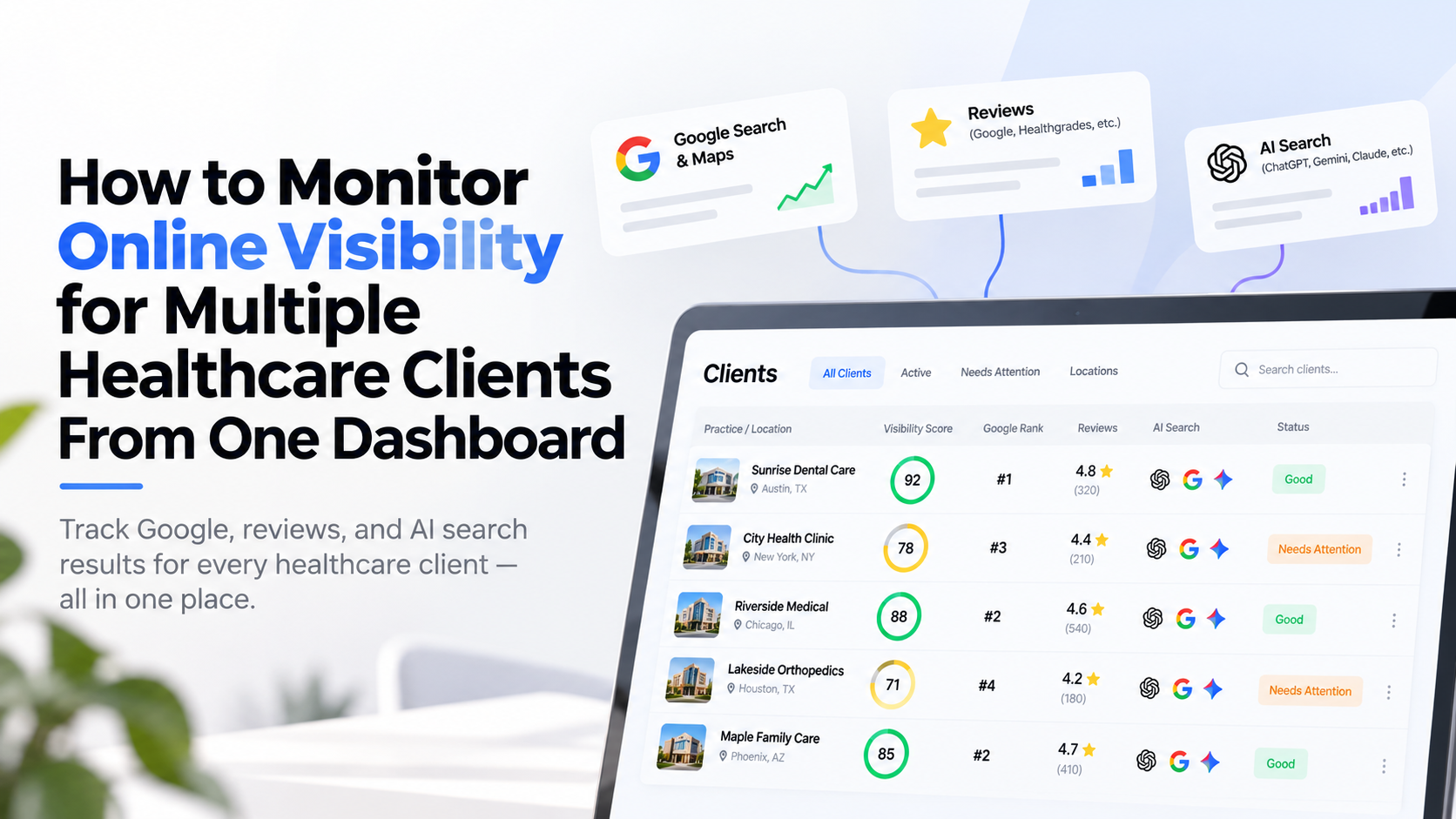
- Multi-client, multi-location architecture. If you serve more than a handful of practices, you need a healthcare client reporting dashboard with white label reports that lets you manage all clients from one admin view while each client only sees their own branded portal. This is especially important if you're trying to monitor online visibility for multiple healthcare clients from a single dashboard without juggling separate logins or spreadsheets for each account.
- Granular filtering. Clients and account managers alike need to filter by date range, location, and channel (search, reviews, directories, AI visibility) rather than scrolling through an undifferentiated data dump.
- Location comparison, not just location listing. For group practices, being able to compare online presence across healthcare practice locations side by side, not just view each one in isolation, is often the single most requested feature from multi-location clients, and it's a capability worth testing directly in a demo rather than taking on faith. If this is a priority for your client base, it's worth reading through how a multi-location practice dashboard approach handles side-by-side comparison before you commit to a vendor.
- Data accuracy and refresh cadence. Stale data undermines trust fast. Ask vendors directly how often listings, reviews, and visibility signals refresh.
- Reasonable onboarding and support for the agency, not just the end client. You're the one troubleshooting on behalf of your clients; make sure the vendor treats agencies as a distinct customer segment with their own support needs.
- Fit within your broader software stack. White-label visibility reporting rarely stands alone; it usually needs to work alongside scheduling tools, review-request automation, and other practice marketing software. It's worth evaluating any new reporting tool against a broader buyer's checklist for medical practice marketing software so you're not solving one problem while creating three integration headaches elsewhere in your stack.
Multi-Location and Multi-Client Considerations
Agencies managing portfolios of healthcare clients face a scale problem that single-location vendors often underestimate. Cardinal Digital Marketing's published healthcare case studies describe helping a large multi-location healthcare client scale digital marketing oversight across 500-plus practice locations. At that scale, manual reporting isn't viable, and the software's ability to roll data up (or break it down by region, specialty, or individual location) becomes a deciding factor in whether an agency can scale its healthcare book of business.
Even at a more modest scale, say, five to fifteen clients, the math works the same way. Healthcare agency software to monitor client visibility needs to let you glance at a portfolio-level view ("which clients dropped in review volume this month?") and then drill into any single practice without switching tools or exporting data into spreadsheets by hand. This is the same underlying need, whether you call it agency visibility reporting or white-label visibility reporting: less time spent assembling data, more time spent interpreting it for the client.
A Simple Evaluation Checklist
Before signing a contract with any white-label reporting vendor, agencies should be able to answer "yes" to each of these:
- Can clients access their own branded portal without seeing the underlying software's name anywhere?
- Can I see all my clients' data from one admin login, including side-by-side location comparisons?
- Does the platform cover the visibility channels that matter most to medical practices (Google Business Profile, reviews, directories, and AI-assistant visibility) and not just traditional SEO rankings?
- How often does the data refresh, and is that documented anywhere rather than just promised verbally?
- What does onboarding and support look like specifically for agencies managing multiple accounts?
- Does pricing scale sensibly as my client count grows, or does it jump unpredictably at certain tiers?
Walking a shortlist of vendors through these questions in a live demo, rather than relying on marketing pages, will surface the real gaps fast.
Where a Visibility Auditing Platform Like The Doc Mirror Fits
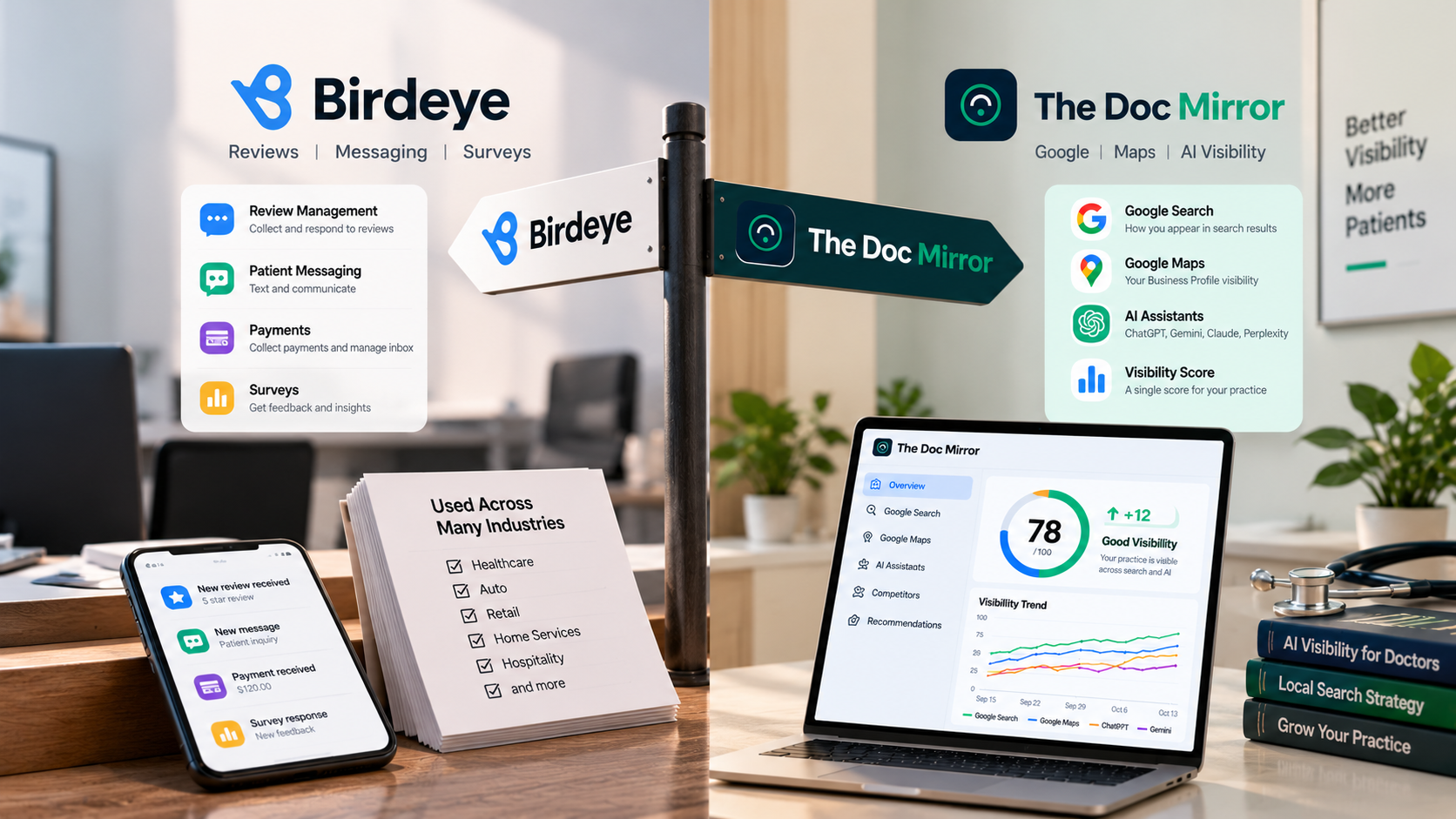
Platforms built specifically for healthcare visibility auditing and tracking, covering presence across Google, patient reviews, and increasingly how practices surface in AI-assistant answers, are generally positioned as the data layer underneath an agency's white-label reporting rather than as a replacement for the agency relationship. The Doc Mirror is one example of a platform built around this kind of visibility auditing and tracking for medical practices.
If you're an agency sorting through vendors for a white-label reporting program, or simply curious what a given practice's current online visibility looks like before you build a reporting workflow around it, running a visibility check is a reasonable, low-commitment way to see what the underlying data actually looks like before you commit to a full rollout.
Sources
- Vista Social — White Label Reporting for Agencies: The Complete Guide — https://vistasocial.com/insights/white-label-reporting
- AgencyDashboard.io — What Is a White Label Marketing Dashboard? — https://agencydashboard.io/blog/what-is-white-label-marketing-dashboard
- Medical Economics — Online reviews are becoming more important to patients in choosing their care — https://www.medicaleconomics.com/view/online-reviews-are-becoming-more-important-to-patients-in-choosing-their-care-how-to-manage-your-online-reputation-in-health-care
- Cardinal Digital Marketing — Healthcare Marketing Case Studies — https://www.cardinaldigitalmarketing.com/healthcare-case-study/