Third-Party Mentions: How Digital PR Builds the AI Authority That Gets Doctors Named
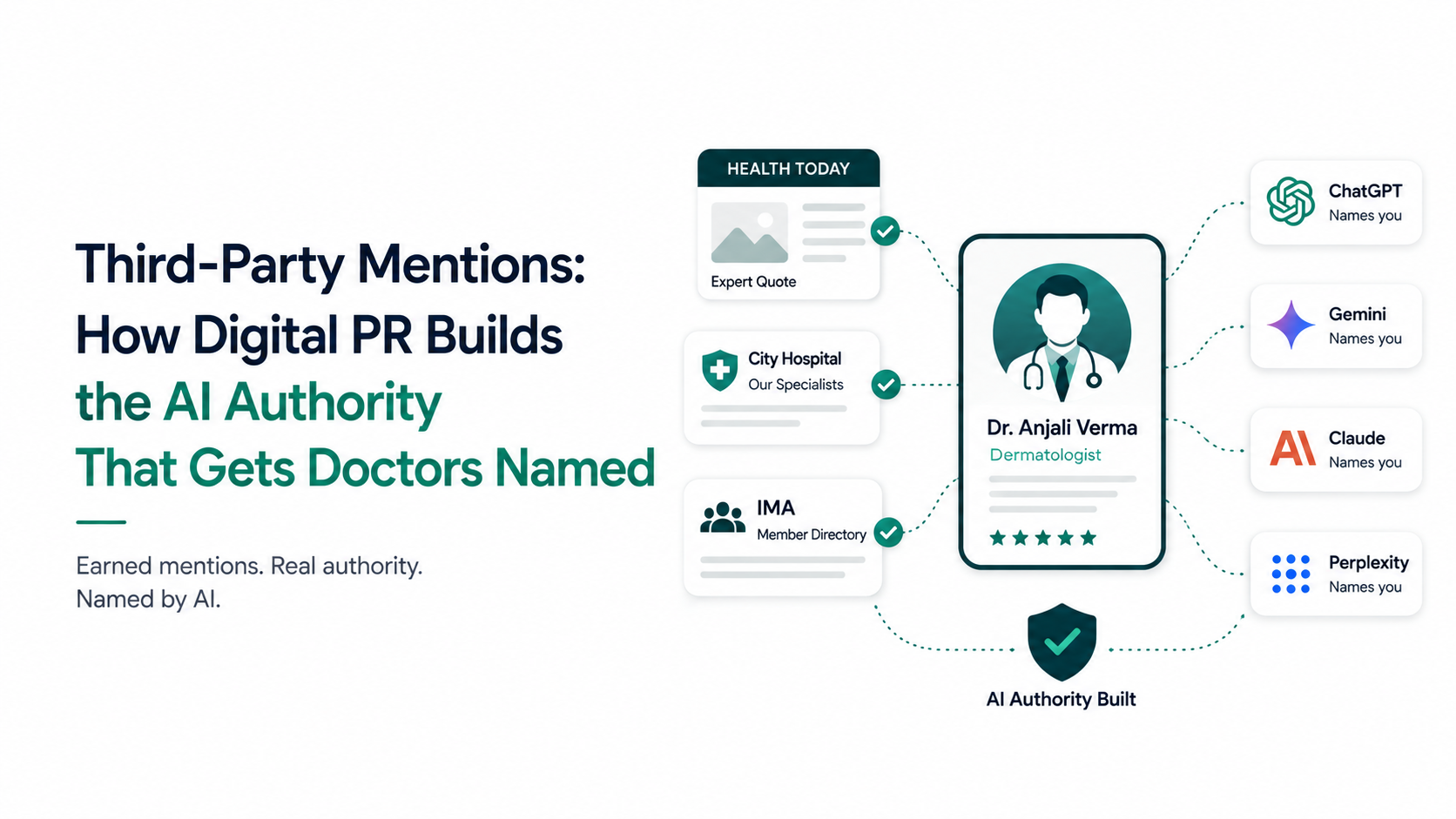
Digital PR for doctors and AI works because an AI model builds confidence in a practice partly from who else has written about it. When a local health publication quotes you, a hospital affiliation page lists you, or a specialty association names you as a member, each of those is an independent, editorial confirmation that you exist and carry weight in your field. This is the off-site half of getting named. Directory listings tell AI your details are correct. Third-party mentions tell AI you are respected. This post explains how earned mentions build the authority that gets you named, and how to earn them ethically in both the US and India.
What is digital PR for AI visibility
Digital PR for AI visibility is the practice of earning credible, editorial mentions of you and your work on websites you do not own, so that AI models treat you as an authority worth naming. It is not press releases or paid placements. It is being quoted in an article, cited as an expert, listed by an association, or written about because you contributed something genuinely useful. These are unstructured mentions, meaning free-text references inside real articles, not the fixed name-address-phone fields of a directory. AI models read that surrounding language as a signal of standing, not just existence.
This is where digital PR differs from directory citations. A directory confirms your facts. A media mention confirms your reputation. You need both.
Why AI models weigh who writes about you
An AI assistant answering "who is a leading cardiologist in Austin" or "best dermatologist for acne in Bengaluru" is not counting your listings. It is deciding which one to three names it can state with a straight face. To do that, it reads the wider picture of how you appear across the open web. A doctor quoted in a regional health article, referenced on a hospital's specialist page, and listed by a specialty society reads as an established figure. A doctor who appears only in their own website reads as unverified.
This connects to E-E-A-T, which stands for Experience, Expertise, Authoritativeness, and Trust. Search and AI systems try to estimate all four, and they cannot take your word for it. Third-party mentions are how the "Authoritativeness" part gets confirmed by sources other than you. When credible outsiders describe your expertise, the model can too.
There is research behind this. A GEO study from Princeton, Georgia Tech, the Allen Institute for AI, and IIT Delhi found that content carrying credible statistics, quotations, and cited sources raised how often an answer engine cited it, by up to 40%. GEO, or Generative Engine Optimization, is the practice of making your information easy for AI answer engines to quote. Being the source others quote is one of its strongest inputs.
Off-site authority versus on-site content: why both matter
Most doctors invest only in their own website and stop there. That is on-site work, and it is necessary but self-reported. Off-site authority is what other credible sites say about you, and it carries more weight precisely because you did not write it. Here is the difference in practice.
- On-site only tells a model what you claim about yourself. Useful, but a model knows you control it.
- On-site plus thin off-site leaves a gap. Your claims exist, but nothing independent backs them up.
- On-site plus real off-site mentions gives the model outside confirmation. Now your expertise is corroborated, and you become safe to name.
The jump from self-reported to corroborated is the whole point of digital PR. It is the same instinct a careful patient uses. Your own site is your resume. A mention in a respected publication is a reference.
How doctors ethically earn third-party mentions
You do not buy these. You earn them by being genuinely useful and credentialed. Here is the order that works for an independent doctor or a clinic owner:
- Contribute real expertise. Offer to comment on health stories for local or specialty publications, or answer journalist queries in your field. A single accurate quote in a respected outlet is worth more than ten weak links.
- Get listed by associations and boards. Ensure your membership of specialty societies, medical councils, and boards is reflected on their public pages. These are hard to fake and read as authoritative.
- Confirm hospital and affiliation pages. If you consult at or are affiliated with a hospital or larger group, make sure their specialist page lists you correctly. That page is a strong editorial signal.
- Publish genuinely useful content. Write a clear explainer for a reputable health platform or your association's blog. Useful, cited content gets referenced by others over time.
- Be quotable. When you do write or speak, include clear facts, plain definitions, and honest sources. Those are the passages AI and other writers lift and cite.
None of this is advertising. Each step is you sharing real knowledge and confirming real credentials.
What this looks like in the US
For a doctor in Austin, Denver, or New York, credible off-site mentions come from a recognisable set of places. Regional newspapers and local health sections run expert commentary. Hospital and health-system specialist directories carry affiliation pages. Specialty bodies such as your American Board listing or society membership provide authoritative records. Reputable health platforms like WebMD and Healthgrades sometimes carry editorial or expert content alongside their directory profiles.
The pattern that helps is being genuinely quoted or genuinely listed, not paying for placement. A cardiologist quoted in a Denver health feature, affiliated on a hospital's specialist page, and listed by their board reads to an AI model as an established authority in that city.
What this looks like in India, within NMC limits
For a clinic owner in Mumbai, Delhi, Bengaluru, Pune, Hyderabad, or Chennai, the same principle applies with one firm boundary. Indian doctors operate under NMC rules that restrict self-promotion and soliciting patients. Digital PR here must stay strictly educational and credential-based, never promotional.
That still leaves plenty of legitimate ground:
- Contribute expertise, not advertisements. Answering a health journalist's question or writing a factual explainer is education, not solicitation.
- Confirm your associations and hospital affiliations. Being correctly listed by a medical body or by Apollo, or a hospital where you consult, is a factual record, not a claim.
- Keep the content about the condition, not the offer. Explain the topic. Do not make claims of superiority, outcomes, or "best in city."
You are making your existing, factual expertise consistent and findable. You are never buying coverage or soliciting patients. That distinction is what keeps this compliant and still effective for AI search in India.
What most doctors get wrong about digital PR
The first mistake is thinking digital PR means paid promotion. It does not. Paid placement is often the weakest signal, and in India it crosses NMC lines. Earned, editorial mentions are what carry authority, because their value comes from someone credible choosing to reference you. [Replace with your real audit figure before publishing.]
The second mistake is treating this as separate from everything else. It is not. Third-party mentions work alongside your entity identity, your directory depth, and your on-page answers. Off-site authority is one pillar of the wider picture the AI visibility overview for doctors lays out across ChatGPT, Gemini, Claude, and Perplexity. You can have a polished website and still be skipped because nothing independent confirms your standing.