Directory Citations and AI Visibility: Why 6+ Consistent Listings Get Your Practice Named
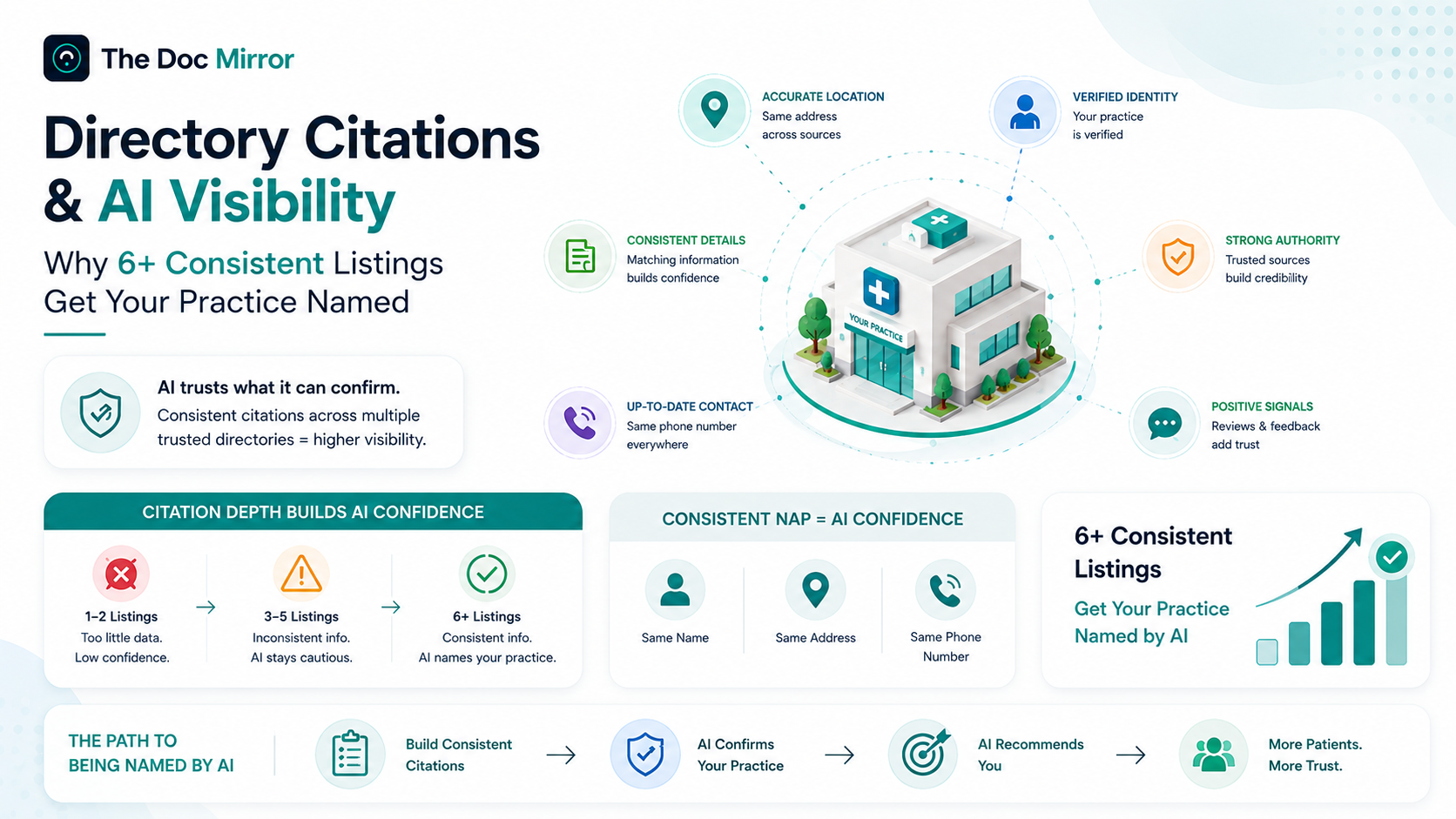
Directory citations are one of the strongest signals that decide whether an AI assistant will name your practice or skip it. A citation is a listing of your name, address, and phone number on a third-party site, such as a medical directory or a local business platform. When the same details appear identically across 6 or more trusted directories, AI models read that agreement as fact. When they appear once, or appear three different ways, the model treats you as a guess it would rather not repeat. This post explains how directory citations for AI work, which ones matter in the US and India, and how to build and clean them without breaking any rules.
What is a directory citation
A directory citation is any public listing of your practice's core identity - your name, address, and phone number, often shortened to NAP - on a website you do not own. A Healthgrades profile is a citation. A Practo listing is a citation. So is a JustDial entry, a Vitals page, or a specialty board record. Each one is a separate, independent record of who you are and where you practise. AI models cannot verify a claim from a single source, so they look for the same claim repeated across many. Citations are those repetitions. The more of them agree, the more confidently the model can describe you.
Why AI trusts information it can confirm across sources
An AI assistant answering "who is a good dermatologist in Denver" or "best gynaecologist near Koramangala" is not ranking links. It is writing a short answer and naming one to three practices it can describe without hedging. To do that safely, it needs to be sure you exist, that your details are correct, and that you match the request. A single listing does not prove any of that. Six matching listings do.
This is the core of citation depth. Depth is not how many words are on your profile. It is how many independent sources confirm the same facts about you. Think of it the way a careful colleague would treat a rumour. Heard once, it is a maybe. Heard the same way from 6 trusted people, it is something you will state out loud. AI models apply the same logic. Consistency across sources is the difference between being named and being left out.
There is real research behind this instinct. A GEO study from Princeton, Georgia Tech, the Allen Institute for AI, and IIT Delhi found that specific content and citation choices can raise how often an answer engine cites a source by up to 40%. GEO, or Generative Engine Optimization, is the practice of making your information easy for AI answer engines to quote. Directory consistency is one of its most basic and most overlooked inputs.
Citation depth versus a single listing: why 6 beats 1
Most doctors have at least one listing somewhere. That is not the same as citation depth. Here is what the difference looks like in practice.
- One listing tells a model your practice might exist. It cannot cross-check the phone number, so it stays cautious.
- Two or three listings that disagree actively lower confidence. Conflicting addresses read as a data problem, and the safe move is to name someone else.
- Six or more listings that match give the model independent confirmation from multiple angles. Now it can describe your specialty, location, and contact details without guessing.
The jump from 1 to 6 matters more than the jump from 6 to 20. Once several trusted directories agree, you have crossed from "unverifiable" to "confirmed." That threshold is why the Free Audit checks your practice across Google and 6 directories rather than just one. It is looking for depth, not presence.
Which medical directories matter for AI in the US
In the US, AI assistants lean on the directories that are structured, widely referenced, and hard to fake. For an independent doctor in Austin, New York, or Denver, these are the ones worth getting right first:
- Healthgrades - one of the most cited physician directories, strong on specialty and location data.
- Zocdoc - booking-focused, so its NAP and specialty data are frequently pulled into answers.
- Vitals - long-established, widely syndicated profile data.
- WebMD and its provider directory - high authority in health contexts.
- Your specialty board or society listing - for example the American Board of Medical Specialties record, which is hard to fake and reads as authoritative.
- Your Google Business Profile - not a medical directory, but the anchor record every other source is checked against.
You do not need all of them on day one. You need the same name, address, phone, and specialty on the ones you do have.
Which directories matter for AI in India
India has its own set, and they carry the weight that Healthgrades and Zocdoc carry in the US. For a clinic owner in Mumbai, Delhi, Bengaluru, Pune, Hyderabad, or Chennai, the directories that AI models most often confirm against are:
- Practo - the most referenced healthcare directory in India, strong on specialty and consultation data.
- JustDial - broad local-business coverage that AI retrieval reads for contact and location facts.
- Lybrate - health-focused profiles and Q&A that reinforce specialty context.
- Apollo 247 and similar hospital or pharmacy platforms - high-authority health records.
- Your Google Business Profile - again, the anchor the others are matched against.
For Indian doctors, one point matters more than any other. Building citations here is not advertising. Under NMC rules that restrict self-promotion, you are not soliciting patients. You are making your existing, factual information consistent and findable, which is fully within those norms. You are correcting the record, not marketing it.
What NAP consistency really means
NAP consistency is the quiet foundation under everything above. It means your Name, Address, and Phone number appear in exactly the same form everywhere. Not roughly the same. Exactly. "Dr. Anjala Rao, 12 MG Road, Suite 4" and "Dr. Anjali Rao, 12 M.G. Rd, #4" read as two different practices to a model that is matching strings. Small differences do real damage:
- A name spelled two ways splits your identity in half.
- A suite number present on one listing and missing on another weakens the address match.
- An old phone number on a stale directory can override your current one if it appears more often.
The fix is boring and effective. Pick one canonical version of your name, address, and phone, then make every listing match it. This is the single highest-return cleanup most practices can do for their AI visibility.
How to build and clean citations, step by step
You do not need an agency for this. You need a short, disciplined pass. Here is the order that works:
- Write your canonical NAP in one document: exact practice name, full address with suite, one primary phone, and your primary specialty.
- Audit what exists. Search your name plus city and list every directory you appear on, in the US or India.
- Fix conflicts first. Correct wrong addresses and old phone numbers before adding anything new. A clean small set beats a large messy one.
- Claim the anchor. Verify your Google Business Profile so it holds the correct record every other source is checked against.
- Fill the gaps. Add or complete the core directories for your market until you have 6 or more matching listings.
- Recheck quarterly. Directories drift, syndicate old data, and duplicate profiles. A short recheck keeps depth intact.
Citations are not a one-time task. They are a record you maintain, the same way you keep your clinical notes current.
What most doctors get wrong about citations
The common mistake is treating citations as a numbers game or as advertising. Neither is right. Adding your practice to 30 low-quality directories with slightly different details is worse than having 6 clean, matching ones. Volume without consistency creates conflict, and conflict is exactly what lowers a model's confidence. [Replace with your real audit figure before publishing.]
The second mistake is assuming reviews or Google rank cover this. They do not. Directory citations are a separate signal from your reviews and from your on-page work. They sit alongside your entity identity as the raw material AI uses to confirm you exist. You can rank first on Google and still be invisible to ChatGPT because your citation depth is thin. The AI visibility pillar for doctors explains how these signals fit together across ChatGPT, Gemini, Claude, and Perplexity.