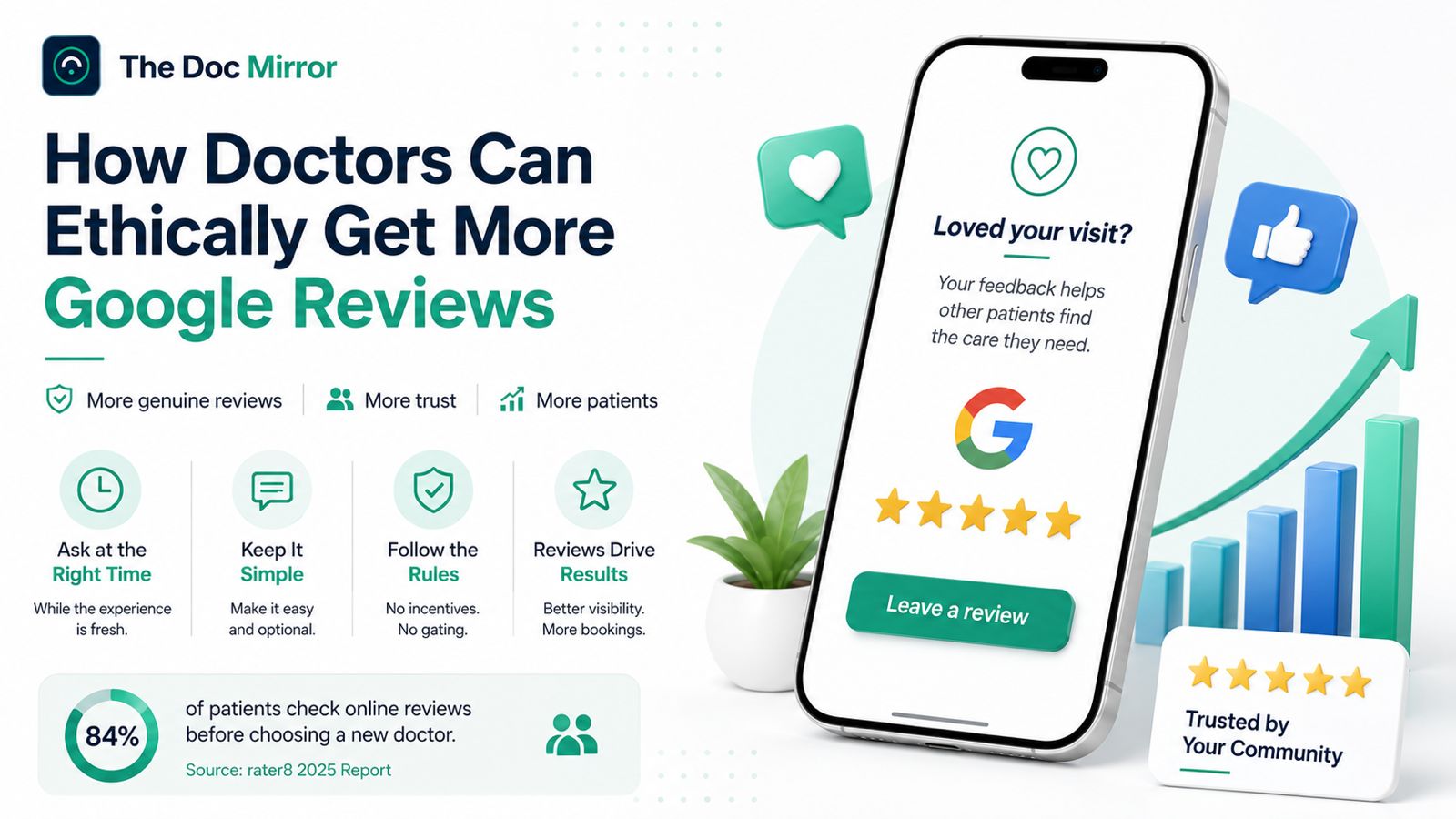
The ethical way for a doctor to get more Google reviews is to ask every satisfied patient soon after a good visit, make leaving one a single tap, and never pay for, filter, or fake a single review. That method is slower than buying reviews, and it is the only version that lasts, because Google removes reviews it detects as incentivized and the Federal Trade Commission (FTC) can now fine businesses for fake or suppressed ones.
Reviews are worth the effort because patients read them before they ever call. In rater8's 2025 report on how patients choose doctors, 84% of patients check online reviews before choosing a new provider, and most read at least six. Reviews are also one of the 7 pillars in your visibility score, and for most practices it is the pillar with the most room to grow.
How reviews shape your ranking and your bookings
Google ranks local results on three factors: relevance, distance, and prominence. Your review count and rating feed prominence, which is how established and trusted your practice looks. A practice with 80 genuine reviews at 4.7 stars usually sits above a nearby one with 12, even when the care is comparable.
Reviews also feed two pillars of your visibility score directly. Rating is worth up to 20 points and Reviews up to 15, which together make reviews the single largest movable block in the score. Two clinically identical practices can land in different verdict bands, one flagged and one strong, purely on the strength of their review profile.
Patients read the same signal in the same order. They scan the star rating first, then the review count, then the most recent comments. The rater8 report found 51% read at least six reviews before they feel confident enough to book, so a thin profile loses the patient before your care is ever considered.
What Google and the FTC actually prohibit
Before you ask for a single review, know the lines you cannot cross. These are not soft guidelines, and both carry financial consequences.
- No incentives. You cannot offer a discount, a gift card, a raffle entry, or anything of value in exchange for a review. Google's content policy bans incentivized reviews outright, and the FTC's 2024 rule, effective October 21, 2024, treats compensation tied to a specific sentiment as deceptive.
- No review gating. You cannot survey patients first and route only the happy ones to Google while steering unhappy ones elsewhere. Google prohibits it, and the FTC now targets this kind of review suppression.
- No fake or insider reviews. Reviews written by staff, family, or a paid service are prohibited and increasingly detectable. The FTC rule allows civil penalties of up to $51,744 per violation for knowing offenders.
- No confirming who is a patient. When you respond, never disclose that a reviewer was treated by you or reference any clinical detail. That risks a Health Insurance Portability and Accountability Act (HIPAA) violation even if the patient named themselves first.
Everything below stays inside these rules. Confirm the current specifics with your own compliance counsel and state medical board, since enforcement details evolve.
When to ask, and why timing wins
The single most effective move is asking soon after a visit that went well, while the goodwill is fresh. Wait a week and your response rate falls, because the moment and the intent both fade.
The data supports a prompt ask. In the rater8 report, 47% of patients who leave a review do so within 24 hours of the appointment. Asking itself is what drives that: 74% of patients say they are at least somewhat likely to leave a review when their provider prompts them, yet most are never asked.
There is a healthcare-specific nuance on timing. In BrightLocal's 2025 Local Consumer Review Survey, the largest group of consumers said they would prefer a healthcare business to ask for a review within three days to a week, not seconds after a sensitive procedure. So the target is prompt but considerate: same-day for a routine positive visit, a few days by follow-up message for anything more involved.
How to ask without breaking HIPAA
The wording of the ask matters as much as the timing. Keep it plain, optional, and about honesty, not about a rating.
- Identify the natural moment. A smooth follow-up, a resolved concern, or a warm goodbye at the front desk all qualify.
- Ask in plain language. "If you have a minute, an honest Google review really helps other patients find us. No pressure at all."
- Ask everyone who had a good experience, not only the patients you predict will rave. Selecting only likely-positive patients edges toward gating.
- Never write, imply, or suggest the words. The review has to be the patient's own, in their own voice, with nothing offered in return.
- Do not disclose the visit in your request or your reply. You can ask any patient to review you, but you cannot publicly confirm that a specific person is one.
The last point is where doctors slip. A request handed to a patient at checkout is fine. A public reply that thanks someone "for trusting us with your surgery" is not, because it confirms a care relationship in writing.
Make leaving a review a single tap
Most patients who intend to review never finish, because the path is too long. Your job is to remove every step between "yes" and a posted review.
Google gives every profile a short review link you can share directly. Turn that link into a QR (quick response) code for the front desk and a tablet at checkout, and drop the same link into your post-visit text or email. One tap should open the review box on the patient's own phone, already pointed at your profile.
Do not build a middle step that screens sentiment first. A survey that decides who reaches Google is gating, whatever the software vendor calls it. The compliant version sends the same open link to everyone you ask.
Why steady volume and recency keep working
Aim for a set number of asks each week rather than one big push. Steady beats spiky for two reasons. Google trusts a natural trickle more than 40 reviews landing in a single afternoon, which can read as manufactured and get filtered. Patients, meanwhile, weigh recent reviews more heavily, so a listing that keeps gathering fresh feedback always looks more current than a stale one with an older total.
Volume also protects you. A single negative review lands much softer against a wide base of genuine positive ones, and it barely moves an average built on 90 reviews. That is why the durable answer to one bad review is more real reviews, never a purchased or fabricated one. Managing your reputation after the fact is a separate discipline, but it starts from the same base of genuine volume you build here.
Set a weekly ask target you can sustain from your patient volume, then hold to it. Consistency, not intensity, is what compounds.
A note on AI: reviews are one signal, not the only one
When a patient asks ChatGPT, Gemini, Claude, or Perplexity for a doctor, those assistants lean more on consistent directory data and website structure than on your star rating. A strong review profile helps your Google standing and your patients' trust, but it is not what gets you named in an AI answer.
That is not a reason to skip reviews. It is a reason to treat them as one pillar among several. Genuine reviews, accurate listings, and clean website markup together are what carry you across both Google and AI.
How to check where you stand this week
You can measure your review position in under 15 minutes without paying anyone.
- Open your Google Business Profile and write down your exact review count and star rating today. That is your baseline.
- Search your specialty plus your city in an incognito window. Note the review counts of the three practices in the local map pack and compare them to yours.
- Count how many of your last 20 reviews you have responded to, and how quickly.
- Set one number: how many patients your front desk will invite to review each week, using a QR code or a post-visit link.
The Free Audit at thedocmirror.com scores your Rating and Reviews pillars against your top 3 local competitors and shows exactly where you sit in your visibility score. It takes about 90 seconds and needs no signup for the free score. If you want the prioritized plan and review response templates, the Full Report is $19.