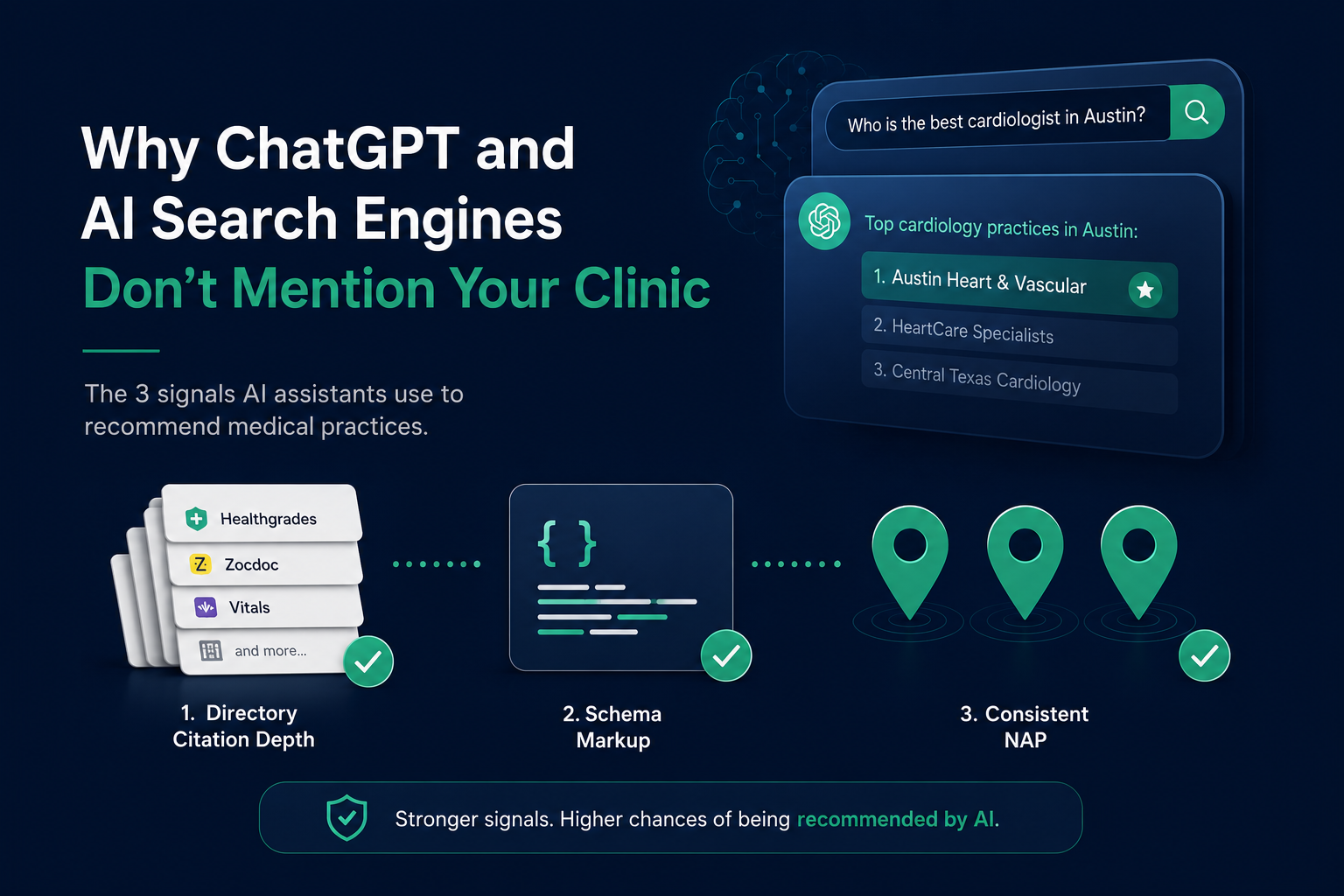
When a patient asks ChatGPT for "the best cardiologist in Austin," the answer does not come from Google's ranking. It comes from a different set of signals: structured business data across medical directories, schema markup on your website, and consistent name, address, and phone information across the web. If those signals are missing, you can rank on page one of Google and still be absent from the AI answer. This guide explains why that happens and the three fixes that move the needle fastest for an independent US practice.
AI assistants do not read Google's rankings
Most doctors assume that ranking well on Google means AI tools will find them too. They do not work that way. When you ask ChatGPT, Gemini, Claude, or Perplexity for a doctor, the tool pulls from its training data, from live web retrieval, and from a small number of sources it treats as authoritative. It then writes a short answer naming one to three practices.
Google decides which link a patient clicks. An AI assistant decides which practice gets named before a patient clicks anything. Those are two different scoreboards, and most independent practices are only watching one.
The three signals AI assistants weigh most
Across the profiles The Doc Mirror has reviewed, three signals separate the practices that get named from the ones that do not.
1. Directory citation depth
A citation is any listing of your practice on a third-party site with your name, address, and phone number. Healthgrades, Zocdoc, Vitals, and your specialty boards all count. In the profiles we have checked, the practices that appeared in AI answers were listed on six or more directories with matching details. The ones that did not appear had two or fewer.
The reason is simple. AI assistants trust information they can confirm in more than one place. Six matching listings read as a fact. One listing reads as a guess.
2. Schema markup on your website
Schema markup is a small block of code that tells search engines what kind of business you are. For a medical practice it lists your specialty, address, hours, and credentials in a format machines read cleanly. Most doctor websites built by a local agency do not have it. Adding it usually moves a visibility score by 3 to 5 points and helps AI assistants identify you as a cardiology practice rather than an unnamed address.
3. Consistent name, address, and phone (NAP)
If your practice name is written three different ways across the web, or an old suite number still lives on two directories, AI assistants lose confidence in the record. Clean, identical details everywhere is one of the cheapest fixes available and one of the most overlooked.
What most doctors get wrong
Two beliefs keep practices invisible.
The first is that reviews decide everything. Reviews matter for the Google local pack. They matter far less for whether ChatGPT names you. One practice we looked at had 380 reviews at 4.9 stars and appeared in zero AI answers for its specialty, because its directory data was thin and inconsistent.
The second is that AI search is a future problem. It is not. A meaningful share of patients already start their search inside an AI assistant, and those patients skew younger and higher-income, which is the exact group most practices say they want more of.
How to check where you stand this week
You do not need to pay anyone to run the first check.
- Open ChatGPT and ask for the best cardiologist in your city, one query at a time.
- Note whether your practice is named, and which competitors are.
- Count how many medical directories list your practice with matching details.
- Open your website source and search for the word "schema." If it is not there, that is your first fix.
If you want the full picture, the Free Audit at thedocmirror.com runs your practice across Google, ChatGPT, Gemini, Claude, Perplexity, and six directories, then scores you on 7 pillars and shows exactly which gaps to close first. It takes about 90 seconds and needs no signup for the free score.