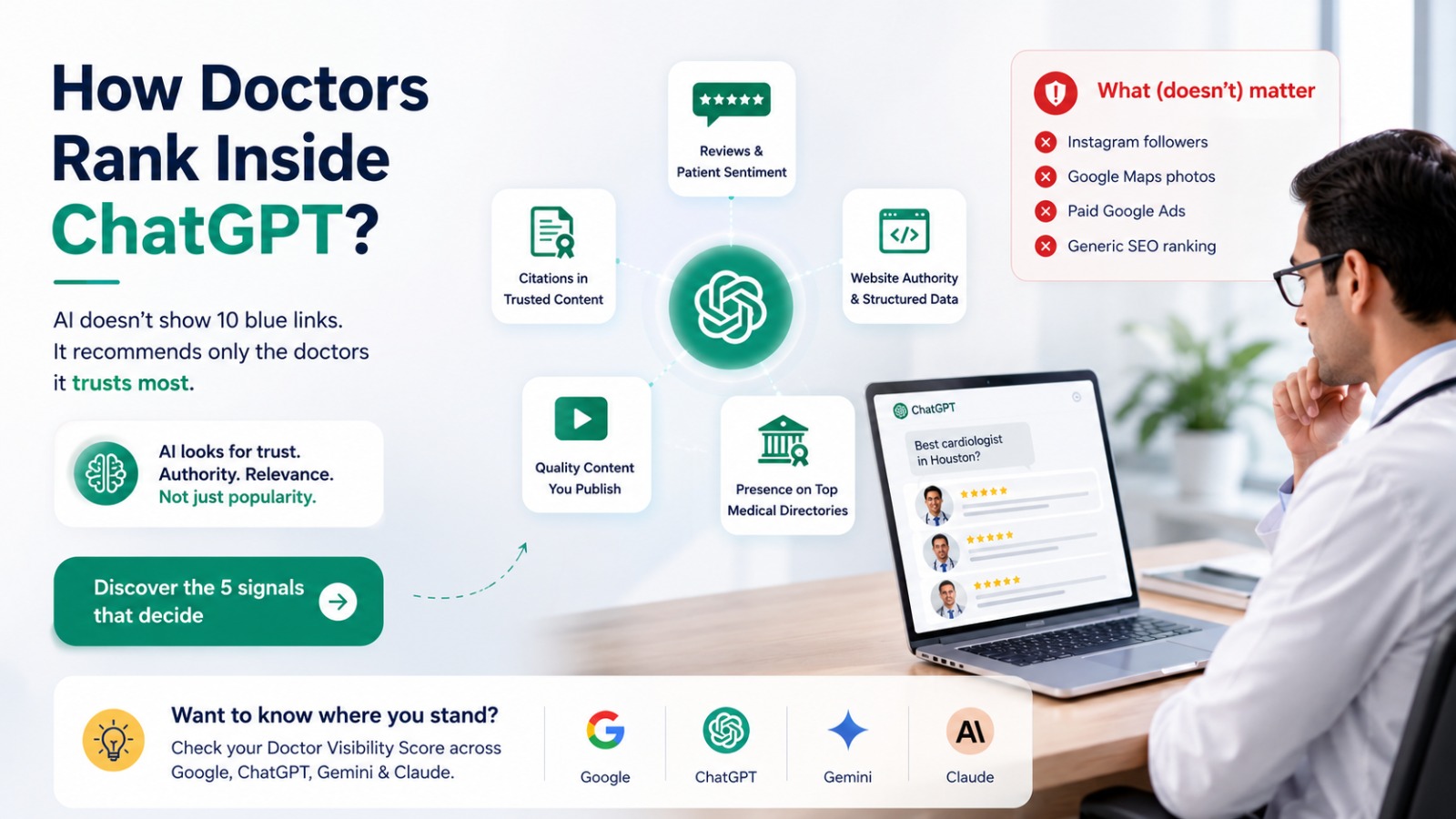
Unlike Google, ChatGPT does not show "10 blue links" with a clear ranking system. It composes an answer in natural language and includes 2–5 doctor names it has high confidence in. That confidence is built from a specific set of signals.
How AI collects information about doctors
Large language models are trained on snapshots of the web. They ingest billions of pages including medical directories, news articles, hospital staff pages, peer-reviewed journals, and patient review platforms. From this, they build a representation of each doctor as an entity — with attributes like specialty, location, qualifications, patient sentiment, and notability.
When a patient asks "best cardiologist in Houston", the model retrieves the entities most strongly matching that query and ranks them by confidence.
The ranking signals that appear to matter
1. Reviews and patient sentiment
Volume and quality of reviews — but specifically reviews that appear in trusted directories that feed AI training: Healthgrades, Zocdoc, Vitals, WebMD. Reviews on smaller or newer review sites carry less weight.
2. Citations in authoritative healthcare content
Being quoted as an expert in a Healthline article, a Mayo Clinic content piece, a regional news healthcare story, or a peer-reviewed journal. These citations dramatically increase AI confidence.
3. Website authority and structured data
Your practice website needs Schema.org markup (MedicalOrganization, Physician, FAQPage). Without it, AI parsers see undifferentiated text. With it, they extract structured facts they can rely on.
Signal strength at a glance
| Signal | AI weight | Effort to improve |
|---|---|---|
| Big-5 directory profiles | High | Low |
| Expert citations in media | High | Medium |
| Structured data on your site | Medium | Low |
| Review recency & volume | Medium | Ongoing |
| Social media following | Low | High |
What likely does not matter (yet)
- Instagram followers (AI tools rarely cite consumer social platforms for healthcare)
- Number of Google Maps photos (helpful for Google itself, not AI training)
- Paid Google Ads (not visible to AI training data)
- Generic SEO ranking (correlated with AI mention, but not the same thing)
A doctor mentioned consistently across Healthgrades, Zocdoc, and one major news outlet is far more likely to be surfaced than one with only a personal website.
How to improve your ChatGPT visibility
The Doc Mirror runs real queries against ChatGPT, Gemini, Claude, and Perplexity to see which doctors are actually surfaced for relevant searches in your specialty and city. Based on the gap analysis, you get a specific action plan focused on the citations, directory profiles, and content additions that will move your AI visibility fastest.