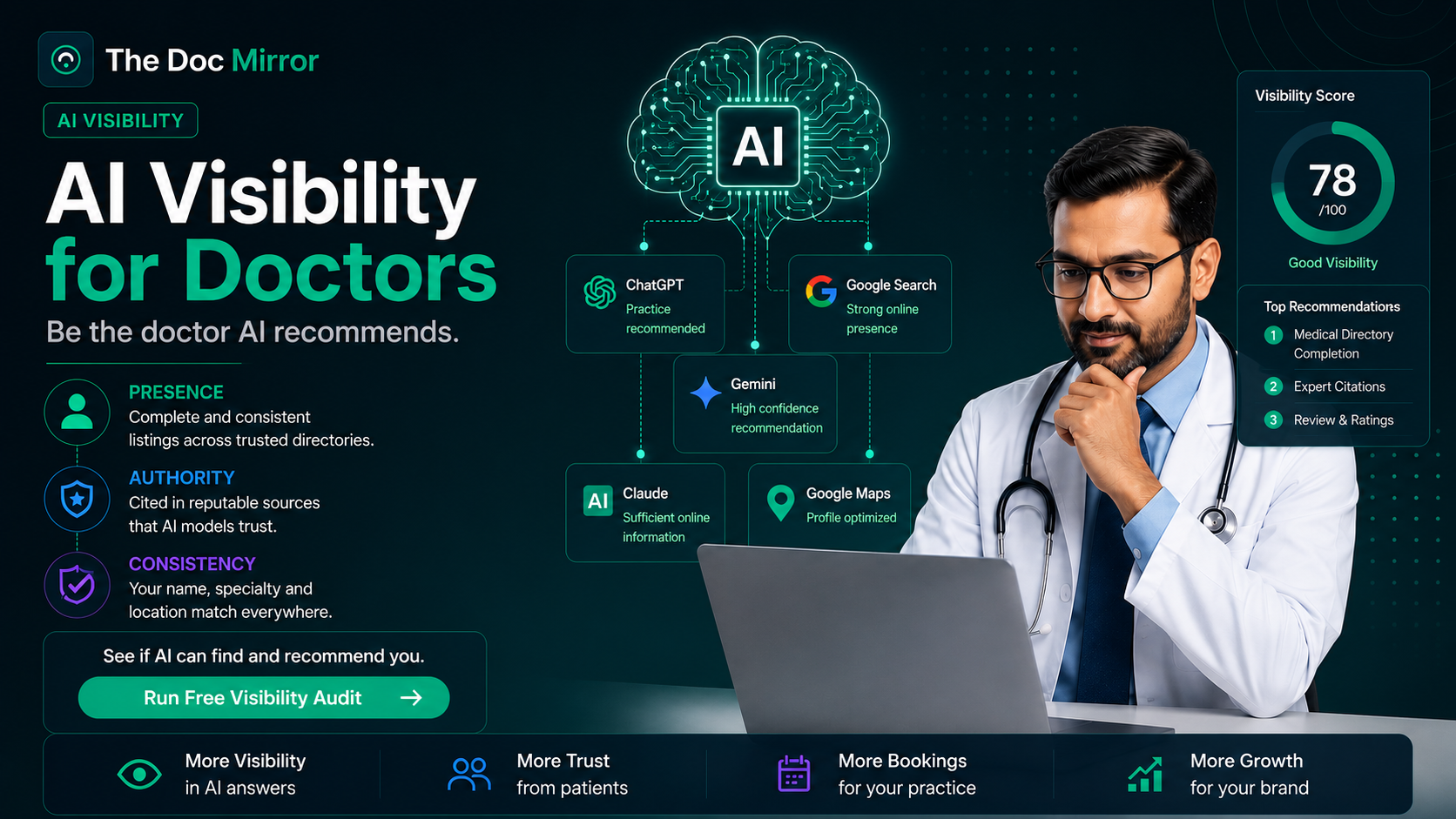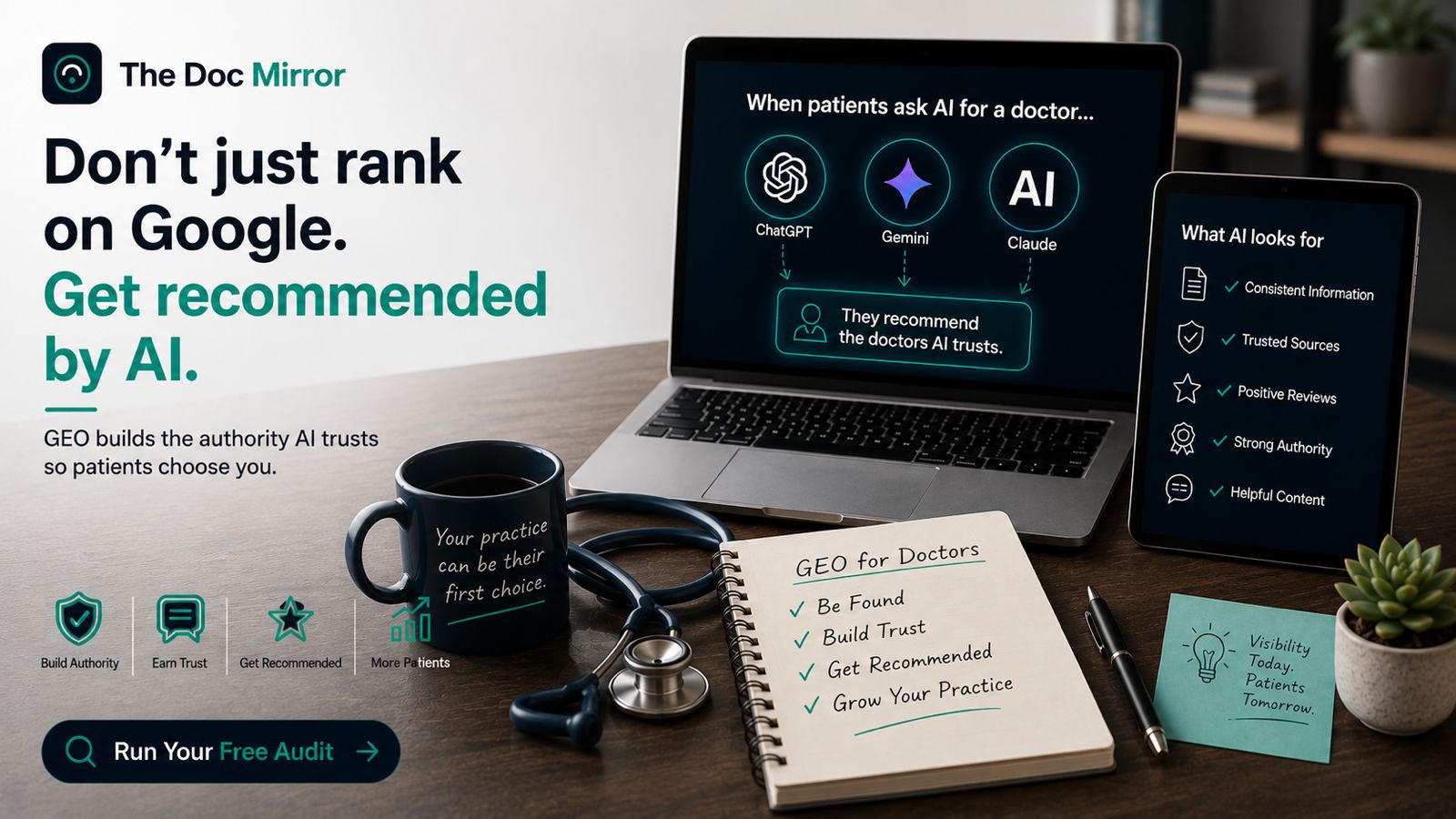
GEO, short for Generative Engine Optimization, is the work of building your practice's authority across the web so that AI assistants like ChatGPT, Gemini, Claude, and Perplexity recognize you and name you when a patient asks for a doctor. It is not about ranking a page in Google's list of links; it is about becoming an entity those models trust enough to recommend. The term comes from a 2023 research paper by academics at Princeton, Georgia Tech, the Allen Institute for AI, and IIT Delhi, who defined GEO and showed that specific content choices can raise how often an AI answer cites a source by up to 40%.
This matters for doctors because patients now act on what AI tells them. In rater8's 2025 patient-choice report, 26% of patients said an AI tool had directly influenced their choice of provider, close to the 28% who relied on a primary-care referral. Separately, KFF found that about a third of adults have turned to AI chatbots for health information in the past year. GEO is how you make sure the doctor those tools name is you.
GEO in one sentence
GEO builds the authority that makes an AI model confident enough to say your name. Where a classic search returns a list of links for the patient to sort through, an AI assistant writes a short answer that usually names one to three practices. GEO is the work of becoming one of those named practices. If you are new to the wider topic of how patients find doctors online, start with what doctor online visibility actually means, then come back here for the AI-specific layer.
How GEO differs from SEO and AEO
These three terms overlap, and doctors are often sold one under the label of another. Here is the clean distinction.
- SEO (Search Engine Optimization) gets your website and Google Business Profile to rank in Google's list of results and in the local map pack.
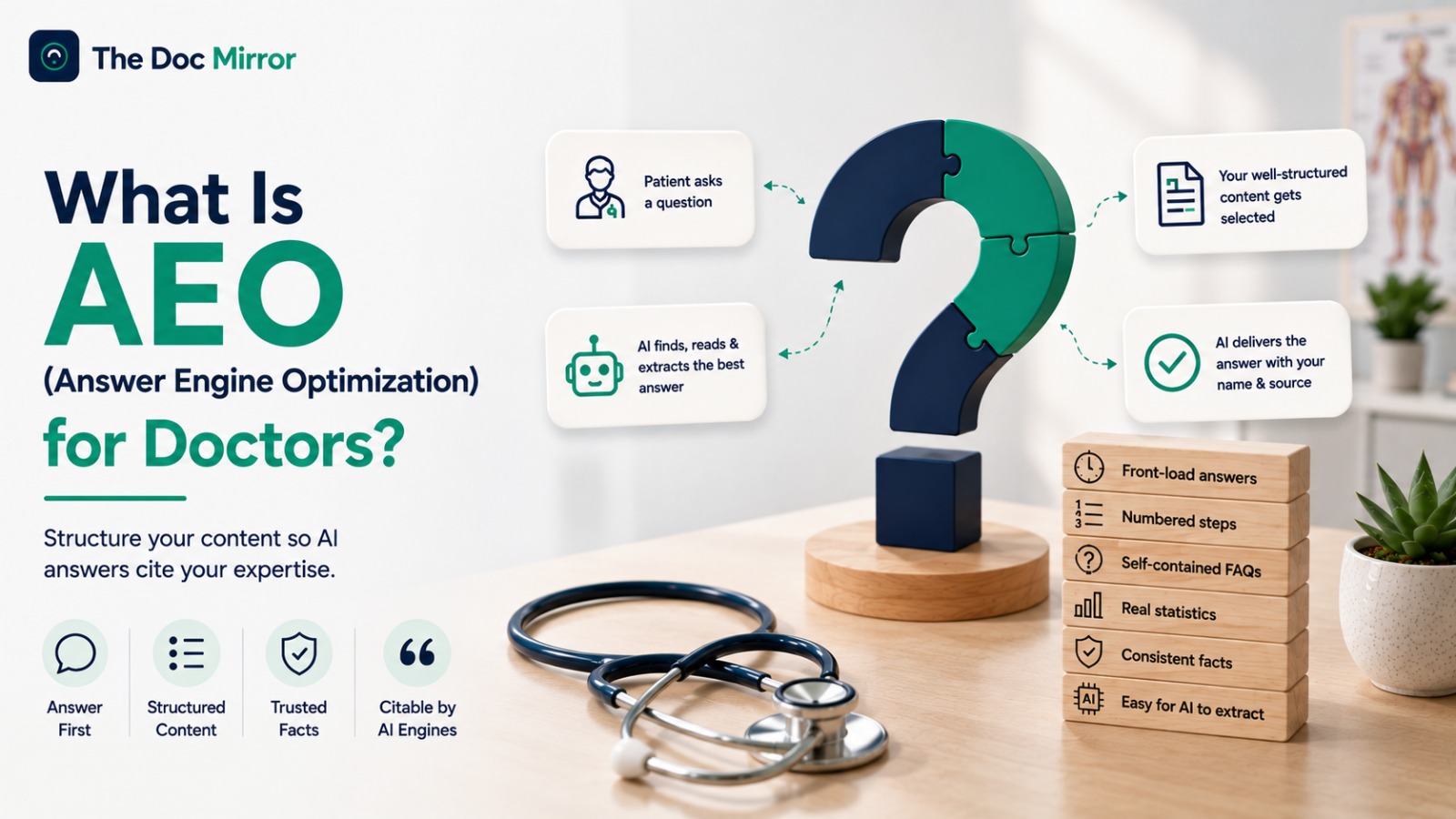
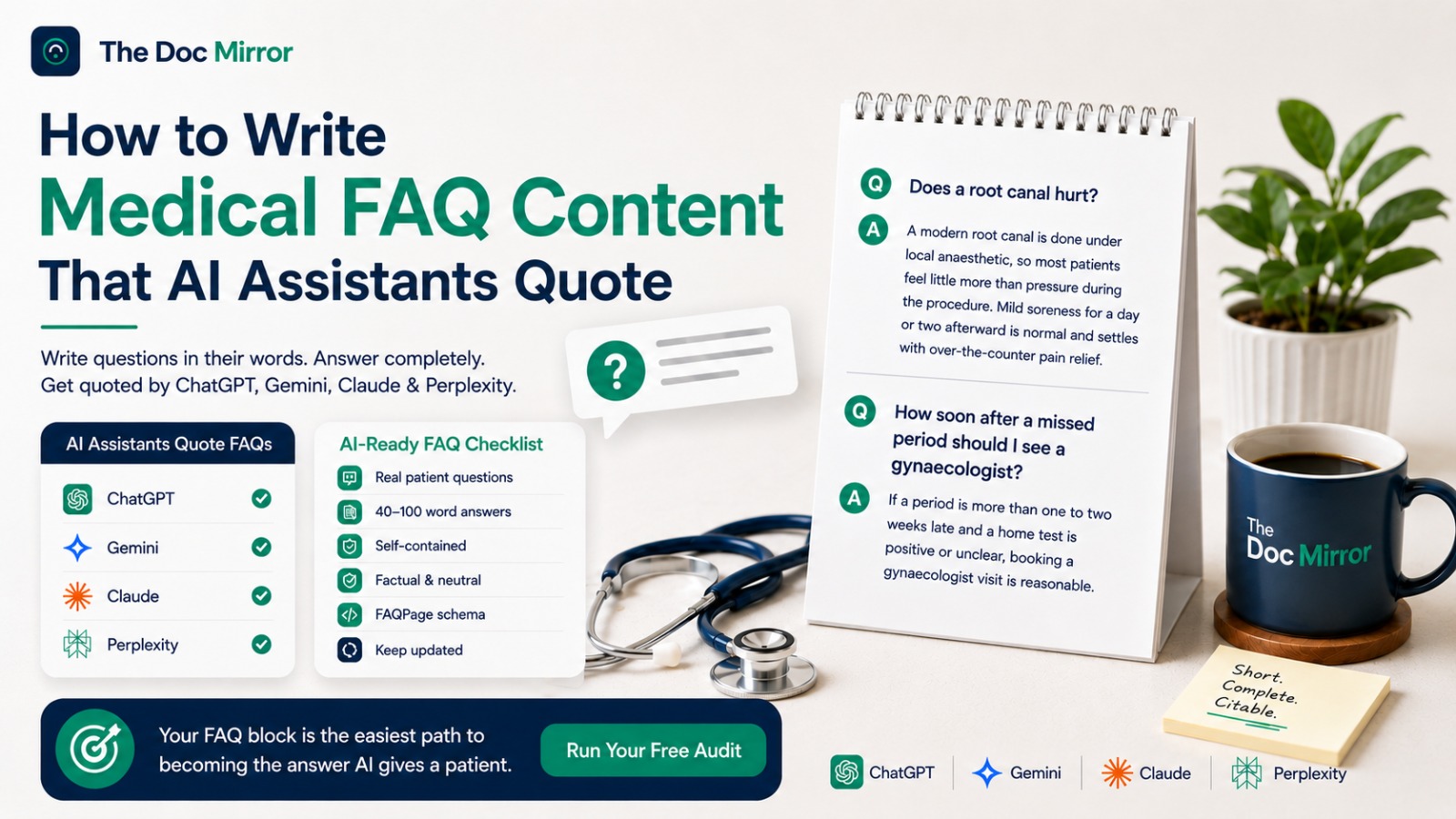
- AEO (Answer Engine Optimization) structures your content so an AI assistant can extract and quote it directly when it answers a question.
- GEO (Generative Engine Optimization) builds your practice's overall authority and entity recognition so AI models recommend you at all.
Think of it this way. AEO is about the format of your content. GEO is about the reputation behind it. You can rank number one on Google and still be invisible to ChatGPT, because SEO and GEO run on different signals. SEO answers the question "does Google think this page is relevant?" GEO answers the question "does an AI model trust this practice enough to put its name in an answer?"
The overlap is real and useful. Much of the work that helps your GEO, such as consistent listings and clean structured data, also helps your SEO. But strong SEO alone does not carry you into AI answers, and that gap is why a well-ranked practice can still be absent when a patient asks an assistant for a recommendation.
Why GEO matters for doctors specifically
Patients who ask an AI assistant for a doctor are not idly browsing. They are close to booking, and the group adopting these tools fastest is younger patients, the exact patients most independent practices say they want more of. In the same rater8 research, 73% of patients said they had adopted a new way to research providers in the past year, including AI chatbots, voice assistants, and social platforms.
When a patient asks ChatGPT for "a good dermatologist in Denver," the model does not open Google and read the rankings. It draws on its training data, on live web sources it can retrieve, and on a small set of places it treats as authoritative, then names the practices it is most confident about. If your practice is not one of those, the patient does not scroll past you. You are simply absent from the answer, and you never find out it happened. That is the quiet cost: not a lower position, but no mention at all.
The signals GEO is built on
GEO for a doctor comes down to whether an AI model can confirm who you are in several trustworthy places at once. Four signals do most of the work.
1. Consistent business data across the web
Your name, address, and phone, often shortened to NAP, should read identically everywhere: Google Business Profile, Healthgrades, Zocdoc, Vitals, WebMD, and your own website. When your details match across many sources, an AI model reads them as fact. When they conflict, it loses confidence in the whole record. One old suite number or a "St" where another listing says "Street" is enough to introduce doubt.
2. Directory citation depth
A citation is any listing of your practice on a third-party site that carries your name, address, and phone. The more trusted directories that list you consistently, the more corroboration an AI model has. Thin or inconsistent directory presence is one of the most common reasons an independent practice is missing from AI answers. Depth here means both the number of directories and the agreement between them.
3. Third-party mentions and entity building
GEO rewards being written about, not just listing yourself. A mention by a local health publication, a hospital affiliation page, or a specialty association helps an AI model build an "entity" for your practice and connect it to your specialty and city. The GEO research found that adding credible statistics, quotations, and cited sources to content raised its visibility in AI answers, which points the same direction: models favor corroborated, referenceable information over unsupported claims.
4. Structured, machine-readable content
Schema markup is a small block of code on your website that states your specialty, address, hours, and credentials in a format machines read cleanly. Google is clear that there is no special markup required to appear in its AI features, and structured data is not a magic switch. What it does do is help systems understand your content unambiguously, which is useful when an AI model is trying to decide whether a page describes a cardiology practice or an unlabeled address. Most doctor websites do not have it, so adding it is a low-cost way to remove ambiguity.
The 90-day timeline, and why GEO cannot be bought
Two things about GEO surprise doctors most.
The first is that you cannot pay for it. There is no ad slot inside a ChatGPT or Gemini answer. Recommendations come from organic signals, so ad spend does not place your practice in the response. This is different from Google Ads, and it is worth stating plainly to anyone selling "guaranteed AI placement."
The second is that GEO is not a one-time fix. AI models update their picture of a practice gradually as they re-read the web and refresh their sources. A change you make this week may not show up in answers for weeks. In practice, plan for about 90 days of consistency before an improvement registers reliably. That lag is a feature, not a flaw: it is what makes GEO hard to fake and durable once you have it. A competitor cannot buy past you overnight, and you cannot lose your position from one bad week.
How to check your GEO this week
You can find out where you stand for free. Set aside 20 minutes.
- Ask ChatGPT, Gemini, Claude, and Perplexity for the best doctor in your specialty in your city, one query at a time. Note whether you are named and which competitors are.
- Count the medical directories that list your practice with identical name, address, and phone details. Aim for six or more that agree exactly.
- Open your website source and search the text for "schema" or "application/ld+json." If there is nothing there, that is a first fix.
- Search your practice name across directories and confirm your details match to the character everywhere they appear.
Those four checks usually show which signal is holding you back. The Free Audit at thedocmirror.com scores your AI Visibility as one of 7 pillars, running your practice against ChatGPT, Gemini, Claude, and Perplexity. It takes about 90 seconds and needs no signup for the free score. If you want to see how that score is built before you run it, here is what a doctor visibility score measures.