A well-built medical FAQ for AI is the single element an assistant is most likely to lift word for word. When a patient asks ChatGPT, Gemini, Claude, or Perplexity a health question, these tools favour short, self-contained answers that already read like a reply. An FAQ block gives them exactly that: a real patient question, followed by a clean 40 to 100 word answer that needs no other context. Write those pairs well and mark them up correctly, and your clinic becomes the source the AI paraphrases.
What is a medical FAQ for AI
A medical FAQ for AI is a set of question-and-answer pairs on your website, written the way patients ask and answered so completely that an AI assistant can quote a single answer with nothing else attached. It differs from a marketing FAQ in three ways.
- The questions match real patient phrasing, not internal clinic language.
- Each answer is self-contained, with no "as mentioned above" or "see our services page."
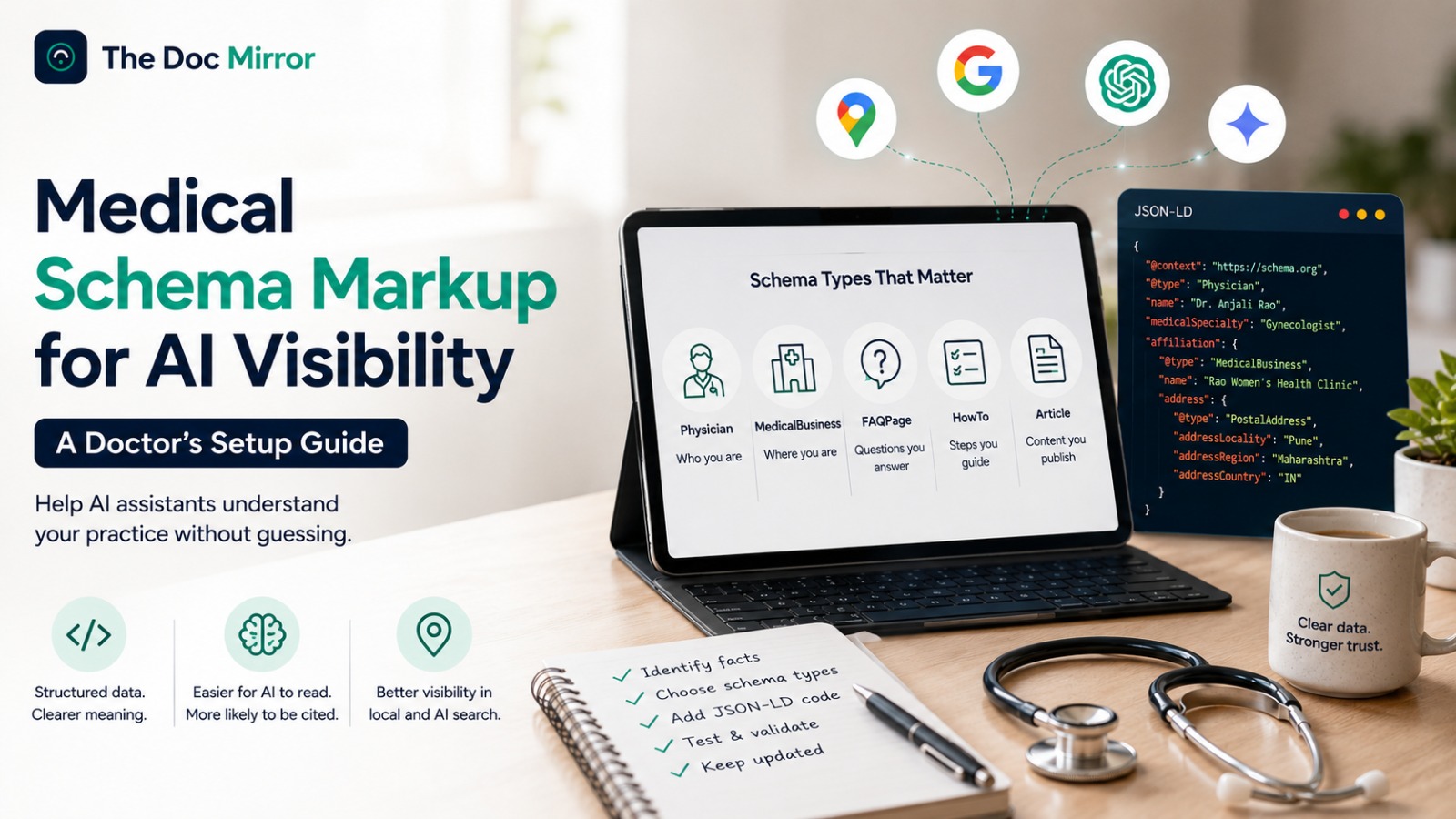
- The block carries FAQPage schema, the structured-data format that labels each pair as a question and an answer.
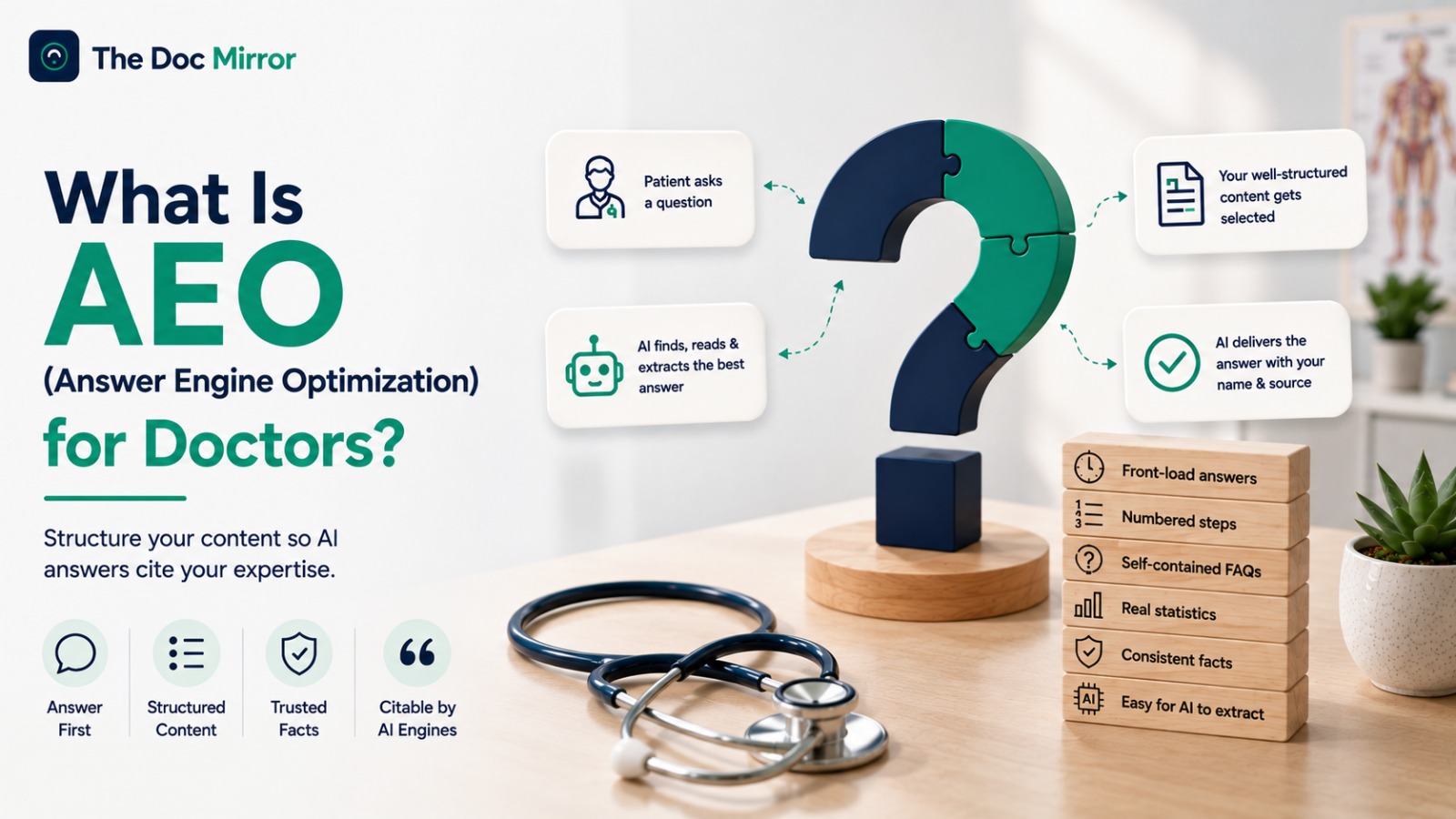
Get quoted by AI and you gain a mention at a patient's moment of decision. That is Answer Engine Optimization (AEO): shaping content so answer engines cite it.
Why the FAQ block gets cited more than any other element
AI assistants assemble replies from passages that already answer a question in isolation. A paragraph buried in a services page rarely qualifies, because it assumes the reader has the whole page in view. An FAQ answer does not. It restates the question and resolves it in a few sentences, the shape these models reach for.
The demand is real. A KFF poll found about 1 in 3 US adults have used AI chatbots for health information, and they arrive with questions in plain language. Your FAQ is where those questions live. For how these tools pick sources, read how doctors rank inside ChatGPT.
How to phrase questions the way patients actually ask
Patients type the worry, not the diagnosis, so your question text should mirror their words and let the AI match your FAQ to their prompt.
- Write the question as a full sentence a nervous patient would say out loud.
- Lead with "how," "is it," "how long," "does it hurt," and "how much."
- Use the common word before the medical one: "gum disease" alongside "periodontitis."
- Keep one question to one idea. Split a two-part worry into two entries.
Phrasing shifts by market. A US patient searching a dermatologist in Austin or Denver might ask, "Does insurance cover a mole check?" A patient in Mumbai, Pune, or Hyderabad more often asks, "How much does skin tag removal cost?" or "Do I need a referral to see a dermatologist?"
How to write answers AI will quote
The answer is where most FAQs fail. For every pair:
- Answer in the first sentence. State the direct reply before any nuance.
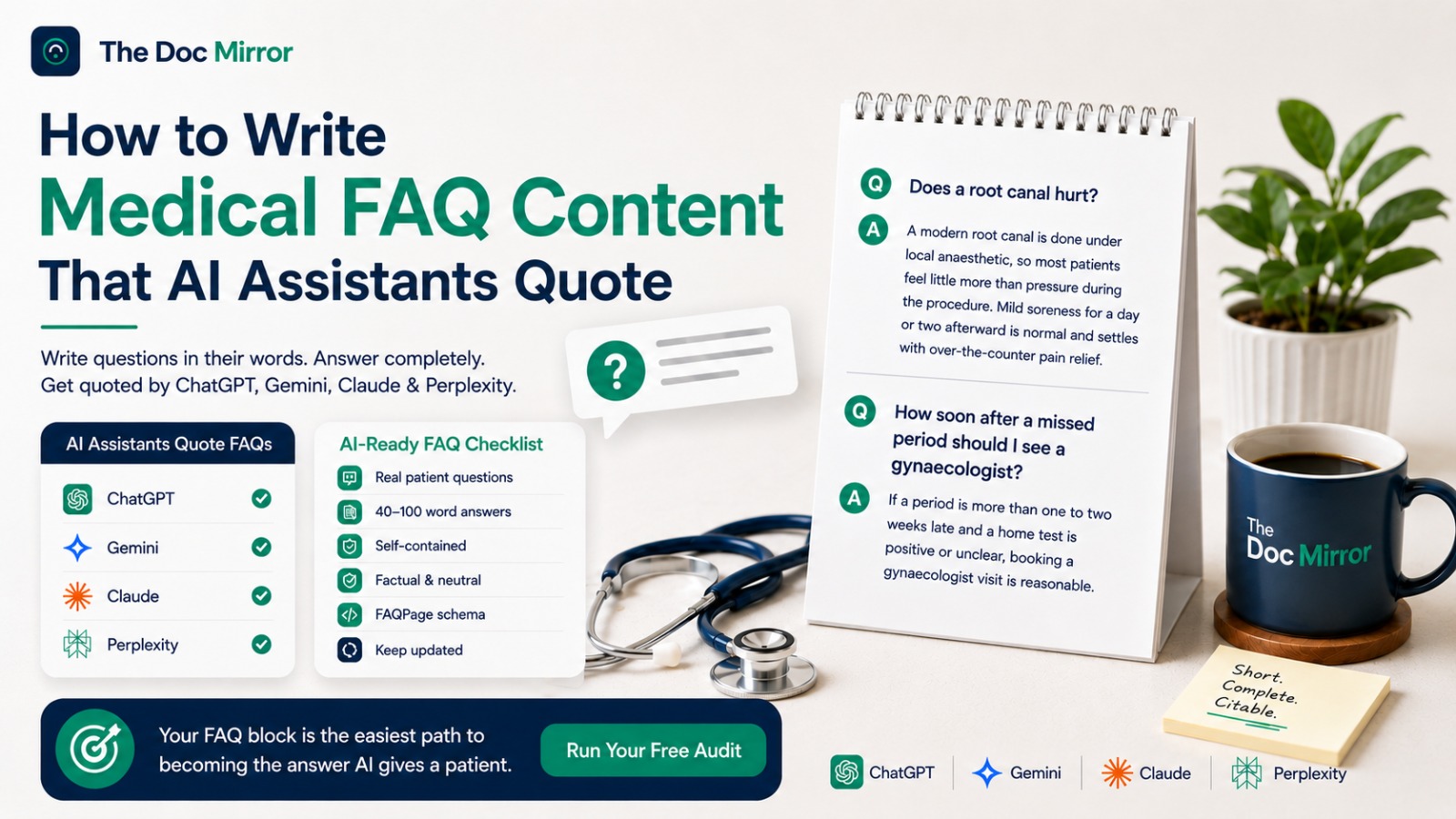
- Keep it 40 to 100 words. Long enough to be complete, short enough to lift whole.
- Make it self-contained. No "click here," no "as mentioned above," no "we offer this too."
- Repeat the key noun. If the question is about a root canal, say "root canal" in the answer.
- Stay factual and neutral. Give information a patient can rely on, not a sales pitch.
A US example a dental clinic could use:
Q: Does a root canal hurt? A: A modern root canal is done under local anaesthetic, so most patients feel little more than pressure during the procedure. Mild soreness for a day or two afterward is normal and settles with over-the-counter pain relief. The pain patients remember is usually from the infection before treatment, not the treatment itself.
An India example a gynaecologist's clinic could use, framed as factual patient information:
Q: How soon after a missed period should I see a gynaecologist? A: If a period is more than one to two weeks late and a home test is positive or unclear, booking a gynaecologist visit is reasonable. Seek care sooner with severe pain, heavy bleeding, or dizziness. An early consultation confirms the pregnancy, checks your health, and sets a schedule for the months ahead. Carry the dates of your last period.
How to add FAQPage schema
Good pairs get you halfway. Medical FAQ schema tells search and answer engines that a block is a set of questions and answers, which makes each pair easier to extract cleanly. Google's guidance notes there is no special markup required to appear in AI features, so treat schema as an aid to clarity, not a guarantee.
- Add FAQPage structured data in JSON-LD, listing each question and its answer.
- Make the schema text match the visible text on the page exactly.
- Mark up only genuine FAQs, not promotional copy dressed as questions.
- Validate the markup, and confirm the block still reads well for patients.
For how structured data fits into the wider work of getting named by AI, see what GEO means for doctors.
What most doctors get wrong with patient FAQ pages
The common mistake is writing the FAQ for the practice instead of the patient. Questions like "Why choose our clinic?" answer nothing a patient typed into an assistant, so they never get quoted. Three more errors show up on almost every audit.
- Answers that end with "contact us to learn more," which an AI cannot resolve.
- One giant answer covering five questions, impossible to lift as a single reply.
- Only a few obvious questions, none matching the long-tail worries patients ask.
In India, keep FAQ content strictly educational and factual. NMC rules restrict self-promotion, so make your existing, correct information consistent and findable, never advertise or solicit.
Your FAQ block is the cheapest, fastest way to become the answer an AI gives a patient. Write the questions in their words, answer each one completely in 40 to 100 words, and add clean FAQPage schema. Before you rewrite a line, find out where you stand today. The Free Audit runs your practice across Google, ChatGPT, Gemini, Claude, Perplexity, and 6 directories, scores you on the 7 pillars, and shows the AI visibility gaps to close first.