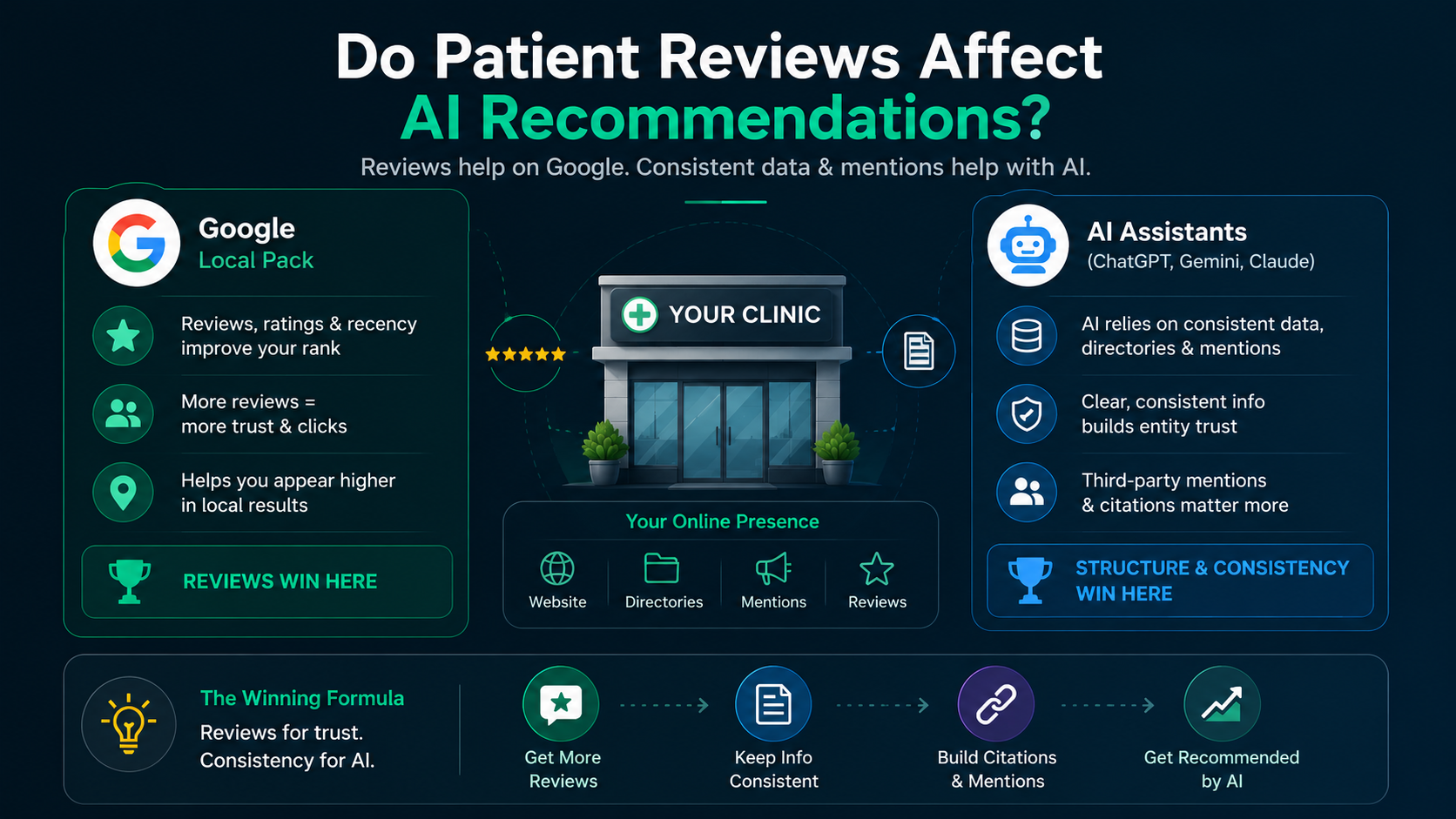
The honest answer on reviews and AI recommendation is this: patient reviews strongly influence whether Google shows you in the local pack, but they have a smaller, more indirect effect on whether ChatGPT, Gemini, Claude, or Perplexity actually names your clinic in an answer. AI assistants lean harder on consistent data, directory depth, and third-party mentions than on your star count. Reviews still help, but mostly by feeding the sources an AI reads and by building trust. This post separates the direct effect from the indirect one, so you invest where it counts.
What is the difference between a Google review and an AI recommendation
A Google review is a rating and comment a patient leaves on your Google Business Profile or on a directory like Practo or Healthgrades. An AI recommendation is when an assistant names your clinic inside a generated answer to a patient's question. These are two different mechanisms.
Google's local pack ranks businesses partly by review count, rating, and recency, so reviews move you up or down a visible list. An AI assistant does not rank a list. It composes one answer from the sources it trusts, deciding who to name based on how clearly and consistently you appear across them. So "do reviews affect AI" is really two questions. Do reviews help you rank on Google? Yes, strongly. Do reviews directly make an AI name you? Less than most doctors assume, because the lever that moves AI naming is whether your identity is clear, consistent, and cited across the web.
Do reviews directly make AI name your clinic
Mostly no, not on their own. When a patient in Denver asks ChatGPT "who is a good dermatologist near me?" or a patient in Pune asks Gemini "best physiotherapist for back pain," the model is not counting your stars in real time. It draws on what it has learned about which clinics are real, well-described, and repeatedly mentioned by credible sources. Star rating and AI naming are loosely linked at best, for three reasons:
- Models often do not read live review counts. Many assistants answer from trained knowledge or a few fetched pages, not a fresh scan of your rating. Your 4.9 average may never enter the calculation.
- Reviews are hard to attribute cleanly. A model can quote a directory listing or a clear service page, but it rarely reasons over a wall of individual patient comments.
- Volume gets normalised. A clinic with 400 reviews and one with 90 can both read as "established," so the gap that matters on Google flattens out for AI naming.
This is why a clinic with excellent reviews can still be missing from AI answers. The signals AI naming depends on sit elsewhere.
Where reviews genuinely help your AI visibility
Reviews are not irrelevant to AI. Their effect is indirect, but in three ways it is real.
- They feed the sources AI reads. Assistants often draw on Google Business Profile, Practo, Healthgrades, and Zocdoc. A profile with genuine, recent reviews is a fuller, more active listing, and fuller listings are more likely to be treated as a real entity worth naming.
- They build the trust layer behind E-E-A-T. E-E-A-T stands for Experience, Expertise, Authoritativeness, and Trust. Authentic reviews signal that a clinic is a real, practising provider with a track record.
- They keep your listing active and surface real patient language. A steady flow of feedback signals an operating practice and enriches the text tied to your clinic across the web.
So reviews are the soil, not the trunk. The tree stands taller because of them, but they do not hold it up.
Reviews versus AI visibility: where each one wins
Reviews and structure win in different places. For the Google local pack, reviews win: count, rating, and recency move you up the map results. For AI naming, structure wins: consistent data across directories plus third-party mentions do more than a higher star count. A 2025 rater8 report found that 26% of patients said an AI tool influenced their choice of provider, but reviews still close the decision at booking. So earn reviews for Google and conversion, and fix consistency and directory depth for AI naming, which we cover in what GEO means for doctors and AI visibility for doctors.
What most doctors get wrong about reviews and AI
The common mistake is assuming a strong Google rating carries over into AI answers. A cardiologist in New York with 300 five-star reviews can still be absent when a patient asks Claude for a cardiologist, because the model never saw the rating and could not confirm the clinic as a clear entity. More reviews on a profile that lists the wrong address or an old specialty will not fix that, because contradictory data confuses a model more than a lower star count hurts it. If ChatGPT is skipping you despite good reviews, the fix is usually structural, which we cover in why ChatGPT doesn't mention your clinic.
A balanced action plan for reviews and AI naming
Do both jobs at once. Earn reviews ethically for Google and conversion, and shore up the data that drives AI naming.
- Fix consistency first. Make your name, specialty, address, and phone identical across Google Business Profile, your website, and every directory. This is the single biggest lever for AI naming.
- Claim and complete your directory profiles. In the US, that means Healthgrades, Zocdoc, Vitals, and WebMD. In India, that means Practo, JustDial, Lybrate, and Apollo 247.
- Invite genuine reviews, ethically. Ask satisfied patients honestly, never with incentives or scripts. In India, keep it within NMC boundaries: make it easy for a real patient to leave feedback, do not solicit or pay for it. Never buy, script, or trade reviews in any market.
- Strengthen third-party mentions. A clear listing, a local health article, or a professional association page does more for AI naming than another five reviews. See how to get your clinic recommended by ChatGPT and Gemini.
- Measure what AI actually says. Ask the assistants your patients' questions and note whether you are named and described correctly.
Reviews earn the click on Google. Structure earns the mention in AI. A dentist in Bengaluru or a gynaecologist in Austin needs both, aimed at the right target.
You do not have to guess whether your reviews, your data, or your directories are holding you back. The Doc Mirror measures where your AI visibility stands and separates the review signal from the structural gaps, so you spend effort where it changes the answer.
Run your Free Audit at thedocmirror.com. It checks you across Google, ChatGPT, Gemini, Claude, Perplexity, and 6 directories, scores you on the 7 pillars, and shows which gaps to close first.