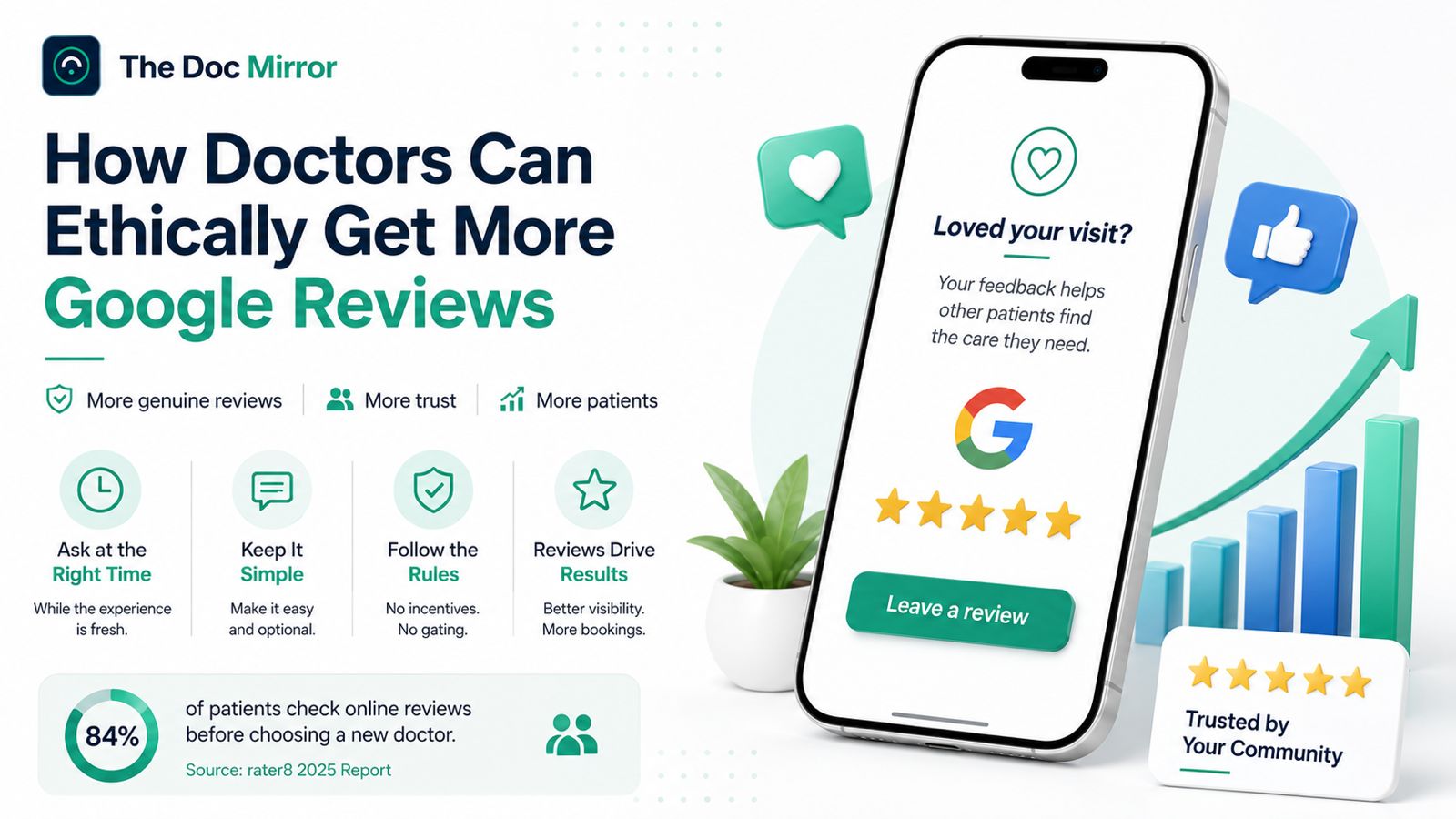
Managing your online reputation as a doctor means three things done on a schedule: monitoring what patients see when they search you, responding to reviews in a way that is professional and HIPAA-safe, and keeping your profiles accurate and consistent so a single bad review cannot define you. It is not about deleting criticism or paying for a polished image, both of which break platform rules and rarely work anyway.
This matters because patients act on what they find. In rater8's 2025 report on how patients choose doctors, 40% have canceled an appointment or changed their care plan based solely on online reviews, and 45% specifically value providers who respond to them. Reputation feeds two of the 7 pillars in your visibility score, Rating and Reviews, so managing it well is also visibility work. Most doctors have not searched their own name in months, which is the first gap to close.
What your online reputation actually includes
Your reputation is not one score on one site. It is the combined impression a patient forms across several surfaces, often within a minute of searching your name.
- Google Business Profile: your star rating, review count, recent comments, and how you respond. This is usually the first and most influential surface.
- Directory profiles: Healthgrades, Zocdoc, Vitals, WebMD, and RateMDs, each with their own reviews and their own copy of your details.
- Your website: credentials, bio, and whether the practice details match everywhere else.
- AI assistant answers: what ChatGPT, Gemini, Claude, or Perplexity say when a patient asks for a doctor in your specialty and city.
Patients rarely stop at one. They cross-check. If your Google rating is 4.8 but your Healthgrades profile shows an old address, that inconsistency itself becomes part of your reputation.
Start by seeing what patients see
You cannot manage what you have not looked at. The first move is a plain search of your own name and specialty, the way a patient would, in an incognito window so your own history does not shape the results.
Note your rating and review count on each surface, the tone of your three most recent reviews, and any factual errors: wrong hours, an old suite number, a phone line that no longer rings. Errors are more common than most doctors expect, because anyone can suggest edits to a Google listing and directories pull data from many sources.
This first audit is usually where a practice realizes it is slightly behind. The reassurance is that almost everything you find is fixable, and most of it is fixable this week without hiring anyone. If your clinic barely surfaces at all, start with why a clinic does not show up in local search before working on reviews.
Respond to reviews the HIPAA-safe way
Responding to reviews is one of the highest-value reputation moves, and also where doctors most often create a compliance problem. The controlling rule is simple. Never confirm that a reviewer was your patient or reveal any clinical detail in a public reply. That holds even when the reviewer names themselves or describes their own treatment first, because a patient disclosing their own information does not waive their rights under the Health Insurance Portability and Accountability Act (HIPAA).
The risk is real and enforced. In 2023 the Department of Health and Human Services Office for Civil Rights (OCR) settled with a New Jersey psychiatric practice for $30,000 after it disclosed patient information, including diagnosis and treatment details, in public responses to negative Google reviews. The settlement also required a two-year corrective action plan. A public reply meant to defend the practice became the violation.
For a positive review, keep it brief and general: "Thank you for the kind words. We appreciate you taking the time to share them." Do not reference a diagnosis, a procedure, or an outcome.
For a negative review, follow four steps:
- Stay calm and professional in tone. Future patients are reading how you handle criticism, not just the complaint.
- Do not confirm or deny any care relationship or medical fact.
- Offer a private channel: "We'd like to understand your experience. Please call our office at [number]."
- Follow through offline, where you can speak within your normal confidentiality obligations.
Respond consistently, not just to the angry ones. In BrightLocal's 2025 Local Consumer Review Survey, 88% of consumers said they would use a business that replies to all of its reviews, against just 47% for a business that never responds. A steady response rate also signals to Google that the listing is active and managed.
Handle a negative or unfair review without breaking the rules
One negative review feels louder than it is. The correct response is rarely removal. You can flag a review that violates Google's content policy, such as spam, a personal attack, or a review from someone who was never a patient, but you cannot get an honest negative review taken down, and you should not try to buy or bury the truth.
The durable fix is volume and recency. A steady flow of genuine reviews dilutes any single negative one and keeps your rating stable. Ten new honest reviews at 5 stars move your average far more than one angry review drags it down, and recent feedback tells patients the complaint is not the current picture.
This is why reputation management and earning genuine reviews are the same effort applied in two directions. Both depend on honest, unincentivized feedback. Offering anything of value for a review, or filtering for only happy patients, violates both Google policy and the FTC's 2024 rule on the use of consumer reviews, which carries civil penalties of up to $51,744 per violation. Keeping your acquisition ethical is what keeps your reputation defensible.
Keep your details consistent everywhere
Reputation is also accuracy. If your name, address, and phone number, often shortened to NAP, read differently across Google, Healthgrades, Zocdoc, and Vitals, patients notice and search engines lose confidence in your record.
Pick one canonical format for your practice details, write it down, and make every listing match it to the character. Watch the small culprits: an old suite number, "Ave" versus "Avenue," a landline on one profile and a cell on another. This single afternoon of cleanup removes a quiet drag on both your reputation and your local ranking, and it is one of the cheapest fixes available.
When weekly monitoring earns its place
A monthly manual check is enough for a quiet practice in a small market. In a competitive metro, review counts and ratings shift week to week among the practices around you, and a new one-star review sitting unanswered for a month does real damage.
Two triggers say it is time to monitor weekly rather than monthly: you compete with several similar practices for the same searches, and you cannot reliably remember to check every surface yourself. At that point the tracking should be automatic, not another task you hope to get to.
The Doc Mirror's Monitor plan, at $49 a month, tracks your Rating and Reviews across surfaces every week and alerts you when a competitor gains reviews or your rating shifts, so a new review reaches you in days rather than at your next manual audit. What that tracking covers is spelled out in what is inside the visibility report.
A note on AI: reputation now includes the answer engines
A growing share of patients ask an AI assistant for a doctor before they ever open Google. Those tools lean more on consistent directory data and website structure than on your star rating, so a clean, matching set of listings is what keeps you named correctly in an AI answer.
The useful part is that the same accuracy work serves both audiences. Consistent NAP details and current profiles improve what a patient reads on Google and what an assistant repeats back, at the same time.
How to check where you stand this week
You can take control of your reputation in under an hour, no vendor required.
- Search your name and specialty in an incognito window. Note your rating, review count, and any factual errors on Google, Healthgrades, Zocdoc, and Vitals.
- Read your three most recent reviews on each and check whether you have responded.
- Fix one inconsistency today: a wrong address, old hours, or a mismatched phone number.
- Decide your monitoring rhythm, monthly or weekly, based on how competitive your market is.
The Free Audit at thedocmirror.com scores your Rating and Reviews pillars, checks your directory consistency, and compares you to your top 3 local competitors inside your visibility score. It takes about 90 seconds and needs no signup for the free score.