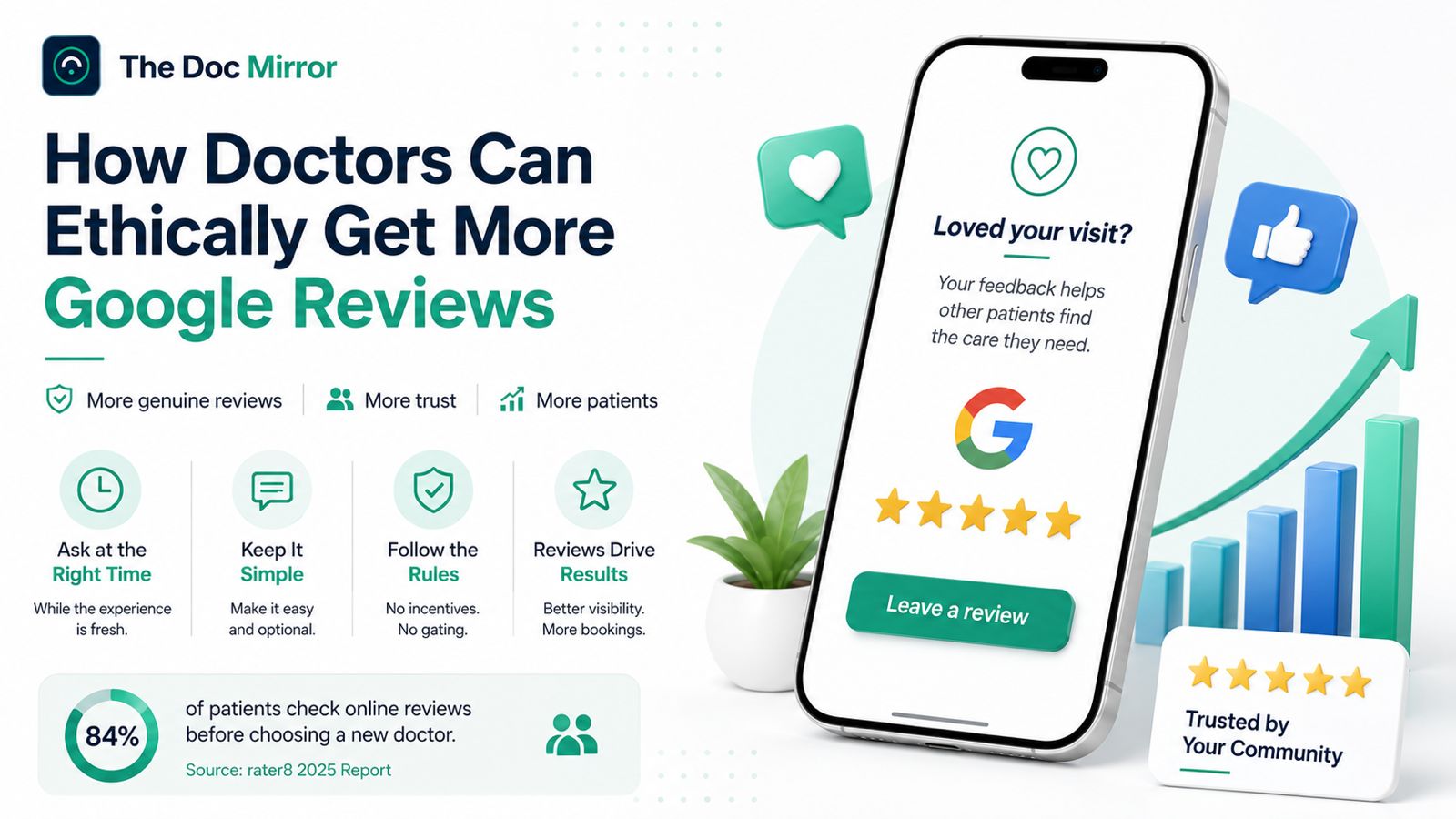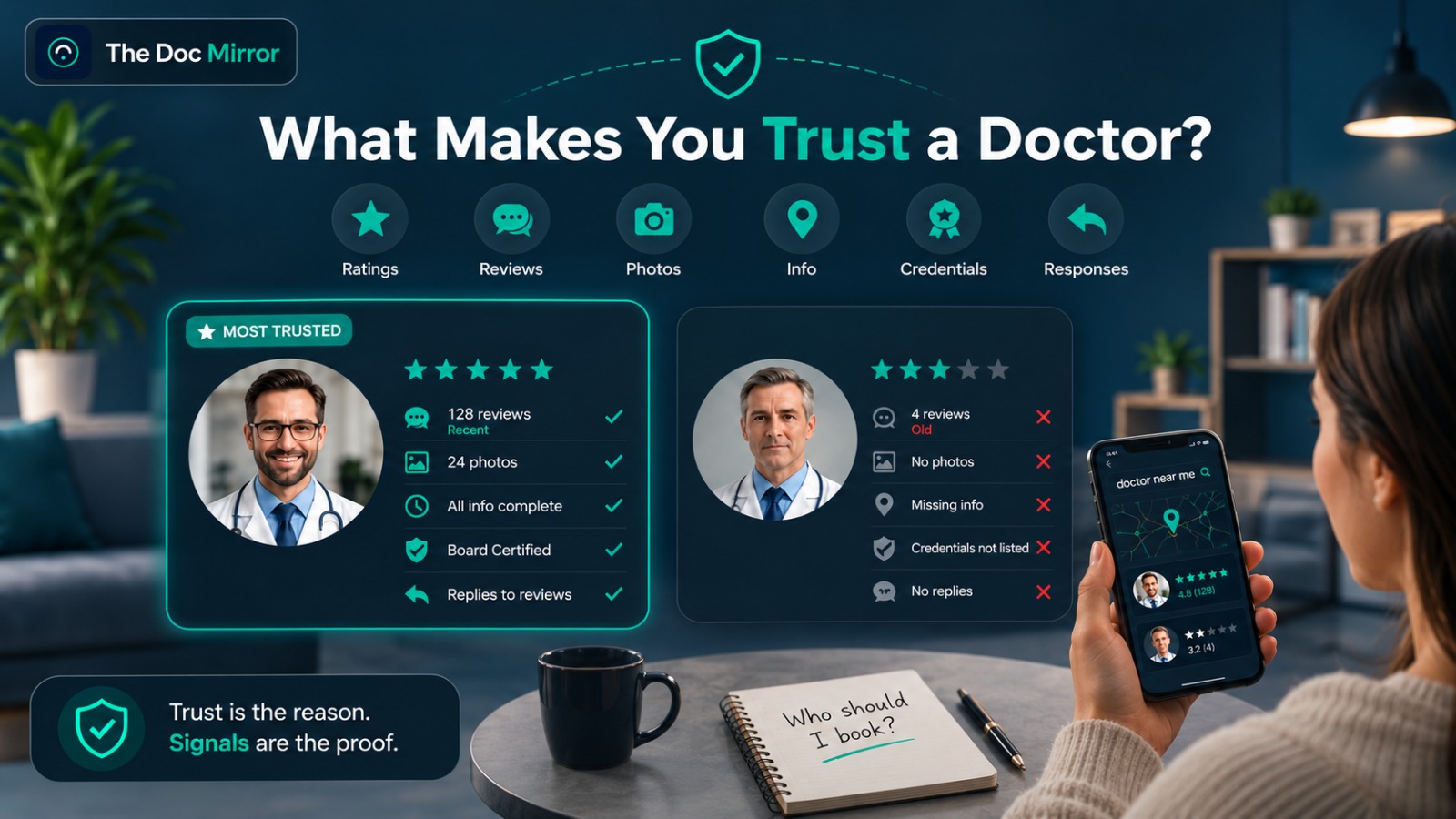
When two doctors have similar credentials, patients choose the one whose online profile looks more trustworthy, and that trust is built from a small, rankable set of visible signals. In rough order of how much they move the decision, they are: star rating, review count and recency, photos, complete and consistent information, credentials, and responses to reviews. These signals decide the choice in the first minute, usually before a patient reads a line of your bio. It is why the more experienced doctor often loses to the more visible one: 84% of patients check online reviews before choosing a provider, and 61% now weigh those reviews above a personal referral, per rater8's 2025 report. This article ranks the signals and explains why each one carries the weight it does.
What a trust signal actually is
A trust signal is any piece of public information that helps a patient decide you are competent, real, and safe to book, without having met you. Patients cannot judge your clinical skill from a search result. So they read proxies: the things that are visible, comparable, and quick to scan.
Google uses a related framework to rank medical content called E-E-A-T, which stands for Experience, Expertise, Authoritativeness, and Trust. Health topics fall into what Google calls "Your Money or Your Life" content, where these signals carry extra weight. So the same signals that reassure a patient also help you rank and help AI assistants identify you. That triple overlap is why trust signals are worth getting right, and why the ranking below is worth working through in order.
The trust signals patients weigh, ranked
1. Star rating
The rating is the first filter a patient applies and the fastest one. The threshold is specific and unforgiving. Press Ganey's healthcare research found that most consumers consider 4 out of 5 the lowest acceptable rating for a provider, and BrightLocal's consumer survey found that 31% will only use a business rated 4.5 or higher while 68% require at least 4 stars. A rating a few tenths below the competitor beside you can lose the click before anything else is read. Rating is one of the 7 pillars in your visibility score, worth up to 20 points, and it does a lot of work in the first two seconds.
2. Review count and recency
A high rating with only 4 reviews reads as thin. A slightly lower rating with 120 reads as proven. Volume tells a patient the rating is real rather than a fluke, and most patients want to see several: 51% read at least six reviews before booking, in rater8's data.
Recency matters just as much. Fresh reviews signal an active practice, while a wall of praise that stops two years ago raises a quiet doubt. The bar here is short. Press Ganey found that 64.8% of consumers consider reviews over a year old irrelevant, and BrightLocal found that 74% look specifically for reviews written within the last three months. Volume and recency together beat a perfect average alone. Reviews are their own pillar, worth up to 15 points, and the recency piece is the one most practices neglect.
3. Photos
Real photos of your space, your team, and your signage make a practice feel legitimate. A profile with no photos, or only a logo, reads as unfinished, and patients want to see where they are going. Profiles with photos draw more clicks and direction requests than those without them. Photos are their own pillar, worth up to 10 points, and they are among the cheapest signals to strengthen, since they cost only attention. Never show identifiable patients without written consent.
4. Complete, consistent information
Hours, address, phone, services, and website all present and matching across sites tell a patient the practice is real and organized. The presence of clear contact information and hours is something 85% of consumers call important when researching a local business. A missing phone number, or hours that conflict between Google and Healthgrades, introduces friction and doubt at the exact moment a patient is ready to act. Consistency across directories is its own pillar, because search engines and AI assistants also read matching details as proof you are one real business rather than several half-formed ones.
5. Credentials and specialty clarity
Board certification, years in practice, and a specific specialty label all reassure patients that you match their need. A profile that clearly says "Dermatologist" beats one labeled generically as "Doctor," both for the patient and for how Google and AI assistants categorize you. Credentials rarely start a decision, but they confirm one. A patient who has narrowed to two options will often break the tie on the clearer, more specific profile.
6. Responses to reviews
A doctor who replies professionally to reviews, especially critical ones, signals attentiveness and accountability. This signal is rising fast. In rater8's report, 45% of patients said they are swayed by whether a doctor responds to reviews, and 41% said their trust increases when they see responses. BrightLocal found that 80% of consumers are more likely to use a business that responds to every review, while 50% are put off by templated or generic replies. Patients read your responses as a preview of how you will treat them. Replies must stay HIPAA-safe and never confirm that a reviewer was a patient, but their presence is itself a trust signal.
Why the more experienced doctor often loses
Two clinicians can be equally skilled, and the patient will still pick the one who is easier to trust online. Consider a common pattern. One dermatologist has 40 reviews at 4.9 stars, a dozen recent photos, a specific specialty label, and replies to reviews. Another has 30 years of experience, 6 reviews, no photos, hours that have not been updated since the office moved, and no responses. The second doctor is very likely more experienced. The first gets the booking, almost every time.
The patient is not rejecting experience. They simply cannot see it. Every signal above is a proxy that stands in for the clinical quality a patient has no way to verify from a search result. When 84% of patients check reviews and 61% weigh them above a personal referral, the profile that supplies those proxies wins, and the one that leaves them blank loses. Closing that gap does not require being a better doctor. It requires being a more legible one.
A note on AI: the same signals feed the machine
The signals patients read are increasingly the same ones AI assistants read. When a patient asks ChatGPT, Gemini, Claude, or Perplexity for a doctor in their city, the assistant pulls from consistent directory listings, structured data, and corroborating sources to name one to three practices. A complete, consistent profile that reassures a human also makes you identifiable to an AI tool. A thin, inconsistent one leaves both the patient and the assistant unsure. AI visibility is a real patient-acquisition channel now, not a future one, and it rewards the same legibility that wins the human decision.
How to check your trust signals this week
You can audit your own signals in under 20 minutes, the way a patient would, working down the ranked list.
- Search your specialty and city in an incognito window. Compare the rating, review count, newest review date, and photos of the three practices in the local pack to yours.
- Check your rating against the 4.0 floor and the 4.5 bar most patients apply, and note the gap to the competitor above you.
- Confirm you have recent reviews within the last three months, a handful of clear photos, and a specialty label that is specific rather than generic.
- Read your last three review responses, if any, and check they are professional and HIPAA-safe.
If you want the full picture, the Free Audit at thedocmirror.com scores every one of these signals across 7 pillars and compares you to your top 3 local competitors. It takes about 90 seconds and needs no signup for the free score. You will see, in one number, where a patient's trust is going and why.