Patient Acquisition Cost for Medical Practices: A Guide
Every practice that spends money on marketing eventually asks the same question: what does it actually cost to bring in one new patient? That number — patient acquisition cost — is one of the few marketing metrics that connects directly to the practice's bottom line. It's also one of the most frequently miscalculated, because healthcare patient journeys don't behave like retail purchases.
This guide walks through the standard formula for patient acquisition cost for medical practices, what to include (and what gets left out by mistake), why attribution in healthcare is harder than most marketing guides admit, and what responsible, privacy-conscious improvement actually looks like — as opposed to tracking tactics that create compliance headaches.
What Is Patient Acquisition Cost?
Patient acquisition cost (sometimes called healthcare customer acquisition cost, or simply PAC) is the average amount a practice spends to acquire one new patient over a given period. It's a healthcare-specific version of the customer acquisition cost (CAC) metric used across industries, adapted for the realities of medical marketing: longer consideration windows, insurance and referral dynamics, and conversions that often happen over the phone or in person rather than through an online checkout.
At its core, PAC answers a simple operational question: for every dollar spent on marketing and outreach, how many new patients does the practice actually get? Practices that don't track this number tend to keep spending on channels out of habit rather than performance.
How to Calculate Patient Acquisition Cost for a Medical Practice
The standard formula, confirmed across multiple healthcare marketing resources, is straightforward:
Patient Acquisition Cost = Total Marketing Spend ÷ Number of New Patients Acquired
A commonly cited worked example illustrates this well: if a practice spends $12,000 on marketing in a given period and that spend is associated with 150 new patients, the patient acquisition cost comes out to $80 per new patient (Improvado, "Patient Acquisition Cost Guide for Healthcare Marketers").
That's the math. The harder part — and where most practices go wrong — is deciding what counts as "total marketing spend" and what counts as a "new patient acquired."
What Costs to Include
To calculate cost per new patient for a clinic accurately, the spend side of the equation needs to include more than ad dollars. According to WebFX's breakdown of the metric, a complete PAC calculation should account for:
- Paid advertising spend (search, social, display)
- Website and SEO costs
- Staff time spent on marketing, intake coordination, and follow-up
- Referral coordination costs, where practices actively manage referral relationships
- Content production, design, and any agency or platform fees
(WebFX, "What Is Patient Acquisition Cost & How Do You Calculate It?")
Leaving out staff time is the single most common error. A front-desk coordinator who spends several hours a week following up on web leads, confirming appointments, and re-engaging no-shows is part of the acquisition cost — even though no invoice reflects that time.
On the "new patients acquired" side, practices need a consistent definition: is a new patient someone who scheduled their first appointment, someone who showed up, or someone who completed an intake form? Whichever definition is chosen, it should stay consistent period over period, or the trend line becomes meaningless.
Why Attribution Is Harder in Healthcare Than the Formula Suggests
The formula itself is simple. Getting trustworthy numbers to plug into it is not, and this is where a lot of practices overinvest in tooling without getting proportionally better answers.
Healthcare patient journeys typically span weeks or months, cross multiple devices and channels, involve more than one decision-maker (a patient and a referring provider, or a patient and a family member), and frequently end in a phone call or a portal login rather than a trackable web form submission. That combination makes clean, single-touch attribution the exception rather than the rule (Improvado, "Healthcare Marketing Attribution Guide for Analysts").
This mismatch between marketing's desire for precision and the reality of how patients actually convert has a measurable cost of its own. One industry analysis found that healthcare organizations can spend 15% to 25% of their marketing budget building out attribution infrastructure, while that added precision typically shifts only 5% to 10% of actual spend allocation — a real but modest return relative to the investment (Response Mine, "Healthcare Multi-Touch Attribution: The Complete Guide for 2026"). In plain terms: chasing perfect, patient-level attribution often costs more than the insight is worth, and practices are better served by directionally accurate reporting than by an expensive black box that still can't fully bridge the offline and cross-device gaps.
This is exactly where patient acquisition reporting for medical practices should lean on broader context rather than a single number in isolation. Reviewing PAC alongside the core metrics every practice should track — new patient volume, no-show rates, review velocity, and channel-level lead quality — gives a far more honest picture than optimizing for PAC alone.
How to Measure New Patient Leads From Digital Marketing
Given those limitations, the practical goal isn't perfect attribution — it's consistent, good-enough measurement that a practice can act on. A reasonable approach looks like this:
- Standardize new-patient tracking at the front desk. Ask every new patient (or have intake software ask) a simple "how did you hear about us?" question, and log the answer in the practice management system. This single habit often does more for attribution accuracy than any analytics platform.
- Use call tracking for phone conversions. Because many healthcare conversions happen by phone, a dedicated tracking number for digital campaigns (separate from the number used on business cards or signage) helps separate marketing-driven calls from word-of-mouth ones.
- Tag digital campaigns with UTM parameters so that website form submissions and booking requests can be traced back to the specific channel, campaign, or ad that drove them.
- Reconcile online and offline data monthly, not in real time. Healthcare's long consideration windows mean weekly attribution snapshots are often noise; monthly or quarterly reconciliation against actual booked and seen patients is more reliable.
- Separate new-patient leads from existing-patient inquiries, since mixing the two inflates lead counts and understates true PAC.
Together, these habits are really just a practical way to track marketing channels that bring new patients without needing a sophisticated attribution platform. For practices that want a deeper framework on connecting these data points to actual marketing ROI, measuring how online marketing performance translates into booked patients is worth reviewing alongside this calculation — PAC is one output of a measurement system, not the whole system.
Privacy-Conscious Patient Acquisition Analytics for Clinics
One more constraint shapes how granular healthcare marketing tracking can responsibly get: HIPAA.
In December 2022, the HHS Office for Civil Rights issued guidance stating that tracking technologies — such as the Meta Pixel, Google Analytics scripts, and third-party SDKs — placed on a covered entity's website or app can transmit protected health information to the tracking vendor, and that this can trigger HIPAA obligations depending on the context (Holland & Knight, "HHS Offers HIPAA Guidance on Online Tracking Technologies").
That guidance was later refined. Following the American Hospital Association v. Becerra litigation, OCR updated its position in March 2024 to draw a sharper line: general, unauthenticated public pages (like a service-line page or a blog post) carry materially lower risk than authenticated patient portals, appointment-booking flows, or symptom-checker pages where a user's health status or intent to seek care can reasonably be inferred (Holland & Knight, "OCR Updates Its Website Tracking Tool Guidance").
The practical takeaway for patient acquisition analytics is not "stop measuring," but "measure deliberately." Practices should work with their web developer, EHR vendor, and legal counsel to understand which pages carry tracking pixels, what those pixels transmit, and whether authenticated or intake-adjacent pages need separate, more conservative handling than a general marketing landing page. This is a compliance question as much as a marketing one, and it's worth treating with the same seriousness as any other HIPAA risk assessment — this article offers context, not legal advice, and practices should confirm specifics with qualified counsel.
Responsible Ways to Improve Patient Acquisition Cost
Once a practice has a reasonably reliable PAC figure, lowering it responsibly tends to come from a short list of levers rather than aggressive new tracking:
- Strengthen the channels that already convert well. Rather than diversifying into new ad channels, double down on the ones with proven lower PAC — often organic search, Google Business Profile visibility, and patient referrals (Zocdoc, "Patient acquisition cost: How to calculate and lower your CAC").
- Reduce friction in the booking process. Every extra form field, phone transfer, or callback delay increases the chance a qualified lead drops off before becoming a new patient — which raises PAC without the practice spending an extra dollar on ads.
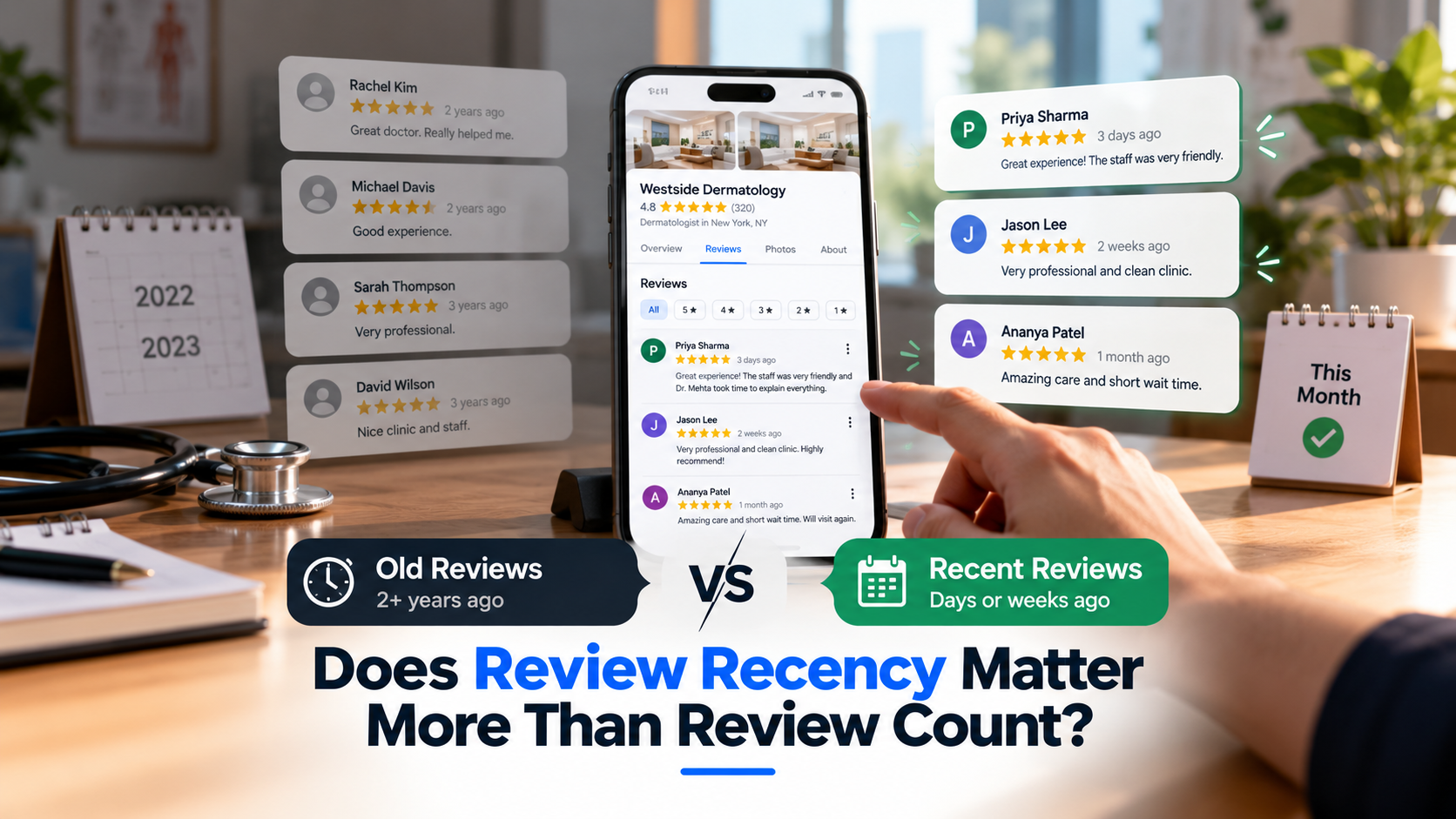
- Improve review volume and response quality. Prospective patients routinely check reviews before booking, and a stronger reputation can lift conversion rates on the same ad spend, effectively lowering PAC.
- Audit referral coordination. If referral management consumes significant staff time, streamlining that workflow can reduce the "hidden" labor cost that inflates PAC even when ad spend stays flat.
- Retire underperforming channels slowly, not abruptly, since healthcare's long consideration windows mean a channel's true impact may lag behind its reported performance by weeks or months.
None of these tactics promise a specific percentage reduction or guaranteed patient growth — results vary by specialty, market, and starting baseline. The goal is a more efficient use of existing budget, not a formula for guaranteed outcomes.
Reporting on PAC Over Time
A single PAC calculation is a snapshot; the real value comes from tracking it over consistent periods and against consistent definitions. This is where many practices start evaluating dedicated reporting tools instead of manual spreadsheets. If that's a direction worth exploring, it's worth understanding what to look for in healthcare marketing reporting software before committing to a platform — the right tool should make new-patient trends easier to see by channel, not harder to interpret.
Bringing It Together
Patient acquisition cost is a useful, necessary metric — but it's only as good as the discipline behind how it's calculated and the honesty about what it can and can't tell a practice. The formula is simple division. The real work is in consistently defining spend and new patients, accepting that healthcare attribution will never be perfectly clean, respecting the legal boundaries around tracking technology, and improving the number through better conversion and retention rather than more aggressive surveillance of patient behavior.
For practices that simply want a starting point before investing in new software or overhauling attribution, a tool like The Doc Mirror can help by auditing how a practice currently shows up across Google, patient reviews, and increasingly, AI-powered assistants — giving a baseline visibility picture that's a useful companion to a PAC calculation, even if it isn't a substitute for internal marketing spend tracking. Checking a practice's current online visibility is a reasonable first step before deciding where new marketing dollars should go.
Sources
- Improvado, "Patient Acquisition Cost Guide for Healthcare Marketers" — https://improvado.io/blog/patient-acquisition-cost
- WebFX, "What Is Patient Acquisition Cost & How Do You Calculate It?" — https://www.webfx.com/blog/healthcare/patient-acquisition-cost/
- Zocdoc, "Patient acquisition cost: How to calculate and lower your CAC" — https://www.zocdoc.com/resources/blog/article/how-to-find-the-cost-to-acquire-a-new-patient-lead/
- Improvado, "Healthcare Marketing Attribution Guide for Analysts" — https://improvado.io/blog/healthcare-marketing-attribution
- Response Mine, "Healthcare Multi-Touch Attribution: The Complete Guide for 2026" — https://responsemine.com/healthcare-multi-touch-attribution-the-complete-guide-for-2026/
- Holland & Knight, "HHS Offers HIPAA Guidance on Online Tracking Technologies" — https://www.hklaw.com/en/insights/publications/2022/12/hhs-offers-hipaa-guidance-on-online-tracking-technologies
- Holland & Knight, "OCR Updates Its Website Tracking Tool Guidance" — https://www.hklaw.com/en/insights/publications/2024/03/ocr-updates-its-website-tracking-tool-guidance