How to Track Your AI Visibility Over Time
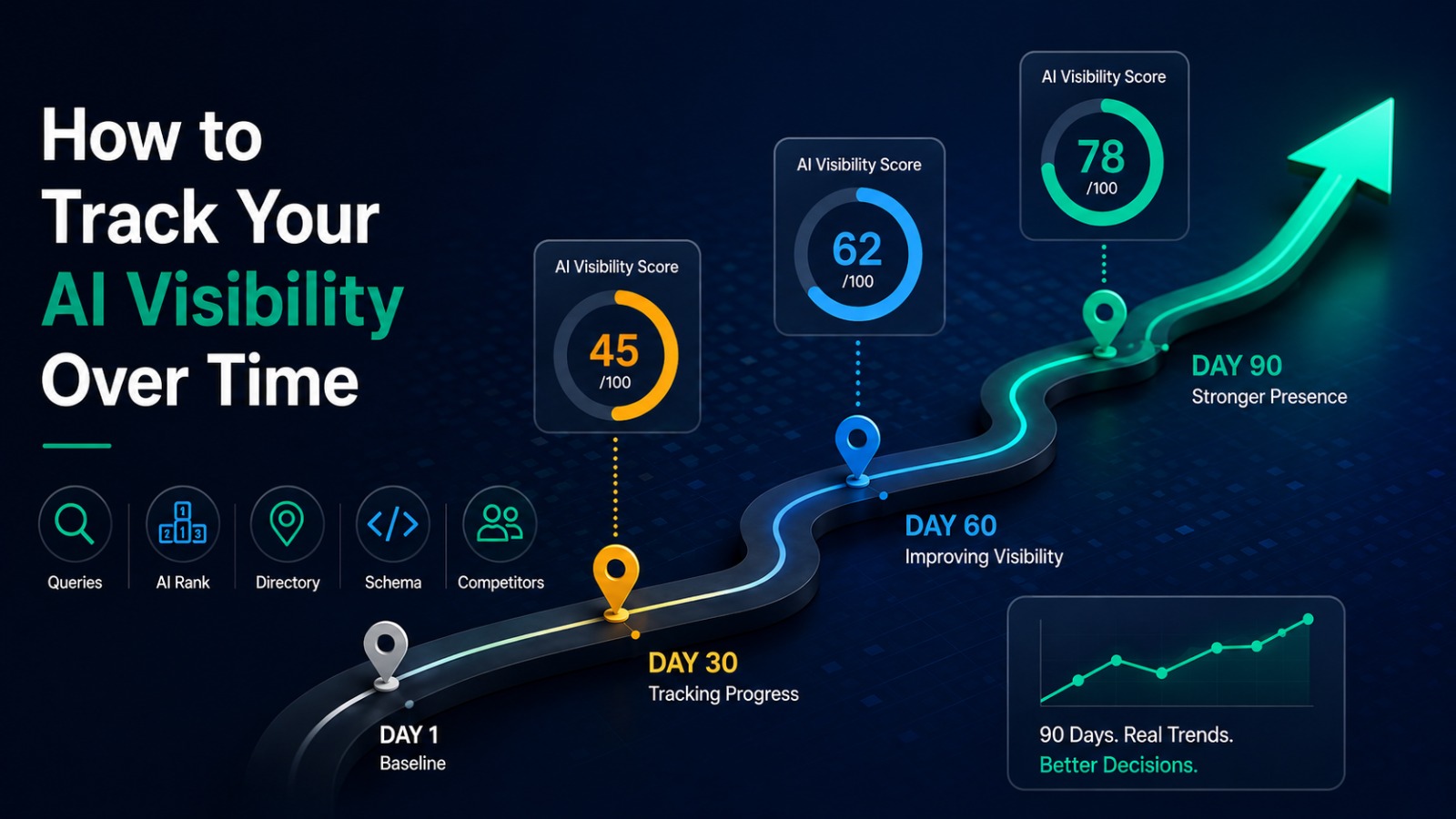
To track your AI visibility over time, you check the same set of patient questions across ChatGPT, Gemini, Claude, and Perplexity on a fixed schedule, then log five things each time: which queries name you, your AI rank when named, how many directories list you consistently, whether your schema is intact, and which competitors get mentioned instead. AI answers change week to week, so a single check tells you almost nothing. A steady record over 90 days tells you whether you are gaining ground, holding, or slipping.
Why a one-time check is not enough
A one-time audit is a photograph. It shows one moment, and AI answers do not stay still. The models that recommend a cardiologist in Denver this week may rewrite that answer next week after a fresh crawl, a competitor's new content, or a model update you never see.
This is different from the first check that establishes a baseline. If you have not done that yet, start with our guide to checking your AI visibility as a doctor. The baseline tells you where you stand today. Tracking tells you which direction you are moving, and direction is what predicts whether a patient will find you next month.
Consider why the answers move at all. A dermatologist in Mumbai might be named by Gemini in June because her Practo profile and website agreed on her clinic address. In July a stale JustDial listing contradicts both, and the model quietly drops her. Nothing on her website changed, yet her visibility fell, and without tracking she would never know why.
What is AI visibility tracking
AI visibility tracking is the disciplined, repeated measurement of how AI assistants represent you, recorded over time so you see trends instead of guessing. It is the difference between asking ChatGPT about your specialty once and asking the same question every week for a quarter while logging what changes.
The unit you measure is not a ranking position on a page of links. It is presence and accuracy inside a generated answer: are you named, are the facts right, and does your name and city travel with the recommendation. GEO, or Generative Engine Optimization, is the practice of improving that presence. Tracking tells you whether your GEO work is paying off.
Two real numbers explain why this matters. A KFF poll found that about 1 in 3 US adults have used AI chatbots for health information. A 2025 rater8 report found that 26% of patients said an AI tool influenced their choice of provider. If a quarter of patients are swayed by what AI says, you need to know what AI is saying continuously, not once.
The five things to track every time
Consistency beats completeness. It is better to log five simple metrics on the same day every week than to run an exhaustive audit once and never repeat it. Track these five each cycle.
- Which queries name you. Keep a fixed list of 8 to 12 patient questions for your specialty and city, such as "best physiotherapist in Pune for knee pain" or "who treats sleep apnea in Austin." Record which ones return your name.
- Your AI rank when named. When you appear, note whether you are first, second, or buried in a list of five. Being mentioned third is not the same as being the top recommendation.
- Directory count. Log how many key directories list you with identical name, address, and specialty. In the US that means Healthgrades, Zocdoc, Vitals, and WebMD. In India it means Practo, JustDial, Lybrate, and Apollo 247.
- Schema status. Note whether your structured data is still present and valid. A theme update or plugin change can strip it silently, and models lean on it to read you correctly.
- Competitor mentions. Write down which other clinics the AI names for your core queries. A competitor who suddenly appears is an early signal that they published something or fixed a listing.
Each metric is a number or a short note. One week's log takes a few minutes once your question list is set.
How often should you check
Weekly for the metrics that move fast, monthly for the ones that move slowly. AI answers can shift within days, so weekly checks catch changes while they are still fresh enough to trace to a cause. Schema and directory consistency change less often, so a monthly deep check covers those.
Here is a workable rhythm for a busy doctor:
- Weekly (10 minutes): run your fixed question list across ChatGPT, Gemini, Claude, and Perplexity. Log which queries name you and your rank when named.
- Monthly (30 minutes): audit directory consistency and schema status, and review the trend in your weekly logs.
- Quarterly (review): look at the full 90-day picture and decide what to fix next.
The exact cadence matters less than never skipping. A metric checked every Monday for 12 weeks is worth far more than one checked brilliantly once and then forgotten. If you already run structured weekly reviews of your practice, fold this into that same slot.
Why 90 days matters more than any single week
Any single week's result can mislead you. A model update the night before your check can add or drop you for reasons that reverse a week later. Read too much into one bad Tuesday and you will chase noise. Read a 90-day trend and you will see signal.
Ninety days is roughly the window over which real changes settle. When you fix directory consistency or add proper schema, models need several crawl and refresh cycles to pick it up. The GEO research paper from Princeton, Georgia Tech, the Allen Institute for AI, and IIT Delhi showed that content choices can raise AI-answer citation by up to 40%, but that lift shows up over cycles, not overnight.
The pattern you want is a line, not a point. Are the queries that name you increasing month over month. Is your rank climbing when you are named. Three months of honest logging answers those questions. A single screenshot cannot.
What most doctors get wrong about tracking
The most common mistake is checking once, feeling reassured, and never checking again. A gynaecologist sees her name in a ChatGPT answer in March, assumes she is set, and does not look again until a patient mentions in September that the AI recommended someone else. Nine months of drift went unmeasured.
Three specific errors undermine tracking:
- Changing the questions each time. If you ask different queries every week, you cannot compare weeks. Lock your list and keep it stable so the data is comparable over time.
- Tracking only whether you appear, not your rank or the facts. Being named fifth with a wrong clinic address is a problem a simple yes or no log hides. Record rank and accuracy, not just presence.
- No written record. Memory is not a log. If it is not written down with a date, you cannot see a trend, and the trend is the whole point.
For an Indian clinic, keep the framing as education, not promotion. You are monitoring whether your existing, factual information is represented correctly, which sits comfortably within NMC guidance. You are not advertising.
How to keep a simple visibility log
You do not need special software to start. A spreadsheet with one row per week and one column per metric is enough to see a trend within a month.
- Create columns for the date, each of your 8 to 12 fixed queries, your rank when named, directory count, schema status, and competitor names.
- Fill one row every week on the same day.
- After four weeks, note the direction of each metric.
- After 90 days, review the whole sheet and pick the one weakest metric to fix next.
This manual method works, and for a single practice it is a reasonable place to begin. The limit is time and coverage. Doing it by hand across four AI assistants and multiple directories every week is repetitive and easy to let slip during a busy clinical stretch. This is exactly the comparable, repeated measurement that automation handles well.
Automating the discipline with Monitor
Monitor is The Doc Mirror tier built for tracking over time. It runs your checks across Google, ChatGPT, Gemini, Claude, Perplexity, and 6 directories on a weekly schedule, records your visibility score across the 7 pillars, and sends you a weekly report with competitor alerts so you are told when a rival starts appearing for your queries. It is $49 per month in the US and ₹4,199 per month in India.
The value is not that Monitor checks something you could not. It is that it never skips, never changes the questions, and keeps the 90-day record automatically. You get the trend line without the weekly effort, and an alert the week a competitor moves rather than the month you happen to notice. For the strategic overview, start with our AI visibility for doctors pillar, and for the directory metric specifically, read directory citations and AI visibility.
You cannot improve what you only measure once. AI answers about your specialty are being rewritten while you read this, and the only way to know whether you are gaining or slipping is a steady record over time. Start by establishing where you stand today.
Run your free audit at thedocmirror.com. It checks you across Google, ChatGPT, Gemini, Claude, Perplexity, and 6 directories, scores you on the 7 pillars, and shows which gaps to close first.