Voice Search and AI Assistants: How Patients Ask for Doctors Now
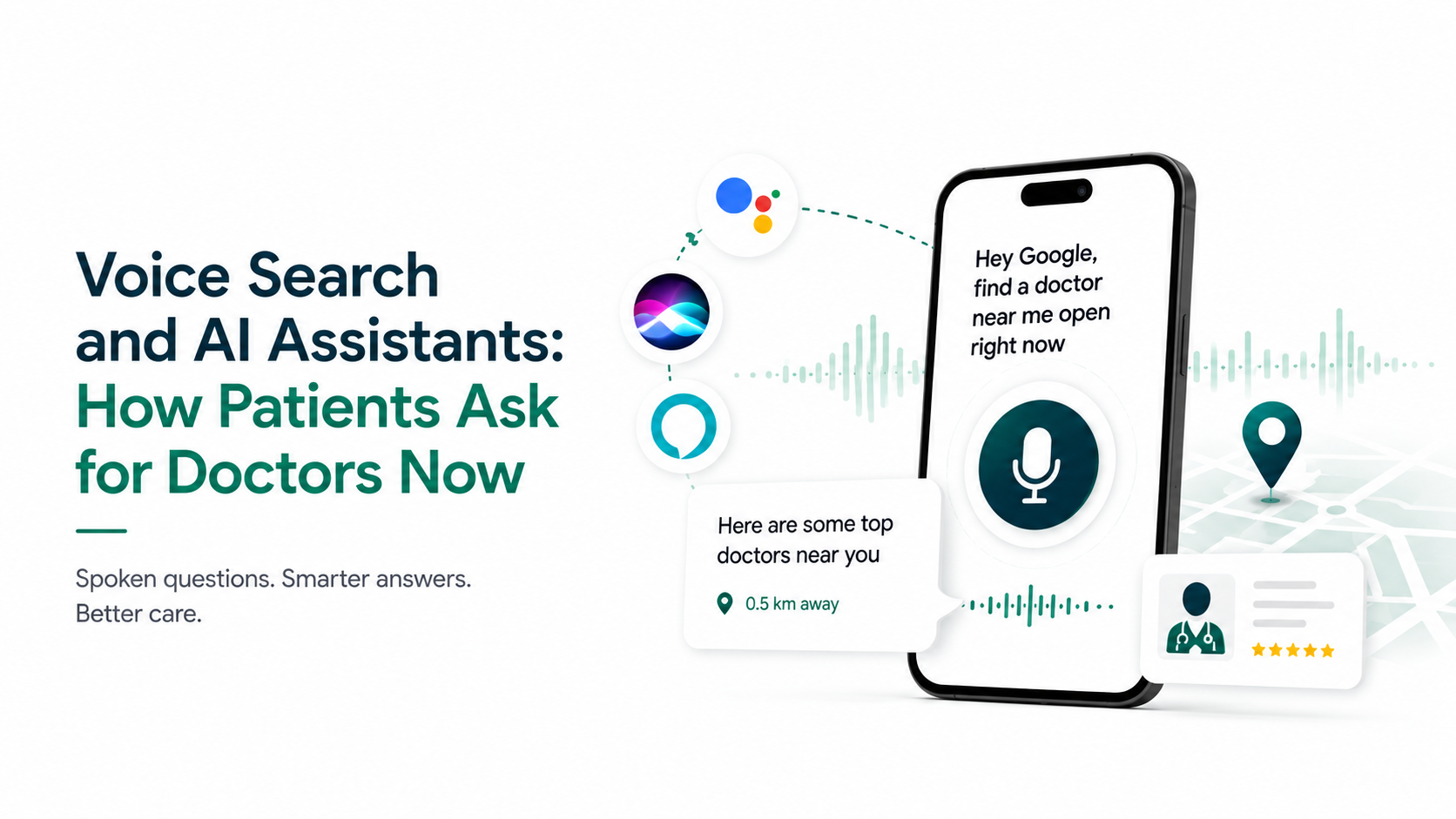
Voice search for doctors has quietly changed the words patients use to find you. Instead of typing "dermatologist Austin," a patient now says out loud, "who is a good skin doctor near me open right now." That single shift, from clipped keywords to full spoken questions, reshapes what a clinic must publish to be found. Voice queries are longer, more conversational, and almost always local, and the assistant reading the answer back rewards content that already sounds like a direct reply.
What is voice search for doctors
Voice search for doctors is any spoken, natural-language query a patient uses to find or vet a clinician, answered aloud or on screen by an assistant. The patient speaks to Siri, Google Assistant, Alexa, or an AI app, and the tool returns one concise answer rather than a page of blue links.
Three traits separate it from typed search.
- Length. Spoken queries run longer, often a full question of 8 to 12 words.
- Phrasing. They are conversational, shaped like speech, not keyword fragments.
- Intent. They lean local and urgent, with "near me," "open now," and "today."
This behaviour sits at the centre of conversational search in healthcare, where a patient expects a spoken reply to a spoken need. The same patient often continues in a chat app, so the query style bleeds straight into how they prompt ChatGPT, Gemini, Claude, and Perplexity.
How spoken queries differ from typed keywords
When patients type, they compress. When they speak, they talk in full sentences the way they would ask a friend. A typed query might be "paediatrician Bengaluru." The spoken version becomes, "which is a good child specialist near me who is open now." Your content has to match the spoken shape, because that is the phrasing the assistant is trying to answer.
The rater8 2025 patient-choice report found that 73% of patients adopted a new way to research providers in the past year, and 26% said an AI tool influenced their choice of provider. Spoken and conversational queries are a large part of that new behaviour. A patient who once scanned a directory now asks a question out loud and takes the first trustworthy answer.
Natural-language search for doctors also carries more context in a single line. A typed query drops filler words. A spoken one keeps them, and those words tell the assistant exactly what the patient needs.
What patients actually say, in the US and India
The safest way to earn voice visibility is to write the way your patients speak, in their city and their idiom. The phrasing differs by market, so cover both.
In the US, a patient is likely to say things like these.
- "Hey Google, find a doctor near me who takes my insurance."
- "Siri, who is the best cardiologist in Denver open on Saturday?"
- "Find a dermatologist near me with good reviews in New York."
In India, the phrasing carries local landmarks, languages, and cost questions.
- "OK Google, best gynaecologist near me in Andheri Mumbai."
- "Find a good child specialist in Koramangala Bengaluru open now."
- "Which physiotherapist near me in Pune does home visits?"
Notice the pattern across both markets. The queries name a specialty in plain words, a neighbourhood, and a practical filter like open hours, insurance, or home visits. A patient saying "hey Google, find a doctor" expects a specific, local, current answer, not a brochure. Your published information has to answer that exact spoken sentence.
Why AI assistants answer conversationally
An assistant does not read a patient a list of ten links. It speaks or shows one composed answer, then perhaps names a source. That single-answer format is why voice and AI search reward the same content. Both pull short, self-contained passages that already resolve the question, then paraphrase them into a reply.
This is Answer Engine Optimization (AEO), the practice of shaping content so answer engines cite it, working alongside Generative Engine Optimization (GEO), the practice of making AI models more likely to surface and cite you. A GEO research paper from Princeton, Georgia Tech, the Allen Institute for AI, and IIT Delhi showed that deliberate content choices can raise how often an AI answer cites a source by up to 40%. Writing for the spoken question is one of those choices.
Because the assistant returns only one answer, the margin for being second is thin. If the reply names a clinic, that clinic wins the moment. To understand the selection logic behind it, read how ChatGPT chooses which doctors to recommend.
How to make your clinic findable by voice and AI
You do not need new technology to win voice queries. You need the right information, phrased the way patients speak, and made consistent everywhere an assistant looks. Work through these steps.
- Write questions in spoken form. On your site, use headings that mirror how a patient talks, such as "Is there a paediatrician near me open on Sunday?"
- Answer in one clean block. Follow each question with a self-contained 40 to 100 word answer that needs no other context.
- Fix your local facts. Keep your name, specialty, address, hours, and phone identical across your Google Business Profile and every directory.
- State hours and availability clearly. "Open now" and "Saturday" queries depend on accurate, structured opening hours.
- Add speakable, structured content. Use clear FAQ blocks and schema so an assistant can lift a single answer cleanly.
Google's own guidance notes there is no special markup required to appear in AI features, so treat schema as an aid to clarity, not a magic switch. The real work is publishing concise, correct answers to the spoken questions your patients ask.
Your Google Business Profile carries most of the local weight for "near me" and "open now" queries. Confirm every field is filled and current through Google Business Profile support. For the written craft of these answer blocks, see how to write medical FAQ content AI assistants quote.
What most doctors get wrong about voice search
The common mistake is optimising for the words a doctor would use, not the words a patient speaks. A clinic page titled "Comprehensive Paediatric Services" answers no spoken query, because no parent says that sentence out loud. Three more errors show up on almost every audit.
- Hours listed only as an image or PDF, which an assistant cannot read as structured data.
- Different addresses or clinic names across directories, which makes an assistant distrust the answer.
- No plain-language questions on the site, so nothing matches the way a patient actually asks.
In India, keep all of this strictly educational and factual. NMC rules restrict self-promotion, so the goal is to make your existing, correct information consistent and findable, never to advertise or solicit patients. A dependable, accurate profile answers the spoken question without crossing that line.