The Zero-Click Patient: How AI Answers Are Changing the Way Patients Find Doctors
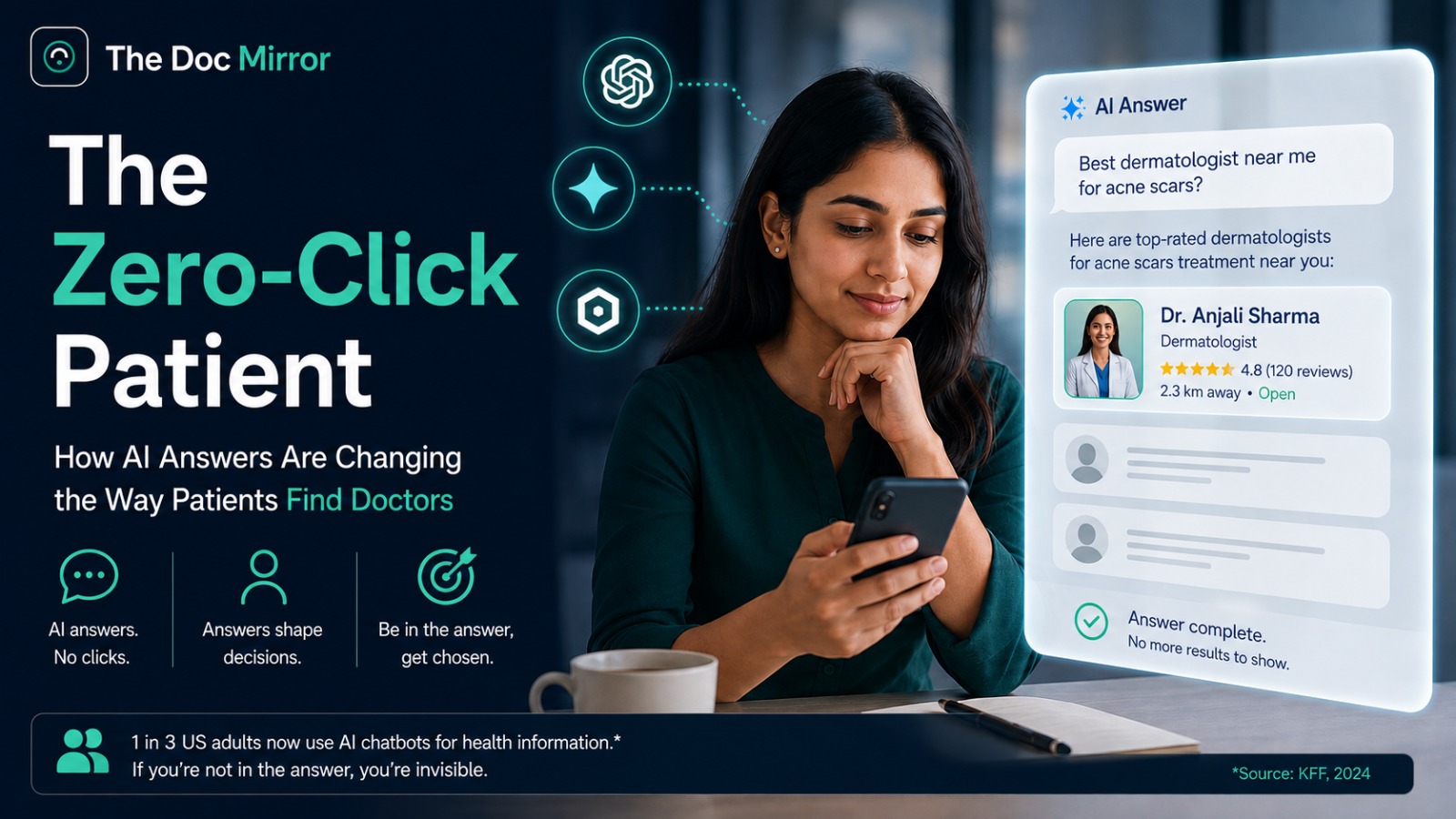
Zero click search for doctors means a patient gets a complete answer from an AI assistant or an AI overview and never visits a single website. The patient asks "best dermatologist near me for acne scars" and reads a finished recommendation, with names, right on the screen. No blue links. No clicks. If your practice is not inside that answer, you were not skipped in the rankings. You were never in the conversation. This is the biggest quiet shift in how patients find doctors, and most practices cannot see it happening.
What is a zero-click patient
A zero-click patient is someone who resolves a health or provider question entirely inside an AI answer, without clicking through to any website. The answer engine reads the web, synthesizes a response, and hands it over complete. The patient acts on that answer, they do not go hunting through ten links.
This is not a small edge case anymore. A KFF poll found that about 1 in 3 US adults have used AI chatbots for health information, roughly the same share who use social media for health. When the answer feels complete, the patient stops there. The click that a practice used to depend on never happens, because the patient's need was already met.
Zero-click behaviour shows up in two places. First, in AI assistants like ChatGPT, Gemini, Claude, and Perplexity, where the patient is in a conversation, not a results page. Second, in AI overviews, the synthesized summary that now sits above the traditional links on many Google searches. Both hand the patient an answer before a website ever loads.
Why zero-click changes patient acquisition
For twenty years, being found online meant one thing: rank high enough that a patient clicks your link. Traffic was the currency, and patient acquisition was a funnel that started with a click. Zero click search breaks that model at the top.
When the answer is complete without a click, the decisive moment moves off your website and into the AI's response. The patient forms an impression, shortlists two or three names, and often acts, all before any site loads. If your practice is not named in that response, you do not get a second chance from a lower-ranked link, because there is no list of links to fall back to.
This reshapes ai answers patient acquisition in a specific way. The goal is no longer only to win the click. It is to be inside the answer. A cardiologist in Denver and a gynaecologist in Pune now compete for the same thing: a mention or a recommendation inside the synthesized response a patient reads. Presence in the answer is the new front door.
A 2025 rater8 report puts numbers to the stakes. It found that 26% of patients said an AI tool influenced their choice of provider, and 73% adopted a new way to research providers in the past year.
The two questions every doctor should now ask
The old question was "where do I rank?" It still matters, but two questions now decide whether patients find you in no click search healthcare results.
- When a patient asks an AI about my specialty in my city, do I appear in the answer? Ask ChatGPT, Gemini, Claude, and Perplexity the exact questions a patient would, and read whether your name comes back.
- When I do appear, are the facts right? An answer that names you with the wrong location or an old phone number can cost you the patient as surely as being left out.
Most practices have never checked either. They watch their Google position and website traffic and assume that covers it. It does not, because the zero-click patient never reaches the page where that traffic is counted. We break down these two separate scoreboards in ranking number 1 on Google is no longer enough.
What zero-click does to website-traffic thinking
If your entire sense of "are patients finding me" comes from website analytics, zero-click search will quietly mislead you. Your traffic can stay flat or even dip while your actual visibility in front of patients changes underneath you, in either direction, and your dashboard will not show it.
Here is the trap. A practice sees steady website visits and concludes everything is fine. Meanwhile, a growing share of patients are getting answers about local dermatologists or dentists without ever generating a visit to measure. A patient who chooses a competitor named in an AI answer never appears as a lost click in your analytics, because they were never going to click in the first place.
The correction is not to abandon website analytics. It is to stop treating traffic as the only proof of visibility. You now need a second measurement: whether AI answers include you, and whether they get you right. This is the core of AI visibility for doctors, and it is why traffic alone is now an incomplete scoreboard.
How AI decides who to name in a zero-click answer
An answer engine does not invent recommendations. It assembles them from what the web already says about you, then decides who is safe to name. Three signals do most of the work.
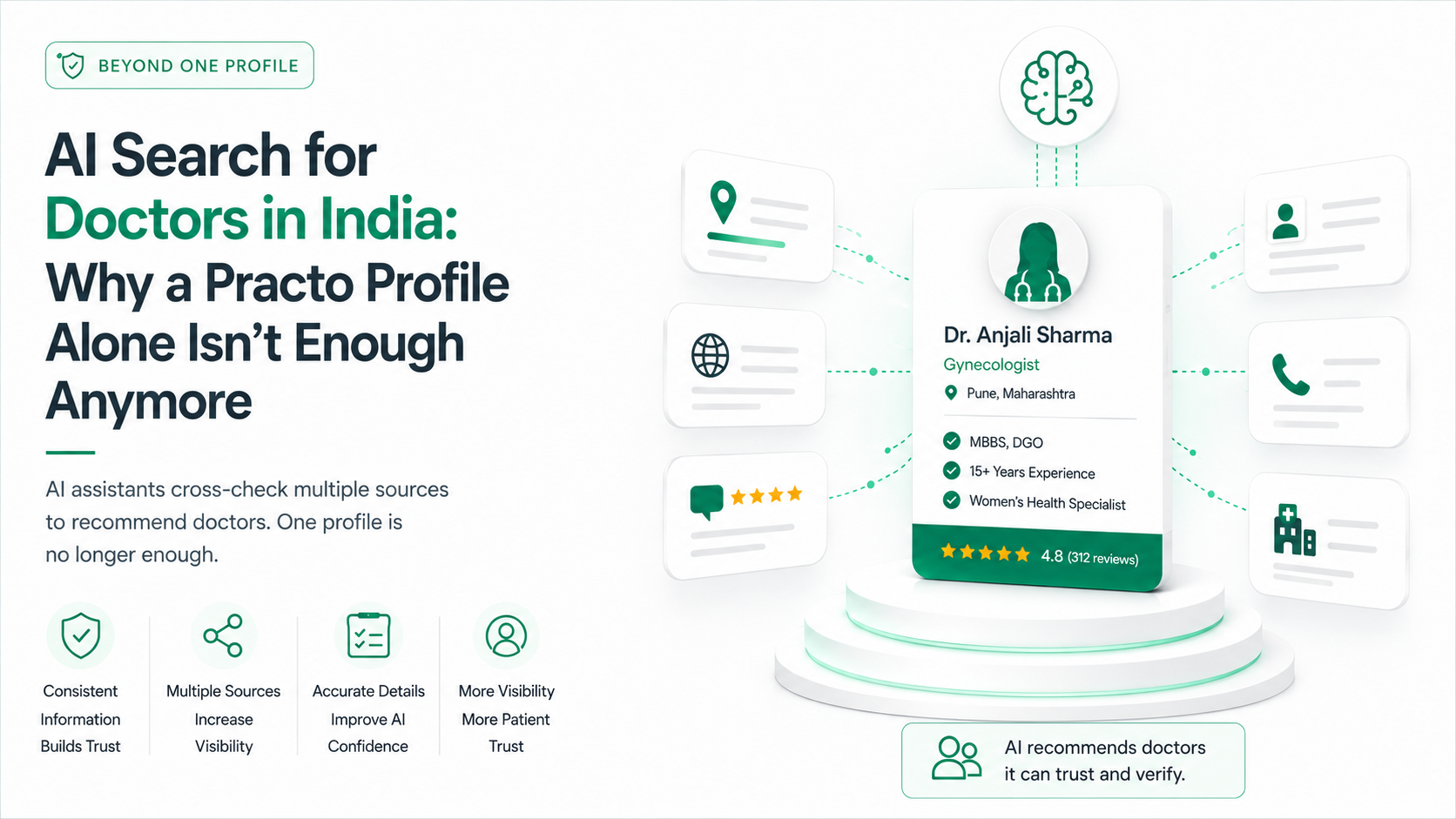
- Consistency across the web. When your name, specialty, address, and phone number match across your website, Google Business Profile, and directories, a model trusts the information and is willing to state it. A dentist whose Practo, JustDial, and website addresses disagree gives the model a reason to stay vague.
- Extractable, well-structured content. Models favour pages that answer a question directly. If your service pages front-load clear answers and carry a real FAQ, your words are easier to lift into an answer. This is the discipline of AEO for doctors, Answer Engine Optimization.
- Corroborating signals of trust. Reviews, directory listings, and mentions across independent sources tell a model that a recommendation is defensible. This maps to E-E-A-T, which stands for Experience, Expertise, Authoritativeness, and Trust, the qualities models weigh before naming a provider.
Google itself states that no special markup is required to appear in its AI features, so this is not about tricks. It is about clear, accurate, consistent information that a model can safely repeat.
What most doctors get wrong about zero-click
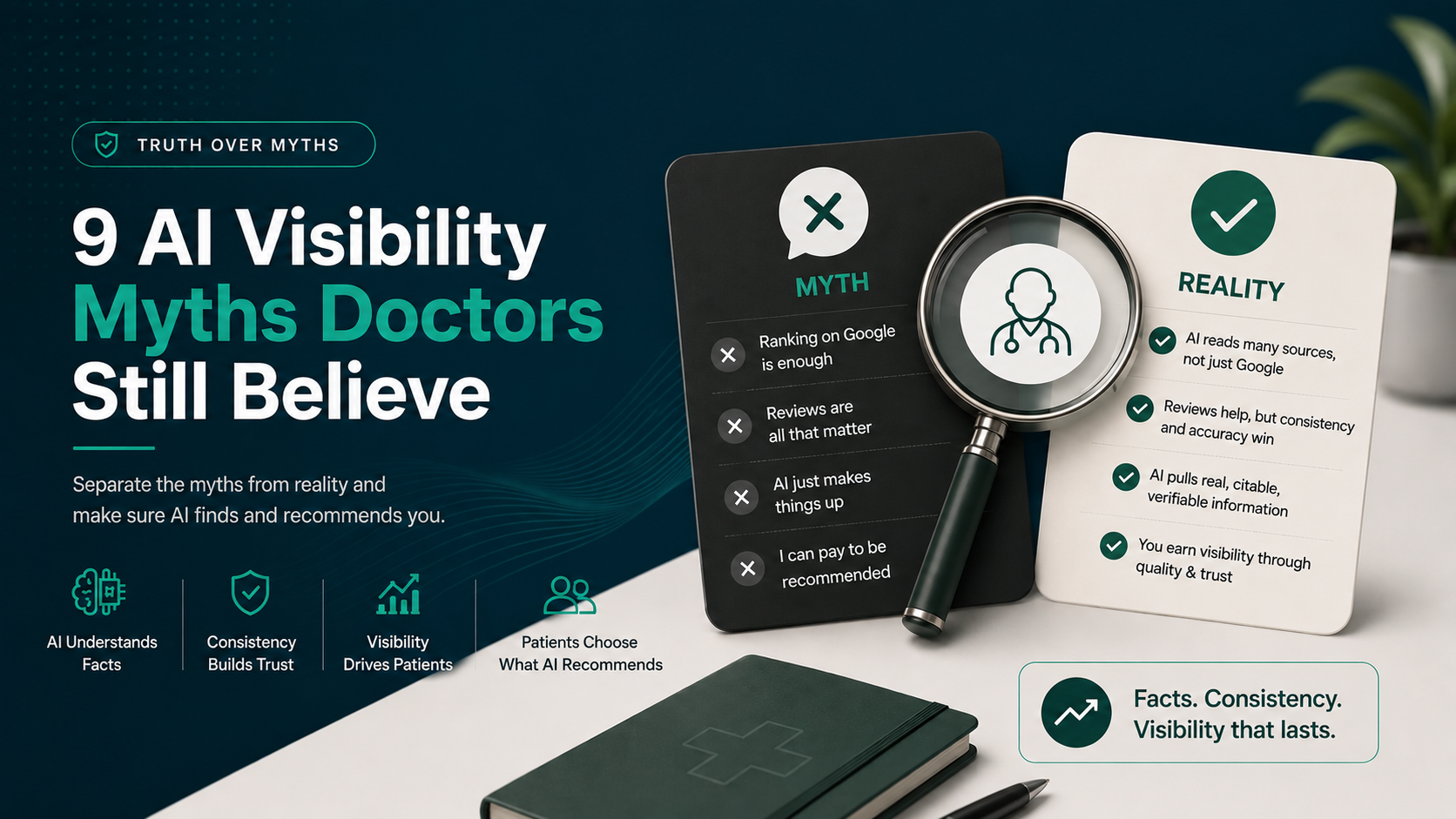
The most common mistake is assuming that a strong Google ranking automatically means presence in AI answers. It does not. Ranking first in the blue links and being named in the AI overview above them are decided by overlapping but different signals. You can own position one and still be absent from the synthesized answer a patient reads first.
Three more errors cost practices visibility in zero-click results:
- Measuring only traffic. As covered above, the zero-click patient never shows up as a click, so a traffic-only view hides the shift.
- Ignoring directory consistency. Doctors treat their Healthgrades, Zocdoc, Vitals, Practo, or Apollo 247 listings as set-and-forget. Stale, contradictory listings quietly reduce how confidently a model will name them.
- Never reading their own AI answers. Practices spend on ads and websites but have never once asked ChatGPT or Gemini what it says about them. You cannot fix an answer you have never read.
For a doctor in India, the fix is framed as education, not promotion. You are not advertising yourself. You are making your existing, factual information consistent and findable, which sits comfortably within NMC guidance on how doctors present information. A gynaecologist in Bengaluru reconciling her listings is doing housekeeping, not solicitation.
How to adapt to zero-click patient behaviour
You do not need a new website or an agency to respond to this. The work is mostly disciplined and factual.
- Read your own answers. Ask ChatGPT, Gemini, Claude, and Perplexity the questions a patient in your city would ask, such as "best physiotherapist in Austin for sports injury" or "good paediatrician in Hyderabad." Note whether you appear and whether the facts are right.
- Reconcile your listings. Make your name, specialty, address, and phone number identical across your Google Business Profile, website, and every directory that lists you. Contradiction is the fastest way to be left out.
- Front-load clean answers on your pages. Rewrite the top of your key service pages so the direct answer comes first, then add a real FAQ. This makes your content extractable.
- Keep facts current. When you add a service, change hours, or move, update every listing. An outdated fact in an answer costs you the patient.
- Measure both scoreboards. Track your Google position and your presence inside AI answers separately, and recheck monthly, because answers shift as models update.
Do these five and you have moved from hoping for a click to earning a place inside the answer. The Doc Mirror automates the measurement side, so you are not checking every engine by hand each month, and your visibility score across the 7 pillars shows which gap to close first.
Patients are already resolving questions about your specialty inside AI answers, in your city, whether or not your practice is part of the answer they read. The click you used to compete for is not always coming. What you can still control is whether you are present, and accurate, inside the answer itself. Start by seeing exactly where you stand today..