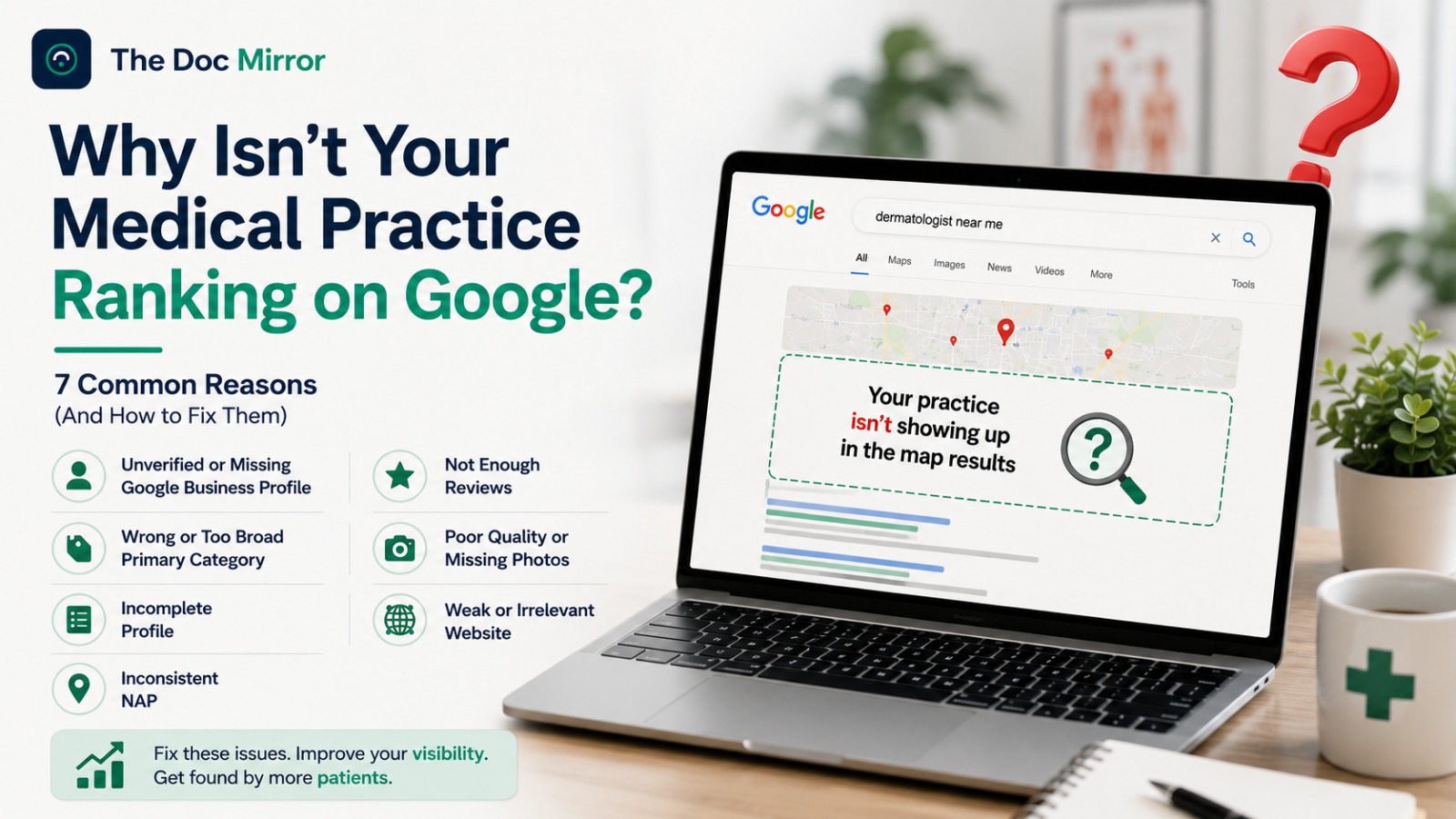
A medical practice usually fails to rank on Google for reasons that are specific and fixable, not mysterious. Google ranks local results on three things, relevance, distance, and prominence, and most practices lose on the parts of relevance and prominence they fully control. The seven reasons below are the ones that cost independent practices the most position, listed in roughly that order. Each one includes how to confirm it yourself, so you can move from "why am I invisible?" to a short list of fixes you can work through in under 2 hours a week.
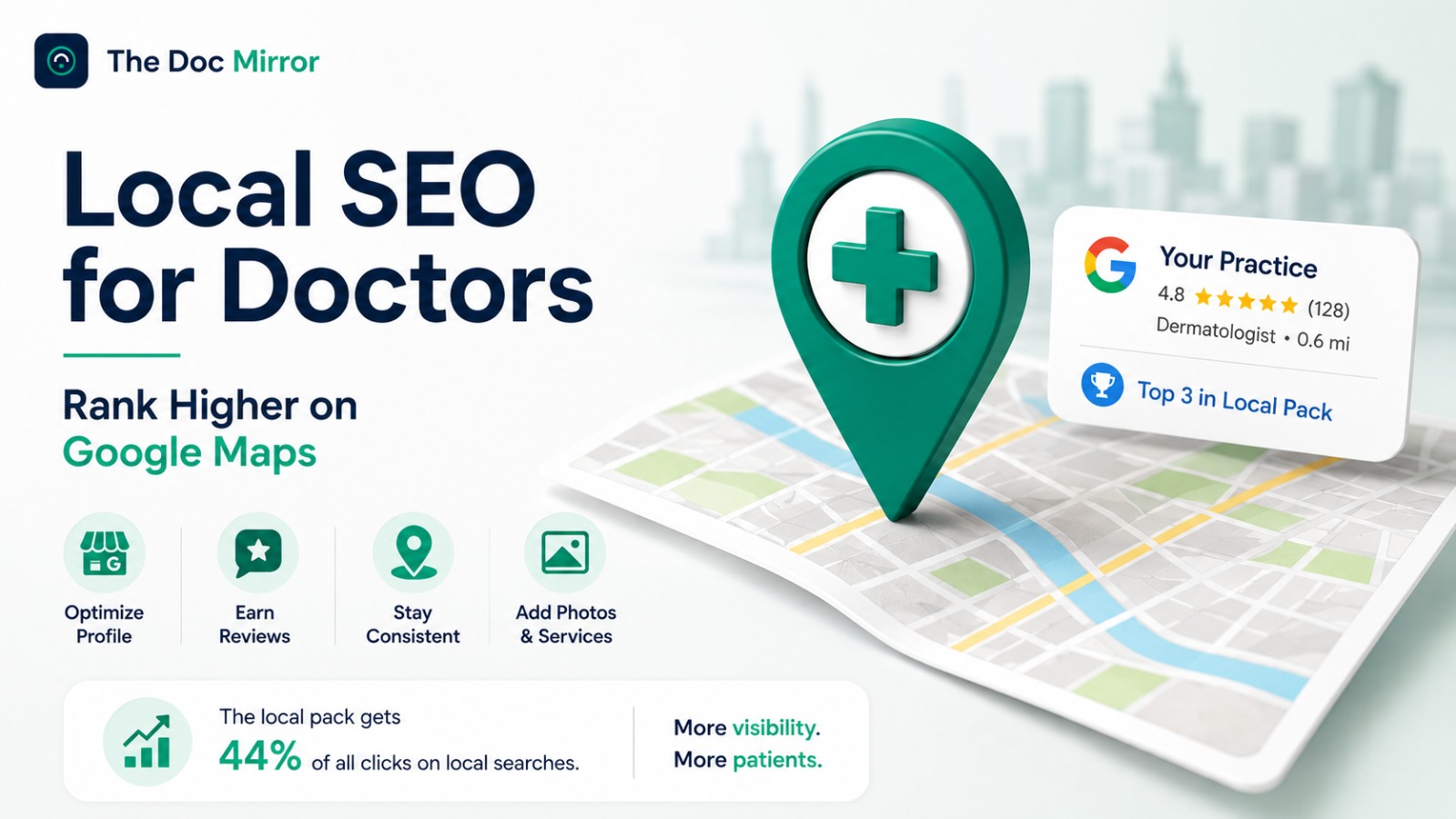
This matters more than it used to. The local 3-pack, the map box with three practices at the top of a local search, captures around 44% of all clicks on local searches, well ahead of the organic links beneath it, according to Local Falcon's analysis of 50 million search results. If you are not in those three, most patients never scroll far enough to find you.
How Google ranks a medical practice, briefly
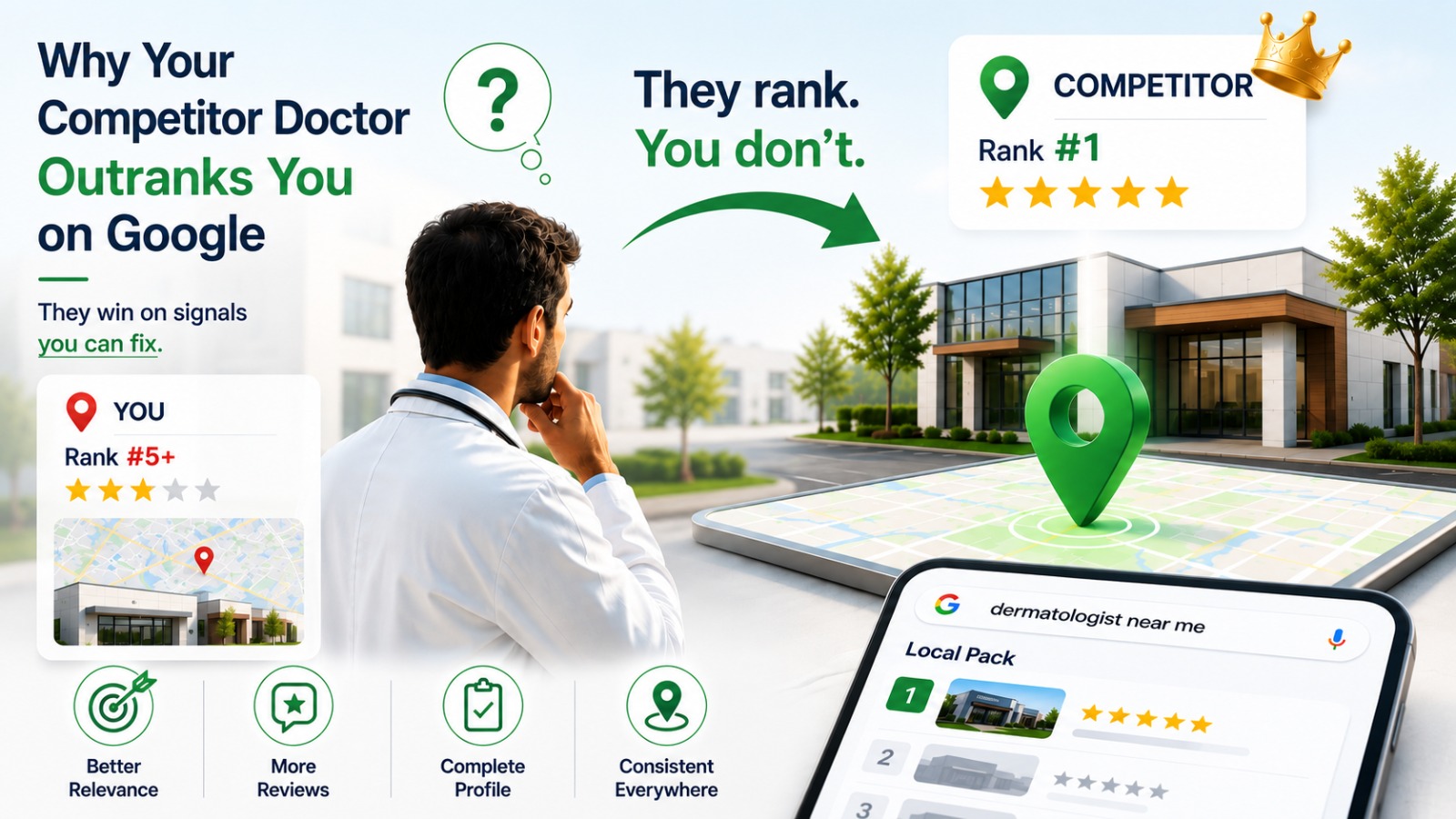
Google's local ranking rests on three factors. Relevance is how well your profile matches what the patient searched. Distance is how close you are to the searcher. Prominence is how established and trusted your practice looks across the web.
You cannot change distance. Everything else on this page sits inside relevance and prominence, which you can change. Independent data backs where to spend your effort: in Whitespark's 2026 Local Search Ranking Factors study, Google Business Profile signals account for about 32% of local ranking weight, review signals about 20%, and on-page website signals about 15%. The seven reasons below map directly onto those three levers. If you want the wider picture of how findability works beyond Google alone, start with what doctor online visibility actually means.
Reason 1: Your Google Business Profile is unverified or missing
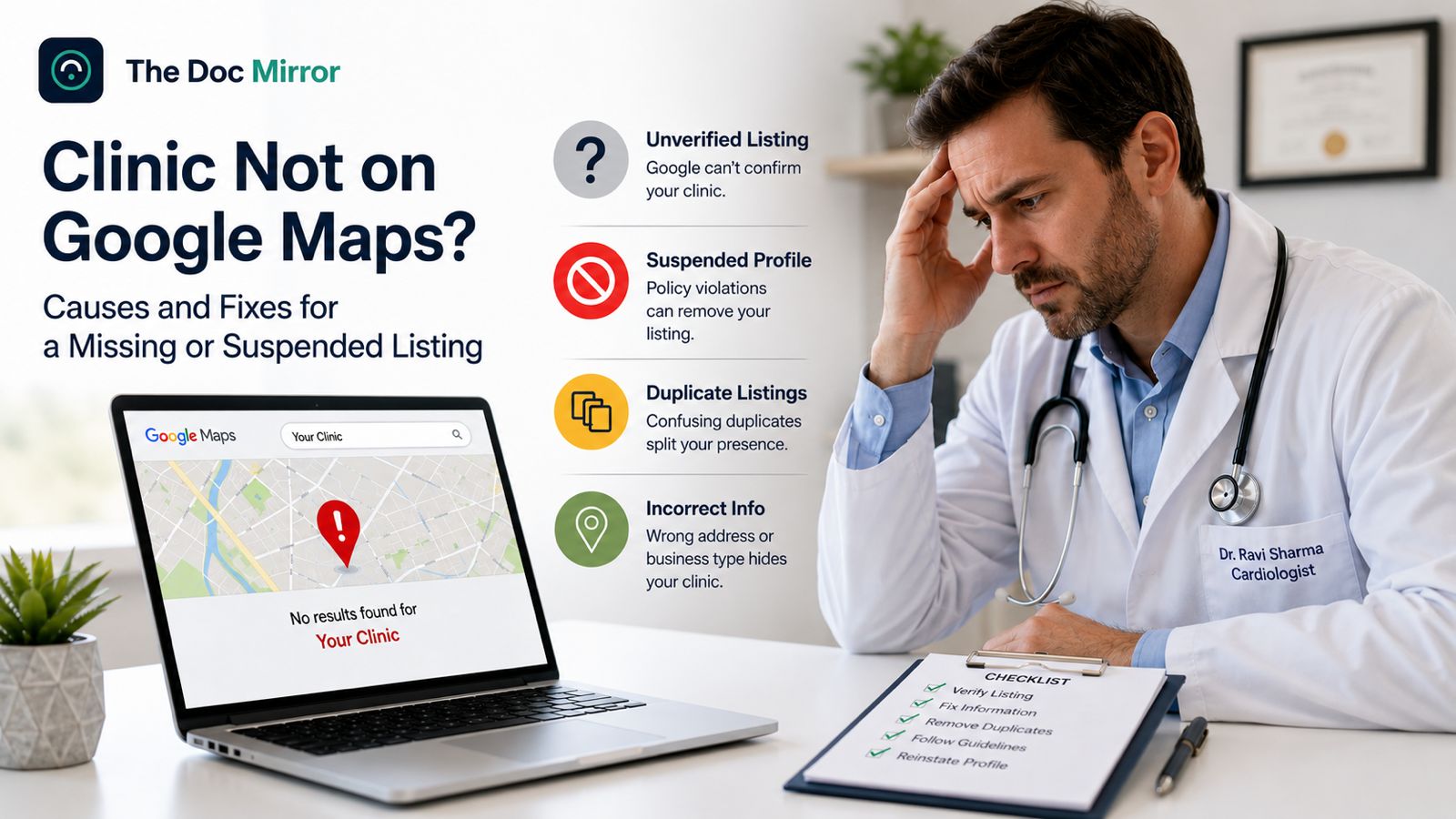
Google will not reliably rank a listing it has not verified. If your profile was auto-generated and never claimed, or you completed the details but never finished Google's verification step, you are starting from behind every competitor who did.
An unverified or missing Google Business Profile is the single most common reason a real practice does not appear in the map results at all. This is a different problem from ranking low, and it is worth ruling out first. If your clinic does not surface for its own name plus city, work through why a clinic does not show up in local search before anything else.
How to confirm it: search your clinic name in an incognito window. If you cannot edit the profile from your management view, or it shows no verified state, verification is your first fix.
Reason 2: Your primary category is wrong or too broad
Your primary category is one of the strongest relevance signals Google uses, and in most ranking studies it sits at or near the top of the list. A dermatologist listed under the generic "Doctor" or "Medical clinic" competes for the wrong searches and loses to practices listed precisely under "Dermatologist."
There is also evidence that using your secondary categories helps. A GBP category study found that profiles using several relevant additional categories tend to hold higher average map positions than those using only one. The rule is accuracy, not volume: add secondary categories only for services you genuinely provide.
How to confirm it: open your profile and read the primary category out loud. If it is broader than how a patient would describe your specialty, tighten it.
Reason 3: Your profile is incomplete
Google shows complete profiles more often than half-filled ones and treats them as more credible. Completeness is also a large share of that 32% of ranking weight tied to your profile. Missing hours, no description, no listed services, and no website link all lower how often you appear, and they lower how often patients click when you do.
Completeness is free and fully in your control. Fill every field: hours including holidays, services, a factual description, your website, and an appointment link. For practices that never finished setup, this single pass often produces the clearest jump in visibility.
How to confirm it: Google reports a completeness prompt inside your profile dashboard. Any field it flags is a field a competitor has probably already filled.
Reason 4: Your name, address, and phone don't match across the web
Google builds trust in your practice by confirming its details in more than one place. When your name, address, and phone, often shortened to NAP, differ across Google, Healthgrades, Zocdoc, Vitals, and your own website, that trust drops and your ranking drops with it.
The culprits are small: an old suite number, "Ave" versus "Avenue," a landline on one listing and a cell on another, a maiden name on an older profile. Machines read those as different businesses.
How to confirm it: open your four most important listings side by side. Pick one exact format, write it down, and make every listing match it to the character.
Reason 5: Too few reviews, or a lower rating than competitors
Reviews are the second heaviest ranking lever after your profile, around 20% of local weight, and their pull is growing as Google leans harder on real-world engagement. Quantity, rating, recency, and your response rate all count. A practice with 18 reviews rarely out-ranks a nearby competitor with 140, even when the care is comparable.
Reviews decide patients, not just rankings. In rater8's 2025 report on how patients choose doctors, 84% of patients check online reviews before choosing a provider, and most read at least six before booking. The gap is a ranking problem and a conversion problem at once.
The fix is slow but reliable: ask recent, satisfied patients to leave an honest Google review, and make it easy with a direct link. Never buy reviews, write them yourself, gate out unhappy patients, or offer anything in exchange. All of that breaches Google's policies and the FTC's 2024 rule banning fake and incentivized reviews, which carries civil penalties.
How to confirm it: compare your review count and rating to the two practices ranking directly above you in your city. The distance between you is your target.
Reason 6: No photos and a stale profile
Profiles with photos earn more clicks and more direction requests, and Google favors listings that are kept current. A practice showing two photos from years ago and no recent activity signals neglect, and neglect ranks poorly.
Add clear photos of your exterior, signage, reception, and care areas, then keep adding them over time. Never show identifiable patients without written consent. Post a short, factual update every couple of weeks so the profile reads as active.
How to confirm it: count your photos and note the date of your last post. If the newest thing on your profile is older than a season, that is the reason.
Reason 7: Weak website signals and no schema markup
Your website supports your ranking even though the local pack is driven mainly by your profile. A slow site, no clear statement of your location and specialty, and no schema markup all weaken how Google understands you.
Schema markup is a small block of code that tells Google exactly what your business is: your specialty, address, hours, and credentials in a format machines read cleanly. Most doctor websites built by a local agency never had it added. In The Doc Mirror's audits, adding it typically moves a visibility score by 3 to 5 points, and it also helps AI assistants identify you correctly.
How to confirm it: open your site, view the page source, and search the text for "schema" or "application/ld+json." If there is nothing, that is your gap.
A note on AI: ranking on Google is no longer the whole picture
Even a practice that fixes all seven can be missing from a channel it never checks. When a patient asks ChatGPT, Gemini, Claude, or Perplexity for a recommendation, those tools name one to three practices using directory data and website structure, not Google's rankings.
This is not a fringe habit anymore. The same rater8 research found 26% of patients have chosen a provider based on an AI tool, close to the 28% who rely on a primary-care referral. You can rank well on Google and still be absent from the AI answer. The good news is that the fixes above, consistent listings and schema in particular, are the same signals that get you named in AI results.
How to check where you stand this week
Run this diagnostic before changing anything.
- Search your specialty plus your city in an incognito window. Note your position, or your absence, in the top three map listings.
- Open your Google Business Profile. Confirm it is verified, the primary category is specific, and every field is complete.
- Line up your name, address, and phone across Google, Healthgrades, Zocdoc, and Vitals, and flag any mismatch.
- Compare your review count, rating, and photo count to the practice ranking directly above you.
Those four steps usually reveal which of the seven reasons apply to you. The Free Audit at thedocmirror.com scores all of this across 7 pillars in about 90 seconds and ranks your fixes in order, with no signup for the free score.