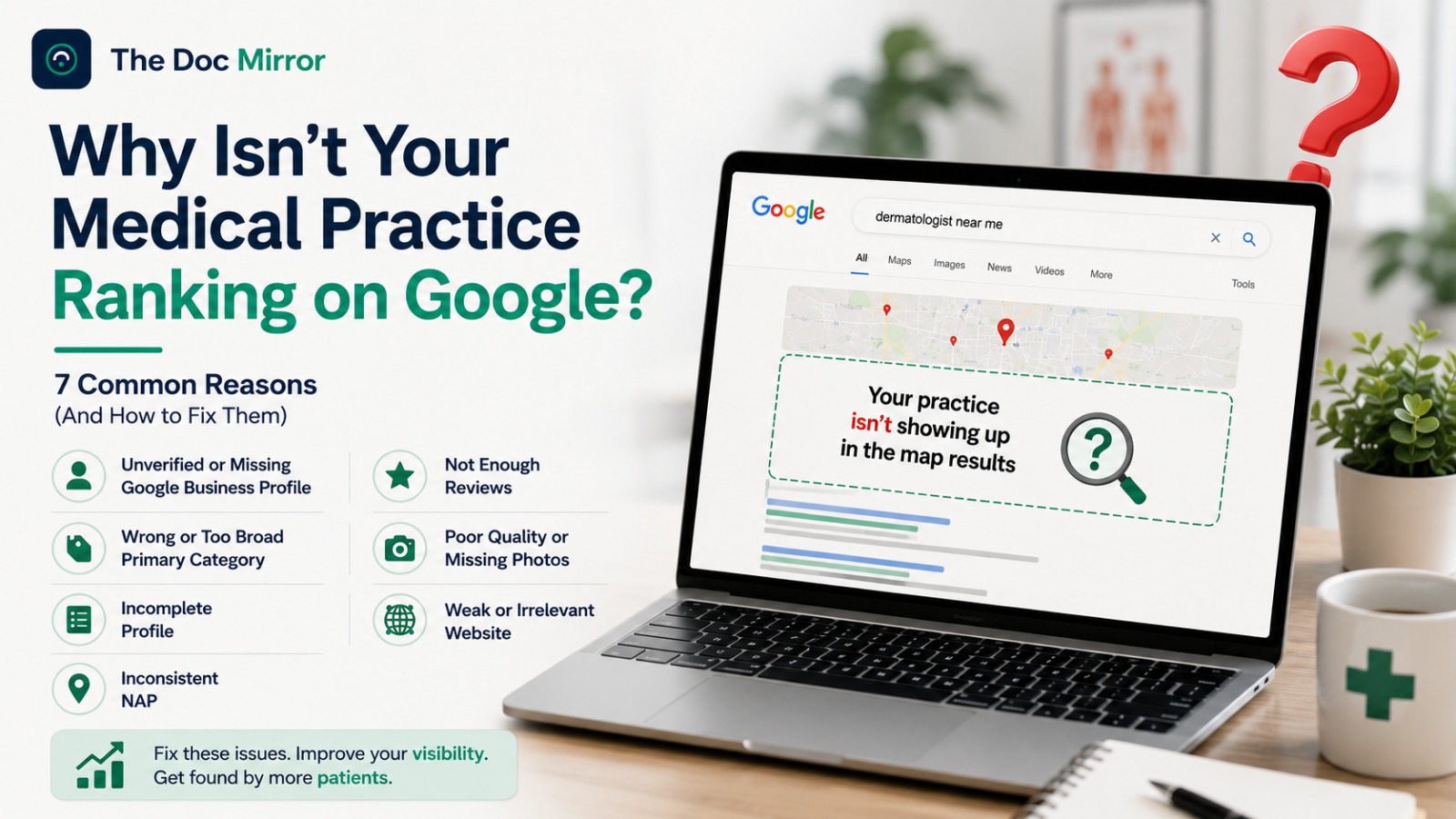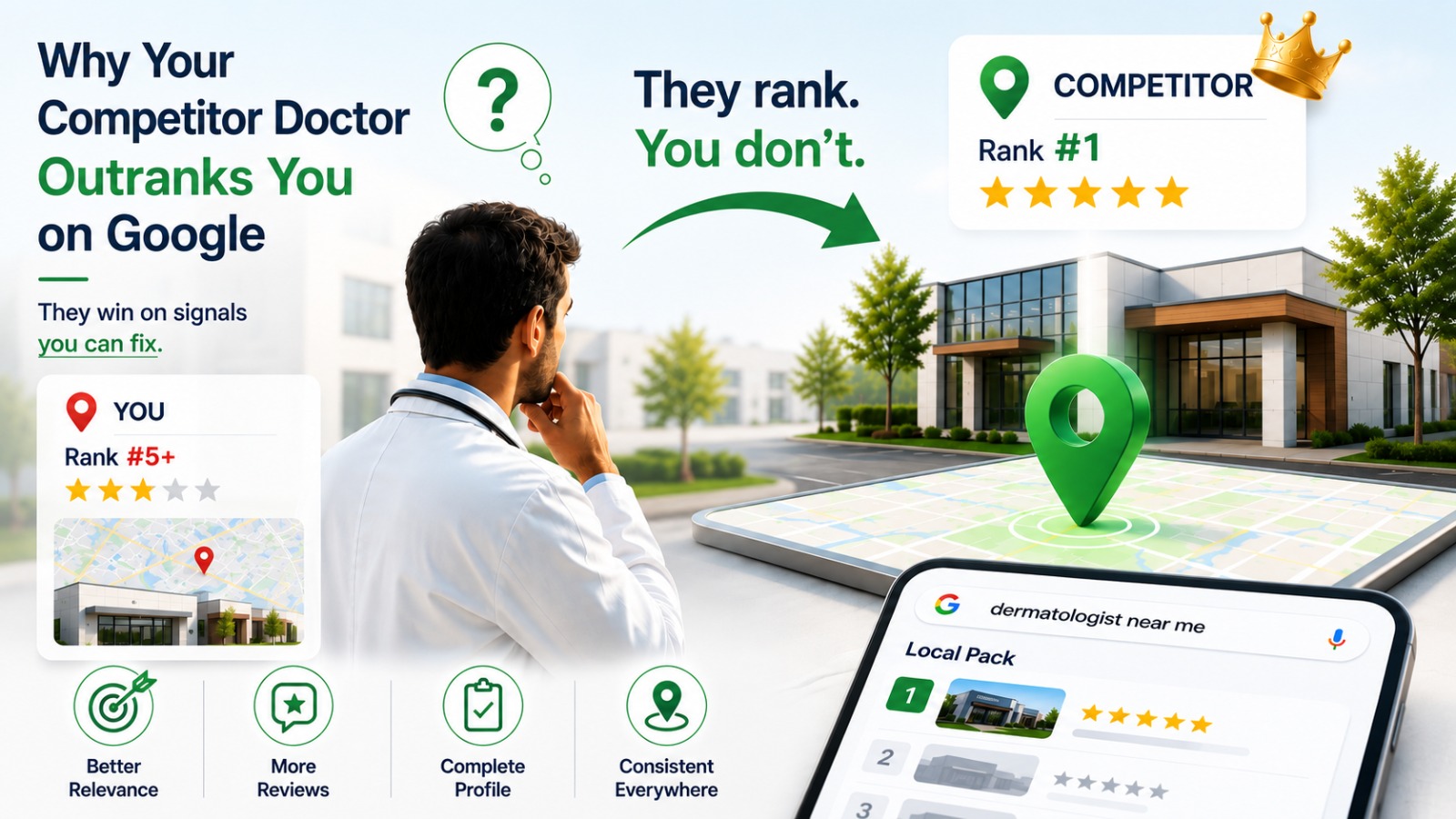
Your competitor outranks you because Google reads their relevance and prominence signals more favorably than yours, not because they are the better doctor. Google ranks local results on relevance, distance, and prominence, and the practice sitting above you is winning on at least one signal you can measure and match. This is a comparison problem, not a mystery. Once you line up your Google Business Profile against theirs field by field, the gap almost always turns out to be a more precise primary category, more recent reviews, a fully completed profile, or details that stay consistent across the web.
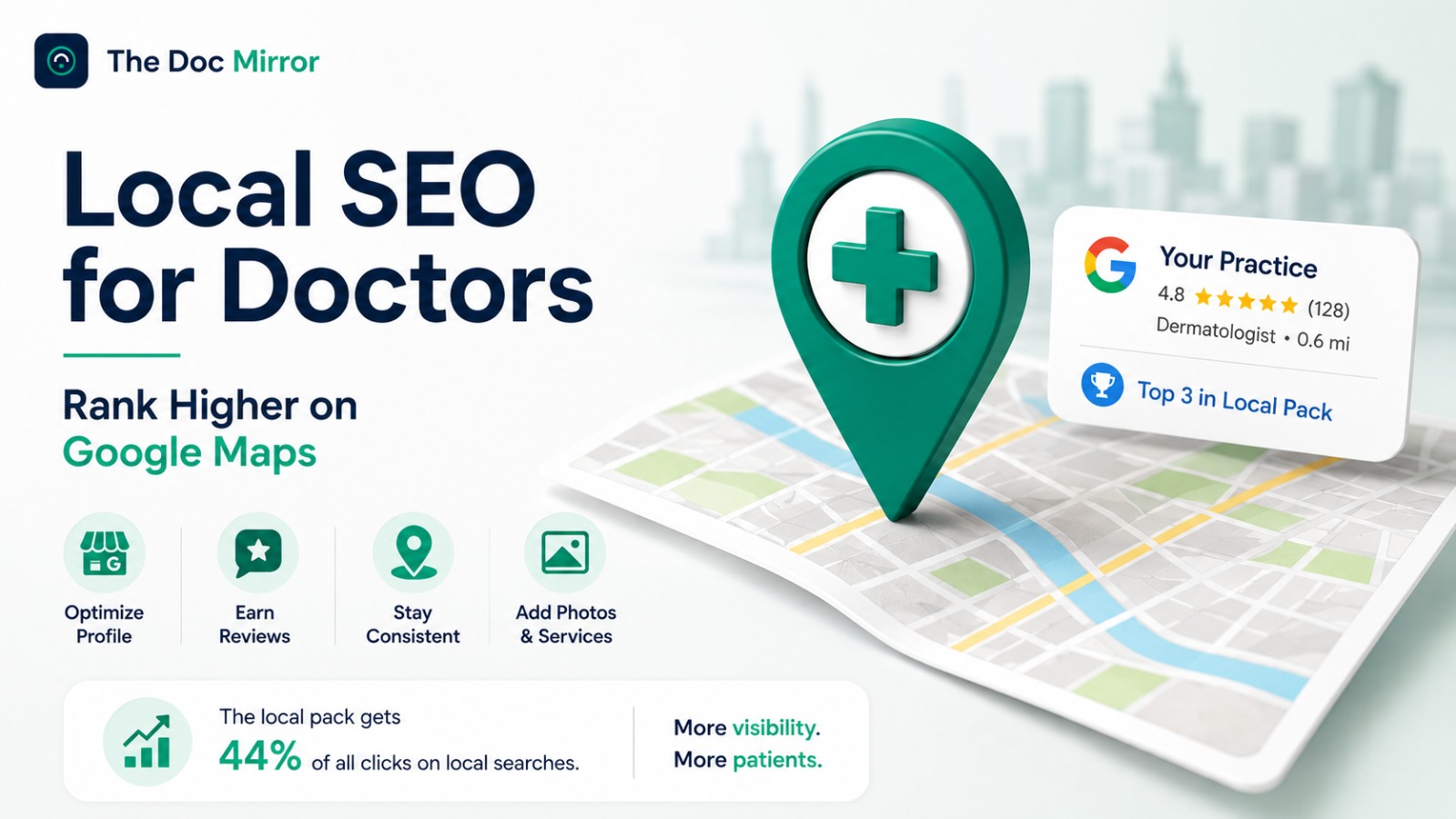
The stakes are concrete. The local 3-pack, the block of three map listings at the top of a local search, captures around 44% of all clicks on local searches, according to Local Falcon's analysis of 50 million search results. If your competitor holds one of those three spots and you sit below the fold, most patients choose from the three they can see. This article breaks down the specific advantages a higher-ranking competitor holds and how to close each one.
How Google decides who ranks above whom
Google is public about its local ranking model. It weighs three factors, and your competitor is beating you on the parts you both control.
Relevance is how well a profile matches what the patient typed. It is driven mostly by your primary category, your listed services, and an accurate description.
Distance is how close each practice is to the searcher. You cannot move your building, so treat this as fixed.
Prominence is how established and trusted a practice looks across the web. It is shaped by review quantity, rating, and recency, by consistency of your details, and by overall profile completeness.
Independent research shows where the controllable weight sits. In Whitespark's 2026 Local Search Ranking Factors study, Google Business Profile signals account for about 32% of local ranking weight, review signals about 20%, and on-page website signals about 19%. Whitespark's panel also rates the primary category as the single strongest ranking factor a business controls. Your competitor is almost certainly ahead on one of these levers. The sections below take them in the order that usually explains the gap. For the wider context of how findability works, start with what doctor online visibility actually means.
Gap 1: Their primary category is more precise
The most common hidden advantage is category selection. A dermatologist listed as "Dermatologist" matches "dermatologist near me" far more strongly than one listed under the generic "Doctor" or "Medical clinic." Because category is the strongest controllable relevance signal, a single wrong choice can cost you the search before any other factor is counted.
Your competitor likely chose the most specific category that fits, then added secondary categories only for services they genuinely provide. To close this gap, open both profiles and read the primary category aloud. If theirs is more specific than yours, tighten yours to match how a patient would describe your specialty, and add accurate secondary categories for each real service line.
Gap 2: They have more, fresher reviews
Reviews are the second heaviest lever after your profile, around 20% of local weight, and their pull is growing as Google leans harder on real-world engagement. Count, rating, recency, and response rate all feed prominence. A practice with 120 recent reviews at 4.8 stars usually outranks a nearby competitor with 20 older reviews at 4.5, even when the second doctor has more clinical experience.
Reviews also decide patients directly. BrightLocal's Local Consumer Review Survey reports that roughly 97% of consumers read online reviews when choosing a local business, and in healthcare specifically, rater8's 2025 report found 84% of patients check reviews before choosing a provider. The gap above you is a ranking problem and a conversion problem at once.
Close it the slow, durable way. Ask recent, satisfied patients for an honest Google review and make it easy with a direct link. Never buy reviews, write them yourself, gate out unhappy patients, or offer anything in exchange. All of that breaches Google's policies and the FTC's 2024 rule banning fake and incentivized reviews, which carries civil penalties. Recency matters too: a steady trickle of new reviews signals an active practice, while a wall of reviews that all stopped two years ago reads as neglect.
Gap 3: Their profile is complete and yours is not
Google shows complete profiles more often and treats them as more credible. Completeness is a large share of that 32% tied to your profile, and most independent practices are missing three or more fields. Hours including holidays, a full service list, a factual description, a website link, and an appointment link all raise how often you appear and how often patients click when you do.
Your competitor has probably filled every field. To match them, work through your profile until Google's own completeness prompt stops flagging gaps. This costs nothing and is entirely in your control, which is why it is often the fastest single move for a practice that never finished setup.
Gap 4: Their details are consistent across the web
Google builds trust in a practice by confirming its details in more than one place. When your name, address, and phone, often shortened to NAP, differ across Google, Healthgrades, Zocdoc, Vitals, and your own website, that trust drops and your rank drops with it. The competitor above you likely shows identical details everywhere, which reads to Google as one confident, verified practice.
The culprits are small: an old suite number, "Ave" versus "Avenue," a landline on one listing and a cell on another, or a maiden name on an older profile. Machines read those as different businesses. Pick one exact format, write it down, and make every major listing match it to the character.
Gap 5: Their profile is active, and yours looks stale
Google favors listings that are maintained. Fresh photos, occasional posts, and answered questions all signal a current practice, and profiles with photos draw more clicks and direction requests than profiles without them. If your competitor adds photos and posts while your newest item is two years old, the activity gap alone can separate you.
Add clear photos of your exterior, signage, reception, and care areas, and keep adding them over time. Never show identifiable patients without written consent. A short, factual post every couple of weeks keeps the profile reading as active.
The signal you cannot beat, and the one doctors overrate
Sometimes the honest answer is distance. If a patient searches from a point nearer your competitor, proximity alone can place them first for that specific search. You cannot fix location, but a stronger profile and review base can outweigh a small distance gap across many searches, so distance is rarely the whole story.
The signal doctors overrate is website design. A polished site attached to a thin profile still loses the local pack, because for local search your Google Business Profile and reviews usually carry more weight than how the website looks. Fix the profile first, then improve the site.
A note on AI: Google is no longer the only race
You can catch your competitor on Google and still lose the patient who never opened it. A growing share of patients ask ChatGPT, Gemini, Claude, or Perplexity for a doctor before they search Maps. The same rater8 research found 26% of patients have chosen a provider based on an AI tool. Those assistants name one to three practices using directory data, schema, and citations, not Google's rankings. The good news is that the fixes above, consistent listings and a complete profile in particular, are the same signals that get you named in AI answers.
How to find the exact gap this week
You can diagnose most of the gap yourself in under an hour.
- Search your specialty plus your city in an incognito window and identify the competitor ranked directly above you in the local pack.
- Open both Google Business Profiles side by side. Compare primary category, hours, services, description, booking link, and photo count.
- Write down each practice's exact review count, star rating, and the date of the most recent review.
- Check whether your name, address, and phone match across Google, Healthgrades, Zocdoc, and Vitals, and note any mismatch.
Whatever shows the widest gap is your first fix. In most cases it is category precision, review count, or profile completeness, and all three are things a doctor can act on directly in under 2 hours a week. The Free Audit at thedocmirror.com scores all of this across 7 pillars in about 90 seconds and compares you to your top local competitors, with no signup for the free score.