The single most important doctor visibility statistic is that 84% of US patients check online reviews before choosing a new doctor, according to rater8's 2025 report. Almost every patient now forms an impression of a practice online before they ever call, which means what they find there decides whether they call at all.
Most doctors run a practice on numbers they can see, such as patient volume, no-show rate, and revenue per visit. The numbers that decide whether a new patient ever reaches the front desk sit online, and almost no doctor tracks them. This piece collects the visibility statistics that actually predict whether patients find and choose a practice, each with a real source, grouped by what it tells you. Read them as benchmarks for what patients now expect, then measure the same things for your own city and specialty.
Why national statistics are only a starting point
A statistic is only useful if you also know your own version of it. A national figure for "patients who read reviews" confirms the behavior is real. It does not tell you whether a dermatologist in your zip code is being chosen over you this month. Use the benchmarks below to understand what patients expect, then find the specific gap moving patients toward a competitor and close it. The habit that matters is measuring your own numbers against these figures, not memorizing them.
Every number below is tied to a named, credible study, listed again in the Sources section at the end. Where a figure comes from Google's own reporting but has no single public page that states it cleanly, it is attributed to Google in the text rather than linked to a guessed URL.
Statistics about how patients search
Patients research a practice online before they ever call, and they now do it in more places than a single search bar.
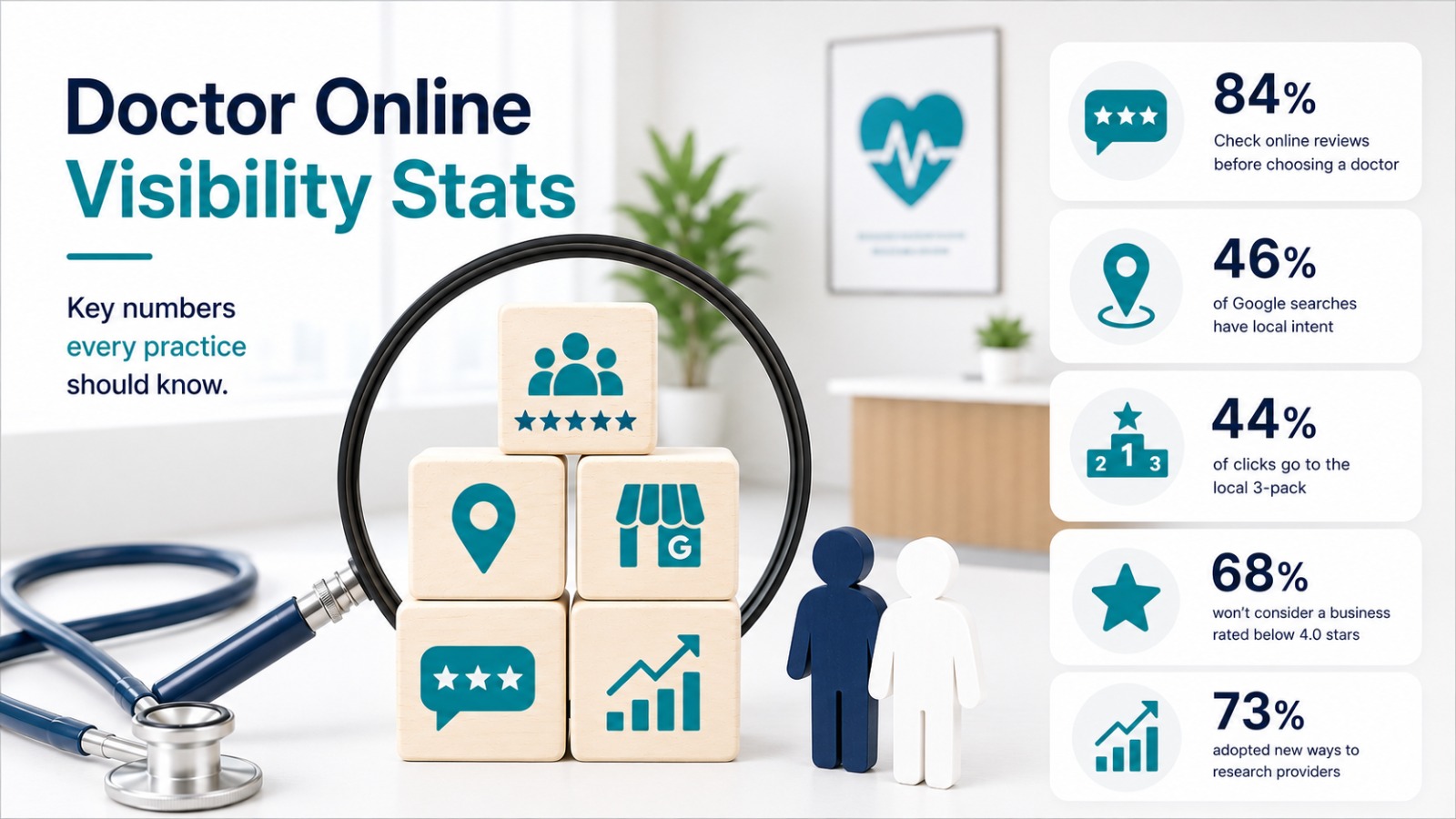
- 84% of US patients check online reviews before choosing a new doctor, according to rater8's 2025 report, a survey of 1,008 US adults. Researching a practice online is the default first step, not the exception.
- 46% of all Google searches have local intent, a figure Google presented at its 2018 local search event and one still widely cited. Doctor searches skew more local than average, because patients want a provider they can actually reach. An accurate address, map pin, and specific primary category decide whether Google counts you for those searches.
- 73% of patients reported adopting a new way to research providers in the past year, including AI chatbots, voice assistants, and social platforms, per rater8's follow-up report. How patients look for a doctor is changing faster than most practices are.
Statistics about Google and local search
Google is still where most doctor searches happen, and the top of the map is where most of the attention goes.
- The local 3-pack, the map box of three practices at the top of a local search, captures around 44% of all clicks, according to Local Falcon's analysis of 50 million search results. If you are not in those three, most patients never scroll far enough to find you.
- Google Business Profile signals account for about 32% of local ranking weight, review signals about 20%, and on-page website signals about 15%, per Whitespark's 2026 Local Search Ranking Factors study. More than half of what moves your local rank sits in two levers you control.
- Google reports that customers are 70% more likely to visit, and 50% more likely to consider buying from, a business with a complete Business Profile, and that complete profiles are 2.7 times more likely to be seen as reputable. Completeness, accurate hours, a specific primary category, and current photos all affect whether you surface in the local pack.
The gaps that cost practices are usually basic: a missing primary category, unverified status, outdated hours, or no recent photos. The Doc Mirror's own benchmarks for how often independent doctor profiles show these gaps are being compiled from live audits and will be published separately, rather than estimated here.
Statistics about reviews and trust
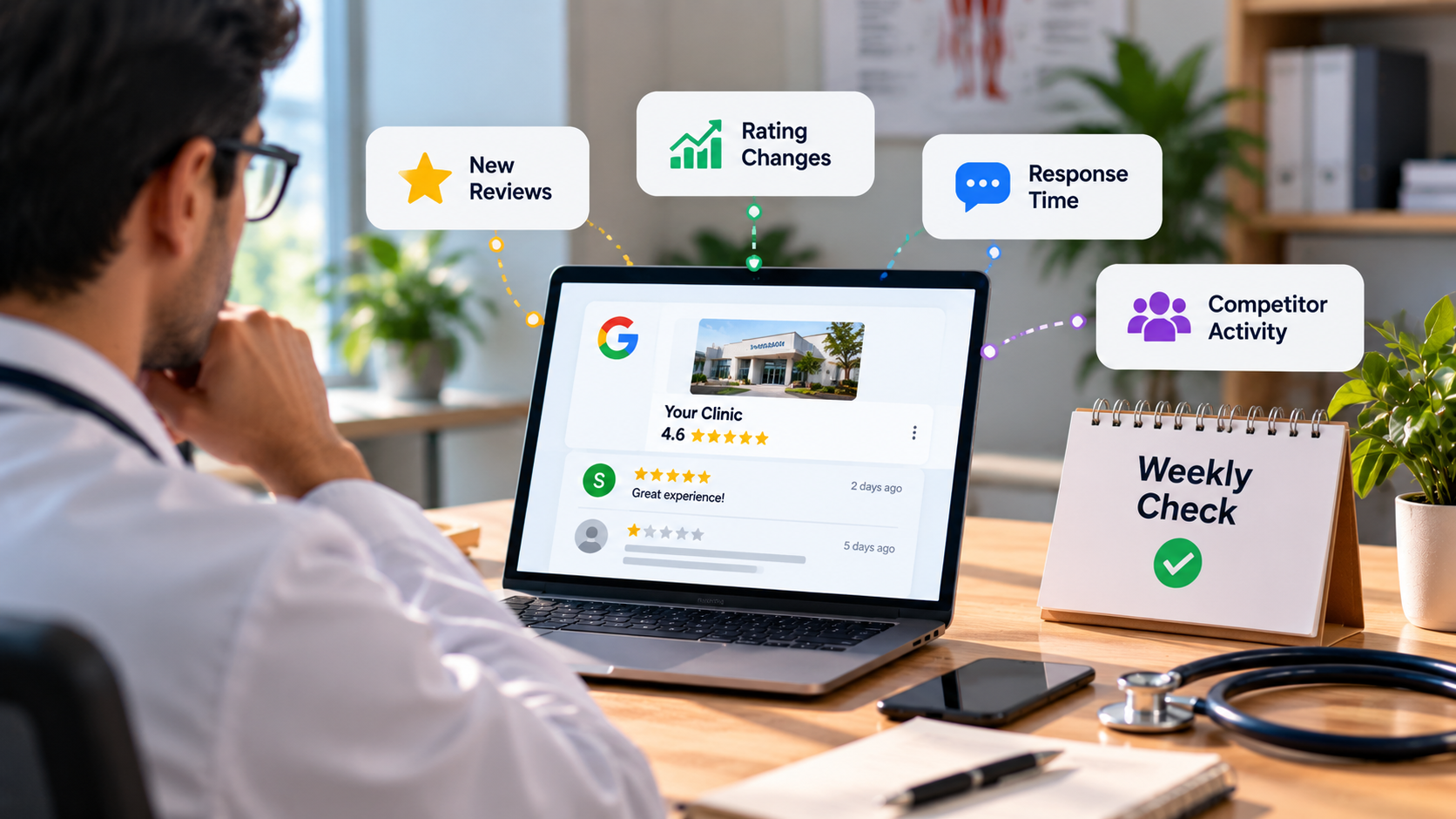
Reviews are the clearest example of a visibility number a doctor can see but rarely tracks against competitors. What matters is your rating and review count measured against the two or three practices a patient sees next to you in the Google local pack.
- 51% of patients read at least six reviews before they feel confident enough to book, and 61% now weigh online reviews above a personal referral from friends or family (rater8, 2025). 40% have canceled an appointment or changed their plan based on reviews alone.
- 68% of consumers will not consider a local business rated below 4.0 stars, and 31% now use only businesses rated 4.5 or higher, nearly double the 17% who said so a year earlier, according to BrightLocal's Local Consumer Review Survey 2026. A practice sitting at 4.2 stars is already filtered out by roughly a third of searchers.
- Recency and volume both count. 74% of consumers only trust reviews written in the last three months, and 47% will not use a business with fewer than 20 reviews (BrightLocal, 2026). A strong rating earned two years ago reads as stale.
- 45% of patients say they are swayed by whether a doctor responds to reviews (rater8, 2025). Replying to reviews is a visibility signal, not just a courtesy.
The pattern holds even without a number attached. A practice with more genuine, recent reviews at a strong rating is chosen more often than a comparable practice with few reviews, even when the second doctor is more experienced.
Statistics about AI search
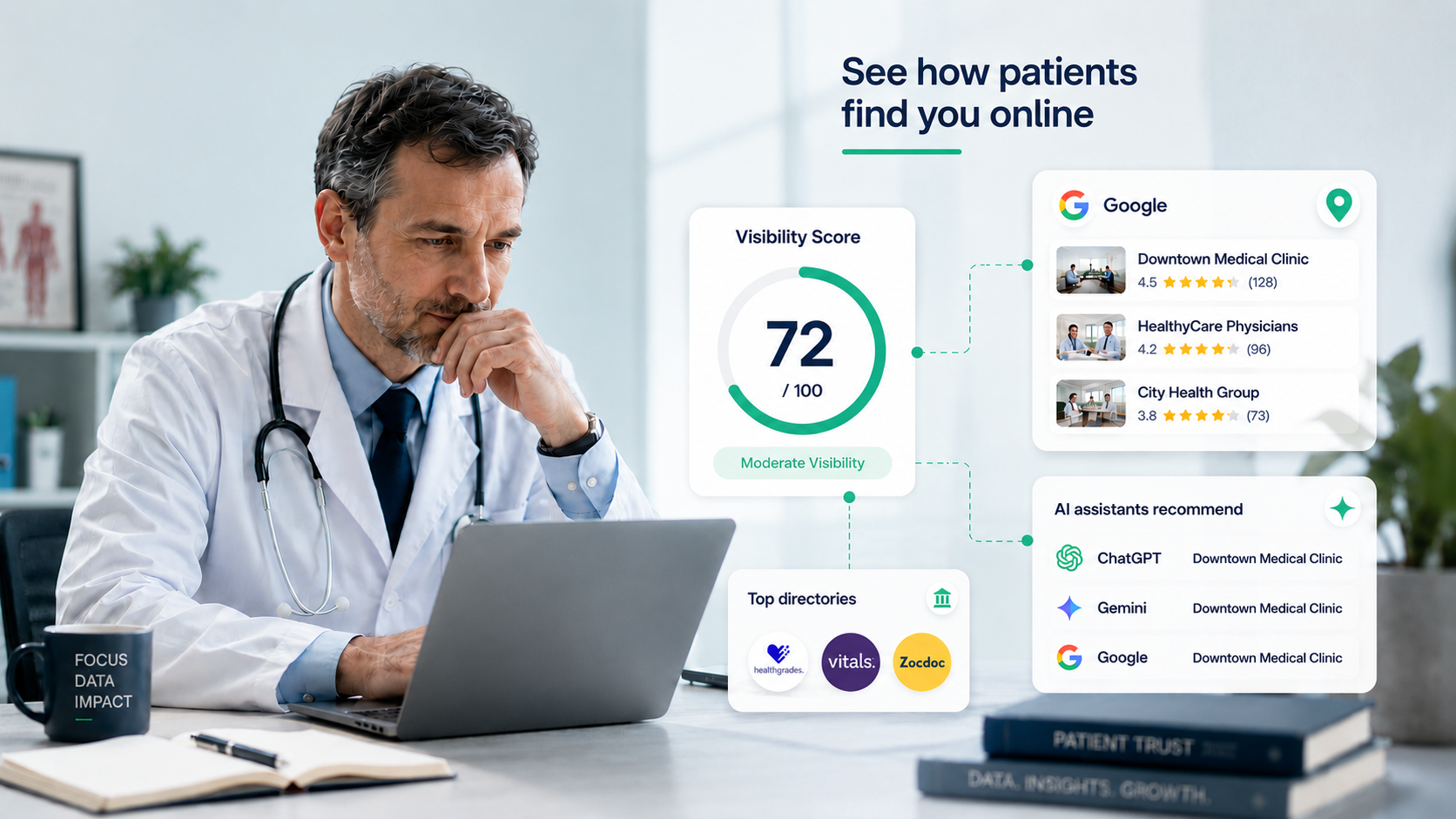
AI visibility is how often an AI assistant names your practice when a patient asks for a specialist in your city. It is one of the 7 pillars The Doc Mirror scores, and the one most doctors have never checked once. You can rank on page one of Google and be entirely absent from a ChatGPT or Gemini answer, because the two systems weigh different signals.
- 32% of US adults said they turned to AI chatbots for health information in the past year, including 29% for physical health specifically, per the KFF Tracking Poll on Health Information and Trust, released in 2026. This is a current place patients form impressions, not a future one.
- 22% of US adults get health information from AI chatbots at least sometimes, rising to 32% among adults aged 18 to 29, according to Pew Research Center. The habit skews toward younger patients, the group most practices want more of.
- 26% of patients said AI tools had directly influenced their choice of provider (rater8, 2025). Directory citation depth and consistent business data appear to matter more than review count for whether an AI assistant names a practice.
- 18% of AI health-information users rate what they get as highly accurate, against 65% for information from providers (Pew, 2026). Patients often use AI to build a shortlist, then verify it against reviews and directories before booking, which makes both channels matter.
The one number that ties them together
The reason The Doc Mirror scores visibility on a single 0 to 100 visibility score is that these categories interact. A strong Google Business Profile feeds AI visibility. Consistent directory listings feed both. A visibility score sums 7 pillars, Google Business Profile, Rating, Reviews, Photos, Local Rank, AI Visibility, and Directories, into one figure, then maps it to one of four verdicts: Strong Visibility (85 to 100), Moderate Visibility (70 to 84), Needs Attention (50 to 69), or Critical Gaps (0 to 49). One number tells you where you stand. The pillar breakdown tells you what to fix first.
How to measure your own statistics this week
You do not need to pay anyone to gather your real numbers.
- Search your specialty plus your city on Google. Note whether you appear in the local pack of three, and count your reviews against the two practices shown beside you.
- Ask ChatGPT and Gemini for the best doctor in your specialty in your city. Note whether you are named, and which competitors are.
- Open your Google Business Profile and check for a specific primary category, complete hours, a website link, and at least a handful of recent photos.
- Count how many medical directories, such as Healthgrades, Zocdoc, Vitals, and WebMD, list your practice with identical name, address, and phone details.
For a complete picture in one place, the Free Audit at thedocmirror.com scores your practice across Google, ChatGPT, Gemini, Claude, Perplexity, and directories on all 7 pillars. It takes about 90 seconds and needs no signup for the free score.
Sources
- rater8, How Patients Choose Their Doctors, 2025 report, survey of 1,008 US adults: rater8.com
- rater8, The Next Evolution of Patient Choice, 2025 report: rater8.com
- BrightLocal, Local Consumer Review Survey 2026, survey of 1,002 US adults: brightlocal.com
- KFF, Tracking Poll on Health Information and Trust, 2026: kff.org
- Pew Research Center, health information from AI chatbots, 2026, survey of 5,111 US adults: pewresearch.org
- Whitespark, 2026 Local Search Ranking Factors: whitespark.ca
- Local Falcon, what 50 million search results reveal about the local 3-pack: localfalcon.com
The two Google-reported figures, the complete Business Profile lift and the 46% local-intent share, are attributed to Google inline. They are not linked because no single public Google page states them in that form.